My father often said he didn’t feel he belonged in the world during his lifetime. In some ways, I agreed, but not in the way he meant. He didn’t belong behind. He belonged ahead of his time. He was innovative, wildly creative, and endlessly skilled when it came to mechanical problem-solving. He joked about building a human robot in his garage workshop. Frankly, I wouldn’t be surprised if someone, somewhere, tapped into his brilliantly beautiful mind when designing the humanoids that now threaten to make the rest of us obsolete.
How could a man so forward-thinking in his craft be so deeply rooted in traditional views? That paradox defined much of our relationship, and much of my reflection now.
My parents often questioned my parenting decisions, usually with raised eyebrows that seemed to be permanently etched into their hairlines. They debated my logic, my priorities, and occasionally the stability of my mental state. They were, after all, children of Mussolini’s fascist regime. Survivors. My mother often told us stories of being woken before dawn to perform calisthenics in the town square. When Mussolini visited their little mountain village, the children were dressed in junior military uniforms and the adults in their Sunday best. She recalled how small the man was, physically, but how enormous he felt to a child raised to fear authority cloaked in patriotism.
Men disappeared during that time. Fathers, brothers, uncles, gone overnight, having fled to the hills or crossed borders to avoid fighting a war they didn’t believe in. No protests. No signs. No city burned, just quiet, decisive exits. Families carried on in silence. No one agreed with the regime, but they did what they had to do to survive. Sometimes I wonder about that, about what it meant to choose quiet action over loud resistance, and whether we’ve lost that understanding in today’s world.
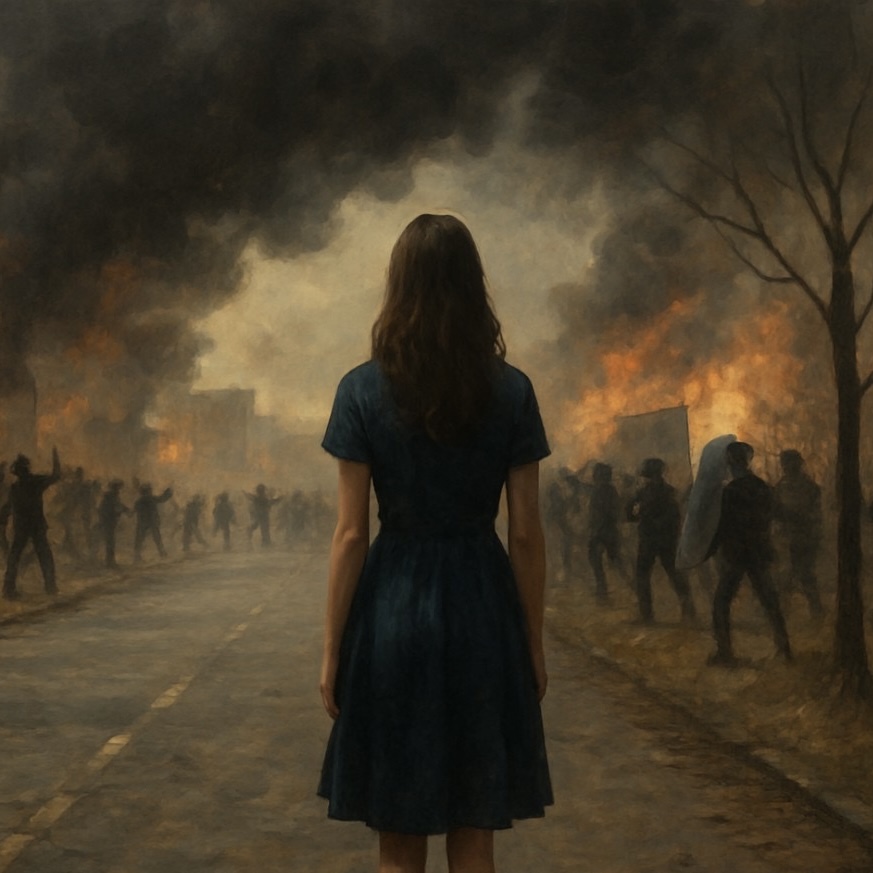
The events of the past few months have felt surreal. My parents, with their firm, archaic values, wouldn’t believe how low humanity seems to have sunk. I’m tired of the constant cycle of destruction and unrest. I’m tired of debate, conspiracy, and chaos. Somewhere between the Oxford comma and the post-Vatican II changes to the Catholic Mass (I will respond, “and also with you,” every single time somebody says, “peace be with you”), it feels like even our traditions are unraveling.
This isn’t meant to minimize our reality, domestically or globally, because none of what we’re witnessing should be taken lightly. But truth itself has become slippery. Every headline feels like half a puzzle, and the missing pieces might not show up for another twenty years. Meanwhile, we’re left in a world that feels more divided and dangerous with each passing day.
The immigrant generation, the so-called “boomers” in my family, never complained about what they gave up. They worked hard, assimilated, and endured. When they were mocked for their accents or their strange food or their unfamiliar customs, they didn’t take to the streets in protest. They called a cousin. Made a plan. Pivoted. They protected their families without fanfare. Did they agree with everything around them? Of course not. But they knew they had traded their homeland for the promise of something better, and they weren’t about to jeopardize that. And that’s the difference. We have nowhere else to go. This is our home. Our flawed, struggling, beautiful home. We can’t “go back”, we are back. We’re already here.
I don’t know if there are any solutions to the unrest we’re facing. I suspect we’re only being told fragments of truth, and I suspect we always have been. But I’m less concerned now with politics and more concerned with the loss of something more profound, our sense of shared purpose, our ability to tolerate one another, our respect for institutions that once represented stability. Maybe my father didn’t belong in his time, and perhaps I don’t belong in mine. Or maybe that’s what everyone feels when the world no longer speaks their language. When your values feel foreign in the place you call home, you begin to question what home even means. But I do know this: survival runs deep in our bloodlines. My parents survived war, exile, and loss, and still found a way to sit around the table with espresso in hand, laughing. Maybe that’s all we can do sometimes. Brew a little hope. Cling to one another. And keep showing up for the world we still believe can be better, even when it doesn’t believe in itself.

 The Creative Quill
Leave a comment