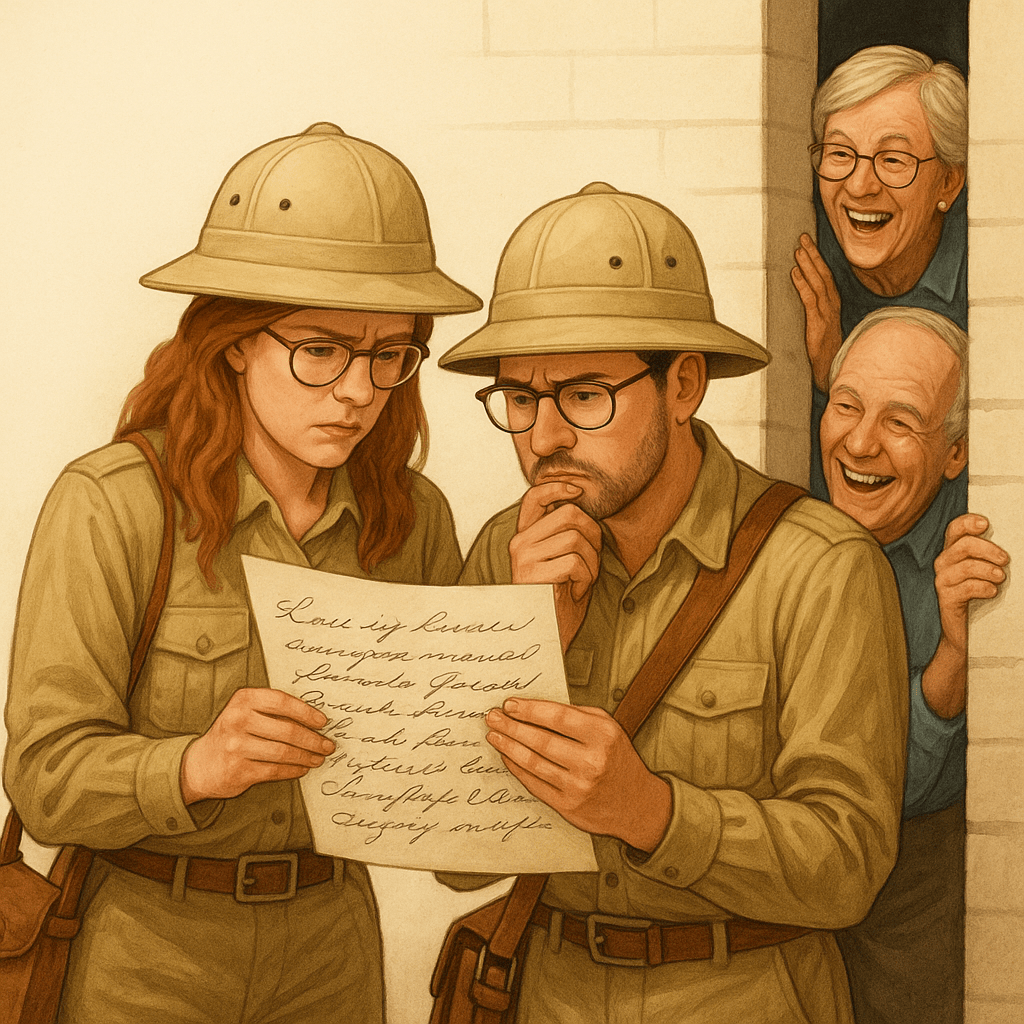
Civilization has survived plagues, wars, and even dial-up internet, but cursive handwriting might be the thing that finally does us in. I saw a post this morning blaming the downfall of civilization on the fact that Gen Z can’t read loopy letters.
The good news is we haven’t blacked out the apocalypse bingo card just yet. Cursive has become the secret code of Boomers and Gen Xers, mainly because Millennials and Gen Z can’t read anything that isn’t in emojis or 12-point Arial.
We may not understand TikTok dances and the bastardization of the English language, but our ultimate flex is reading a birthday card without asking Google Lens for a translation. Forget nuclear war, climate change, or the Bears’ offensive line. The real crisis is that a teenager might assume a signature unlocks a hidden treasure map. But in my house, handwriting wasn’t mysterious at all; it was an unspoken standard to live up to.
I’ve always been told I have beautiful handwriting, but it wasn’t divine intervention or nuns with rulers; it was my dad. I grew up in a house where the contrast in handwriting was impossible to ignore. My mom’s notes looked like a lost Dead Sea Scroll, complete with mysterious symbols and zero chance of translation. Even she had trouble decoding her grocery lists. But my dad? His penmanship was perfection. He wrote like a human word processor. Every letter was so crisp and sat neatly on the line as sharp as Times New Roman fresh off the printing press. His numbers looked like they belonged in a calculator display. I spent years trying to mimic his effortless precision, chasing after those perfect strokes like they were some genetic inheritance.
Two of my kids inherited the family gift and write like they’ve got a built-in font setting; clean, and consistent, the kind of script that teachers would frame as an example. And then there’s my other child, whose writing looks less like words and more like a gnat parade marching across the page. You practically need a magnifying glass, a microscope, and a secret decoder ring. I say that with love, of course, but trying to read it sometimes feels like an archaeological dig. It’s a far cry from my dad’s calculator-perfect numbers and Times New Roman letters, but hey, at least the family tree has range.
The irony is, all these “back in my day” arguments about cursive skip over the fact that handwriting wasn’t exactly flawless to begin with. Love letters often looked like ransom notes. Grocery lists deciphered like Da Vinci codes. Nostalgia makes us forget we spent half our lives squinting at scribbles. And let’s not forget: the number of report cards mysteriously signed by parents who had no idea a 12-year-old with a ballpoint pen and nerves of steel had forged their signatures. It wasn’t always elegance and ink; it was just as often chaos in cursive.
We act scandalized that TikTok kids can’t read cursive, as if society is circling the drain because someone mistakes a capital “Q” for a “2.” These kids can’t read a birthday card, sure, but hand a rotary phone to anyone under 40 and watch the panic set in. Every generation gets its secret code; ours just happened to be squiggles on lined paper.
And yet, for all its ransom notes and forged signatures, putting pen to paper still matters. It turns out the simple act of gripping a pencil and dragging it across a page isn’t just about producing pretty letters, it’s about wiring the brain. Studies show kids who spend more time swiping on screens than scribbling on paper often fall behind on fine motor skills. This explains why a five-year-old can navigate Netflix like a pro but can’t hold a crayon without looking like it weighs ten pounds. Handwriting isn’t just old-school, it’s brain training disguised as squiggles. It is literally practice for learning how to learn.
And now, thanks to AI, we have come full circle. Schools are dusting off the composition books, as if it were 1995. Professors have figured out the only way to prove that a human wrote an essay is to have students do it in real time, in actual handwriting. Forget citing sources; the new gold standard is proving you’re not a bot by producing legible sentences with a pen. Irony at its finest: we built machines to save us from writing, and now writing is the only way to prove we’re not machines. It’s amusing how handwriting is making a comeback as an anti-bot strategy, yet the biggest controversy is that half of Gen Z thinks cursive is a secret code from the Da Vinci Code movies.
So is handwriting doomed? Probably not. It’ll just sit in the same museum wing as typewriters, floppy disks, and the phrase “be kind, rewind.” Until then, I’ll hold on to my penmanship, because someone has to preserve civilization once Gen Z’s signatures start looking more like Wi-Fi passwords than names.

 The Creative Quill
Leave a comment