My last client gifted me an editor who, in the truest sense of the word, was a logophile, a lover of words. I enjoyed sparring with her over language, as every conversation felt like stepping into a friendly duel, armed with dictionaries instead of swords. She’s the inspiration for this post. I nicknamed her M, a nod she sweetly pointed out belonged to James Bond’s sharp-tongued superior in the 007 films.
It turns out there’s an entire rabbit hole for people like us. Merriam-Webster has a corner of its website dedicated to long words and linguistic oddities. It is the equivalent of TikTok for word nerds. One minute I was scrolling, and the next thing I knew, I lost an hour gawking at syllables that looked less like words and more like a hostage note from a crossword puzzle.
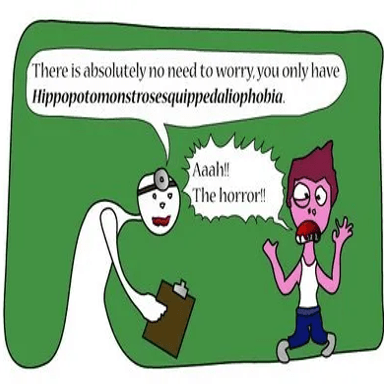
And somewhere down that rabbit hole I found the monster itself: hippopotomonstrosesquippedaliophobia. Yes, the fear of long words is itself… a very long word. It’s a cruel joke, a self-fulfilling prophecy, and proof that sometimes scholars have way too much time on their hands.
Yes, the fear of long words is itself… a very long word. It’s a cruel joke, a self-fulfilling prophecy, and proof that sometimes scholars have way too much time on their hands.
Like all things unnecessarily complicated, this one comes from Latin:
- Hippo – filler, not a river horse.
- Monstro – “giant” or “monstrous.”
- Sesquipedalian – literally “a foot and a half long,” meaning “ridiculously wordy.”
- Phobia – fear. Finally, a word that plays nice.
Put it together and you’ve got “a giant, monstrous, foot-and-a-half-long fear.” Which feels more like an insult than a diagnosis.
Picture this: you finally get the courage to see a therapist. You sit down, take a breath, and they greet you with:
“So, you’re here for hippopotomonstrosesquippedaliophobia?”
At that point, you don’t need therapy, you need a safe word. Ironically, the condition censors itself. If you suffer from it, you can’t even say what it is. You’re stuck with: “I have… it starts with an H… oh, never mind, just give me the Xanax.”
Of course, long words aren’t all bad. Writers secretly love them. They make us sound smarter, even when no one knows what we’re talking about. (Floccinaucinihilipilification, anyone?) Lawyers, academics, and politicians practically hoard polysyllables like Halloween candy.
But let’s be honest, the words that actually land, the ones that cut straight to the bone, are usually the shortest:
“No.”
“Stop.”
“Love.”
“Pay me.”
Sometimes brevity really is the soul of wit.
The irony of hippopotomonstrosesquippedaliophobia is that it doesn’t just describe a fear, it inflicts it. It’s the dictionary equivalent of a bully who hands you a tongue twister and laughs while you choke.
But maybe that’s the secret lesson. Language is supposed to be about connection, not intimidation. If a word needs three lines and a Latin degree to exist, maybe it’s not as powerful as it thinks it is.
So the next time someone tries to impress you with a 36-letter monstrosity, smile and hit them with the strongest vocabulary you’ve got:
“Why?”

 The Creative Quill
Leave a comment