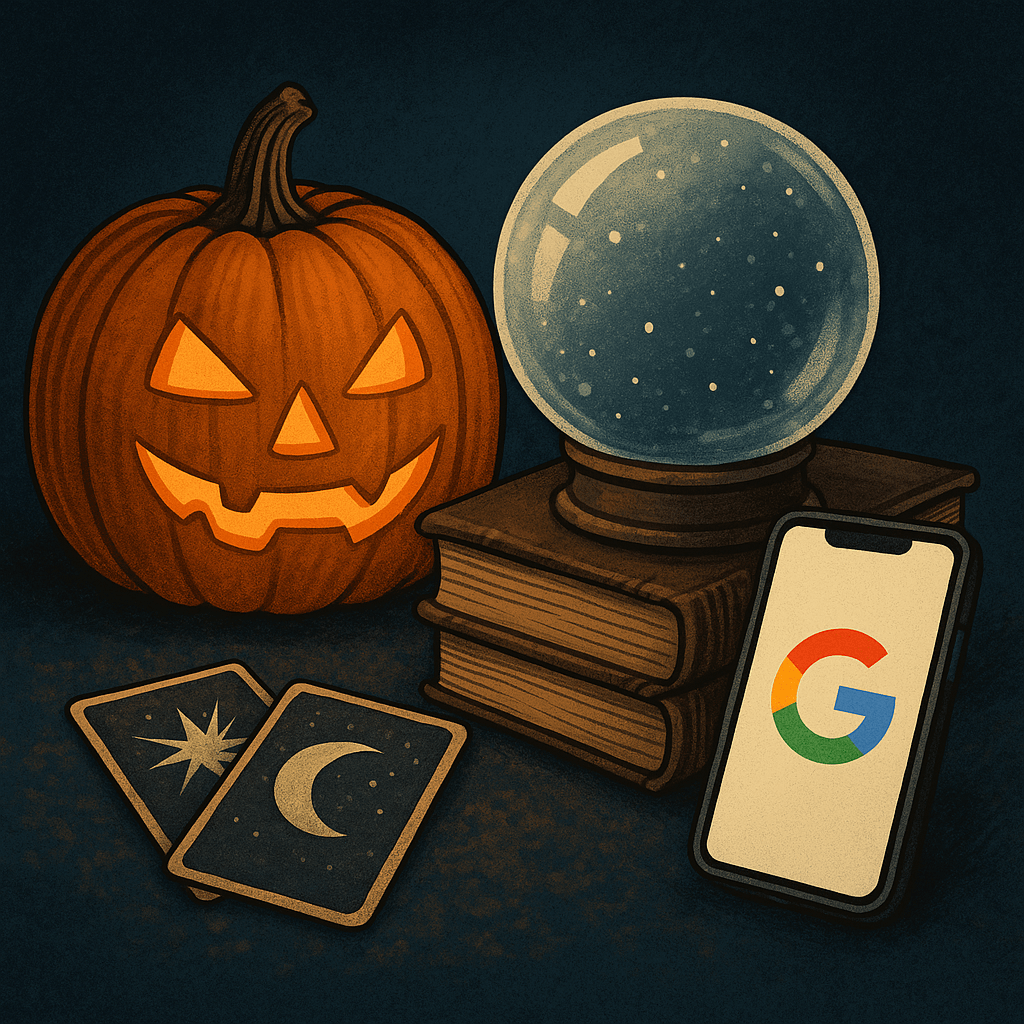
Every year, we slather kids in face paint, zip them into fuzzy costumes, and launch them into the night like sugar-seeking missiles. The adults? We tag along with travel mugs and opinions, admiring jack-o’-lanterns and judging yard inflatables. And like clockwork, the same question pops up: what exactly are we doing here, celebrating autumn, or auditioning for a séance?
Halloween didn’t borrow just orange and black from the past; it borrowed spirit traffic. Samhain (say it “sow-in”) was the Celtic end-of-harvest checkpoint when the veil supposedly thinned and the dead could mingle with the living. Bonfires and disguises weren’t just festive; they were spirit-management strategies. That “the dead might drop by” idea is the root system for later customs that try to talk to whoever’s on the other side.
Enter the Christian calendar rebrand: All Saints’ (Nov 1) and All Souls’ (Nov 2). The dates changed; human curiosity didn’t. The same impulse that once left offerings at the door eventually pulled up a chair to the table, séances, trance speaking, table-tipping, Ouija, and today’s “readings.” Halloween became the cultural on-ramp where “just spooky fun” slides into mediumship and parties with spirit boards, “let’s see who shows up,” and TikTok tutorials that confuse common sense with décor.
So let’s be plain: costumes are fun, candy is fun, caramel on apples is a menace to dentistry, but also…fun. But some “traditions” are just occult practices with better packaging. If your game night requires pretending to chat with the dead, maybe shuffle toward Uno.
Halloween has always carried a reputation for blurring boundaries; the night when costumes, candy, and the occasional “spirit experiment” all get a free pass. If history teaches us anything, it’s that humans can’t resist poking at the unknown. Curiosity about the dead has a habit of sneaking in when the porch lights go off.
Halloween is the perfect excuse: a little sugar, a little spook, and suddenly the old impulse to talk to the dead is back in the room. Mediumship is just the modern name for the same ancient curiosity. It’s a short hop from bobbing for apples to nodding your head at a Ouija board.
Halloween is the one night the boundary between fun and “let’s talk to spirits” gets thin. People have always gone looking for answers in all the wrong places, whether it’s tea leaves, crystal balls, or that one cousin who swears Mercury is in retrograde. Mediums were the original “call a friend” lifeline, except the friend was dead. Mediumship is older than your grandma’s candy dish. Since then, the talent pipeline has run from Victorian parlors to cable TV.
If Halloween is the on-ramp to ‘talking with the other side,’ mediums are the toll booth operators. From candlelit parlors to cable TV, they’ve been cashing in on curiosity for centuries. Meet a few of the standouts.
- Emma Hardinge Britten – One of the founders of the Modern Spiritualist Movement in the 1800s. She toured as a trance lecturer across America and Britain and even wrote the “Seven Principles of Spiritualism,” still used by churches today. She basically wrote the rulebook for talking to ghosts in public, and could talk a Victorian wallpaper pattern into manifesting.
- Jeane Dixon – A syndicated astrologer whose horoscope column ran in over 100 newspapers. She shot to fame for “predicting” JFK’s assassination in Parade magazine and later became the go-to psychic for Washington, D.C., politicians. Apparently, even presidents wanted a hotline to the stars. The 24/7 news cycle says thank you for your service
- Sally Morgan – Known as “Britain’s most famous psychic”. She sold out stage shows across the UK, wrote multiple bestsellers, and turned her abilities into a full-on brand, including a TV series called Psychic Sally on the Road. If your séance comes with a tour bus and merch, I have questions.
- Tyler Henry – Star of E!’s reality show Hollywood Medium and Netflix’s Life After Death with Tyler Henry. He built an empire telling celebrities like Khloé Kardashian and Alan Thicke what their dearly departed wanted them to know. If stars wish to spend their money being told exactly what they want to hear… Hollywood’s been doing that since silent film.
- Amanda Raye – A rising YouTube-era medium best known for teaming up with Sam and Colby on their paranormal investigation channel with 11 million+ subscribers. She’s gained credibility for showing up to haunted sites “blind” and still nailing details before the history is revealed. Raye also attempts humility, boundaries, and a healthy respect for “maybe we don’t know.” Less glitzy than Hollywood, more “ghost hunting with receipts.” If you must wade into the weird, carry a flashlight and a moral compass.
- Nathan Fielder – The Canadian comedian behind Nathan for You and The Rehearsal. He isn’t a medium, but he did turn “Google Halloween’s satanic origins” into a pop-culture moment, sparking real-world curiosity about how search engines shape what we believe. Basically, he proved the scariest thing about Halloween might be your browser history. Bless Nathan Fielder for wandering into the discourse with a straight face and a camera. In The Rehearsal, someone tells him Halloween is the “highest Satanic holiday” and to “Google the origins.” So he does. He finds, wait for it, Celtic stuff.
Here’s the comedy: Google “Halloween origin” and you’ll land in a tidy History Channel explainer with Samhain, saints, and zero pitchfork emojis. Search “is Halloween satanic” and you’ll get an all-you-can-eat buffet of takes, from “obviously yes” to “please calm down.” Try “Halloween Satanic Origins” and you’re escorted to Christian outlets explaining why the whole thing is spiritually sketchy. It’s not a conspiracy; it’s how search works. Ask a leading question, get a leading answer. The algorithm isn’t possessed, it’s polite.
(If the Devil controlled Google, the first result for “pumpkin bread” would be a kale smoothie. Checkmate.)
So, what do we do with October 31?
Here’s my very un-mystical rubric:
- Know your why. If you’re joining in, keep it about neighbors and fun, not dabbling in the dark.
- Halloween rules aren’t just for trick-or-treaters. Haunted houses? Fine. Summoning circles? Hard pass. Tarot for “fun”? Maybe.
- Keep the story straight. Teach your kids that death is real, evil is real, and neither is a joke, but neither is the final word.
- Be a porch light. Sometimes the boldest move is just handing out candy and being normal.
Halloween is simultaneously a harvest party, a Celtic time capsule, a Christian calendar remix, a secular sugar rush, and, if you let it, a door you leave cracked for things better left outside. You don’t need to panic, and you don’t need to pretend the dark is cute. Hold the tension. Hand out the KitKats. Skip the occult cosplay. And if someone tells you the “real truth” is on page four of the search results, smile, bless their heart, and remember: the Devil doesn’t get the last word, the algorithm doesn’t get the first, and you, lucky you, get to decide what crosses your threshold.

 The Creative Quill
Leave a comment