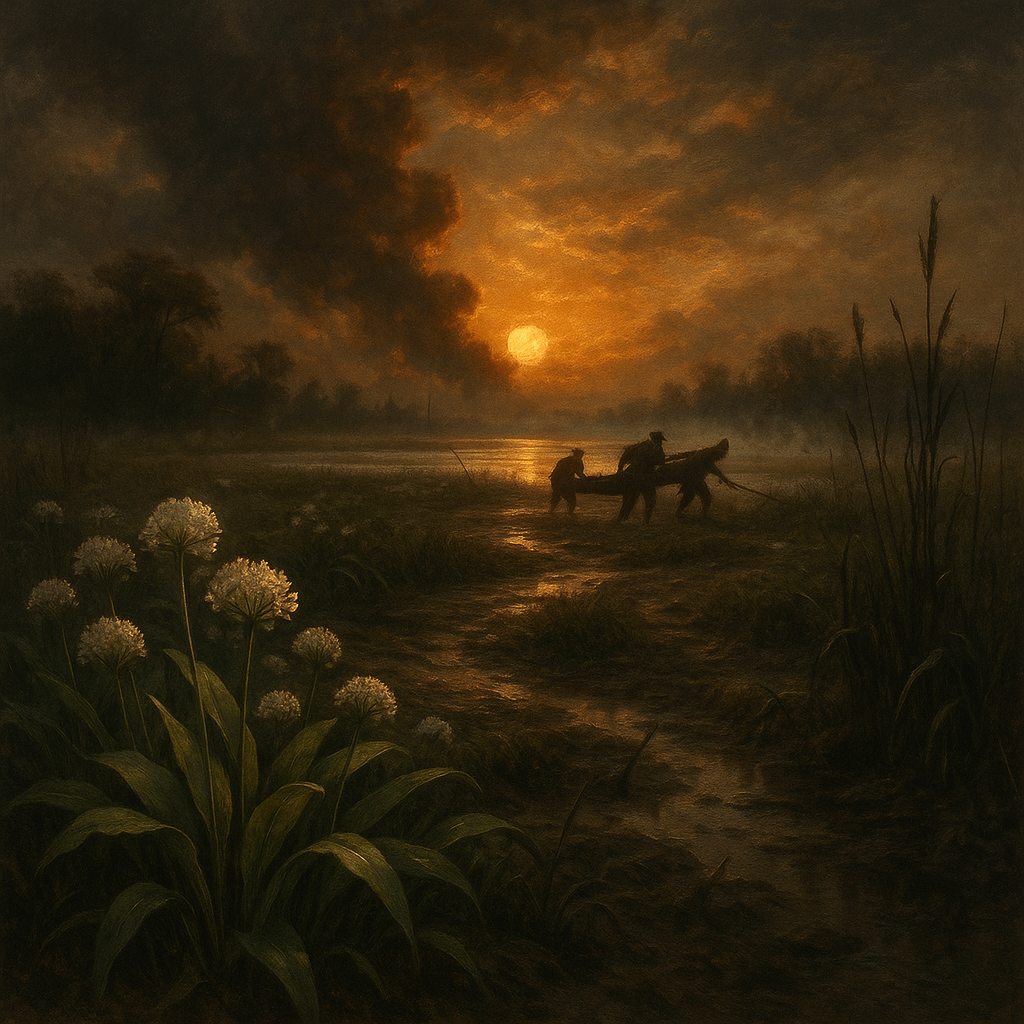
This isn’t a story meant for polite museum halls or laminated tour pamphlets. This is the Chicago whispered about when the fire cracks low, when the dark closes in, and someone finally says, “Alright… let me tell you how it really began.”
Before the skyline carved its teeth into the sky, before steel and smoke and fortune built their kingdoms here, this land was something older. Wilder. A place that breathed.
And its breath smelled of garlic.
Not the kind tossed in a skillet or baked into bread. The primal kind. Sharp. Untamed. Rising from the mud in thick green clusters that swayed like they were standing guard. Ramps and wild onions grew so dense that the breeze felt seasoned. When the wind swept across the marsh, it carried the scent like a warning or a prophecy.
Early French explorers wrote of it with equal parts fascination and discomfort. They claimed the air burned with the smell long before the river revealed itself, as if the land was introducing itself first.
The people who lived here already knew its name: shikaakwa.
A word from the Miami-Illinois language that doesn’t sit neatly in any dictionary. The name, like the land, was heavy, alive, shifting in meaning the way shadows change around a fire. Wild garlic. Smelly onion. Striped skunk. A name that didn’t just describe the land, but summoned it. The French smoothed it into “Chicago,” but the original word still hangs in the soil like an echo.
And that name? That was just the beginning.
Long before newcomers invaded this land with compasses and flags, and before surveyors carved boundaries into everything, this land pulsed with nations whose histories ran deeper than any river. The Miami and Illinois peoples shaped villages along the waterways. Later came the Potawatomi, Ojibwe, and Odawa. These three nations bound together as the Council of Three Fires, an alliance sharpened by kinship and carried by stories.
The land then was not quiet. It hummed.
Prairie grass hissed like it was spreading warnings from one horizon to the other.
Cranes and herons stalked the shallows like sentinels.
Canoes glided across mirrored water so smooth it seemed to hold the sky in its hands.
Where newcomers saw a swamp, they saw the spine of a continent.
And at the heart of it, hidden, humble, but powerful, was the portage.
The place where the Chicago River brushed the Des Plaines River was a crooked, narrow, swamp-soaked path. A muddy corridor where travelers hoisted canoes over their heads and trudged through reeds taller than a man. Mosquitoes swarmed thick enough to blur the air. Most outsiders would’ve turned back. But to the people here, this wasn’t misery. It was power. A gateway that cut a shortcut across the continent. The mosquito-choked land tested you. Boots sank. Spirits wavered.
But those brave enough to cross it gained something priceless.
They called it the Chicago Portage, and it was more than a trail. It was a hinge between worlds. It was a bridge between the Great Lakes and the Mississippi, between the North and the South, between what was known and what waited.
That muddy vein mattered because it wasn’t just a trail. It was a threshold that decided who would shape the world waiting on the other side. On one side, the Great Lakes stretched cold and merciless to the Atlantic. On the other hand, the Mississippi coiled its way toward the Gulf like a dark artery. And between them lay this narrow, mosquito-choked passage. Travelers hauled their canoes over sinking earth, haunted by the hum of insects and the knowledge that this path decided fortunes. Whoever commanded that strip of land held the power to shape the future of nations.
The portage swallowed the unworthy, tested the strong, and granted passage only to those it chose. Elders said the earth there remembered every footstep, every burden, every whispered secret traded in the hush of the marsh. Without it, this place would’ve remained a quiet, forgotten sliver of swamp.
But it wasn’t forgotten.
It was the doorway.
The key.
The secret.
And the world has never been able to resist a secret for long, nor keep one hidden…

 The Creative Quill
Leave a comment