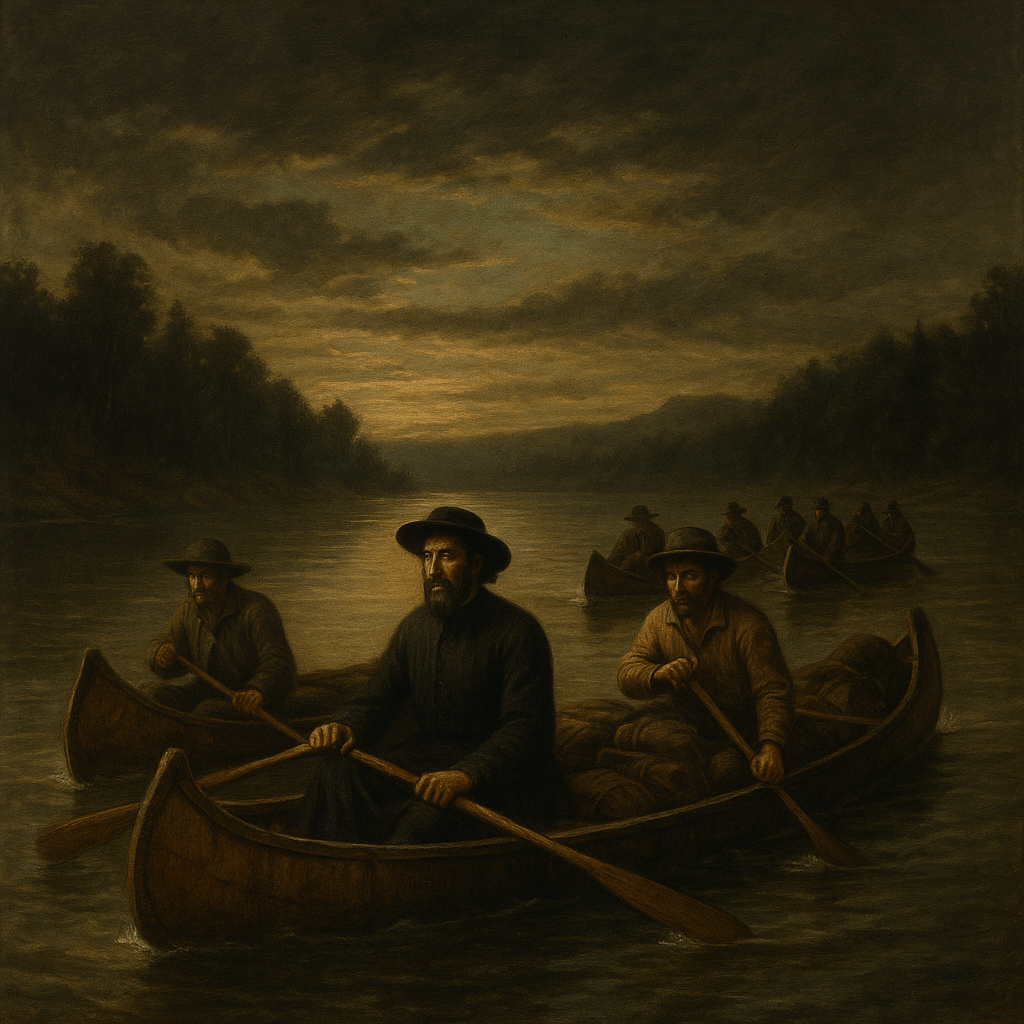
In the summer of 1673, two men pushed their canoes away from the mission at St. Ignace near the northern tip of what we now call Michigan. Their silhouettes slipped into the blue-green edge of the unknown. Jacques Marquette and Louis Jolliet weren’t chasing glory; they were chasing a rumor, a secret carried on the wind from village to village along ancient trails, murmuring of a river beyond the horizon, so vast it cleaved the continent in two.
Marquette was the gentler of the two. He was a French Jesuit missionary with a gift for languages and a patient habit of listening before he spoke. He’d already built missions across the Great Lakes, earning trust not through force but presence. Beside him was Jolliet, sharp-eyed and practical, a fur trader with a mapmaker’s mind. If Marquette dreamed in scripture, Jolliet dreamed in trade routes.
The French had sent them to find the fabled river, the Messipi, a river the Indigenous nations spoke of in tones heavy with inherited memory. Some said it flowed to oceans no European had touched. A route to Asia that meant riches untold in trade. Others claimed you could ride it straight into the future. Armed with nothing but birchbark sketches and Indigenous knowledge, the two paddled west.
The land guided them. The people guided them. They pushed south into the brooding expanse of Lake Michigan, a great gray body that moved with the slow patience of something ancient and half-awake. The lake bore them into the narrowing cradle of Green Bay, where the water tightened around them and funneled their canoes toward the Fox River. Following the Fox River’s twisting path as if obeying a beckoning finger, the water wound through the land like a living vein. They were being pulled deeper into a world where maps meant nothing and stories meant everything. When the Fox dwindled to a trembling thread, they raised their canoes and crossed a short, sodden strip of trail leading into the Wisconsin River, dark, silent, and watchful, as if it had known they were coming long before their bows touched its shadowed surface. Waiting like a beast at rest, the Wisconsin River’s surface lay dark and unbroken. The instant their canoes kissed its skin, the water drew them in with a slow, possessive pull, as if the river had been watching their approach for days, hungry for the weight of their bones. From then on, the current spoke in a voice older than the land itself.
As they moved deeper into the continent, the world around them shifted into something mysterious and less familiar. Villages flickered along the riverbank. The Menominee, Mascouten, Miami, and Illinois, each offering warnings in low, cautious tones.
Farther south, they had finally slipped into the great river. They had entered the Messipi, and the land seemed to wake beneath their passage: monstrous catfish slammed against their birch-bark hulls, buffalo crowded the banks in living walls of muscle and breath, and traders spoke of Spanish goods drifting upriver from a world they were nearing far too quickly. Each night the fires burned low, and the river’s black surface held reflections that didn’t always belong to them.
The old stories, those murmured along trails and fire circles for generations, rose around them in full. They were drifting through this vast dark artery, farther from home and closer to whatever the river meant to reveal. It traced through the continent, wide and slow enough to feel disturbingly alive, as if the land beneath their canoes was drawing breath. They drifted through the shadowed heart of a world Europeans had only imagined, sinking deeper into a landscape that seemed older and more mysterious with every bend.
But they didn’t need to see the sea to know where the river was carrying them. Long before they reached the place we now call Arkansas, the warnings had already found them, drifting from village to village like echoes older than memory. The people along the banks spoke of a warm, salt-breathed water far to the south, a place where the river dissolved into a great, restless expanse watched over by Spanish men with iron in their hands and violence in their shadows. The Messippi itself betrayed the truth: the air grew heavier, the nights thick with heat, the current slow and swollen like something preparing to empty its veins into a wider body. Strange goods appeared in the hands of the Quapaw tribes. Cloth, metal, and trinkets touched by distant shores carried upstream as quiet proof of a world they were drifting toward but should never enter. By then, Marquette and Jolliet understood. This was no passage to the Pacific. This was a descent toward a different edge. One claimed by Spain, one known by the land, and one the river would not let them meet without a price.
And that is where the river held its silence… for now.

 The Creative Quill
Leave a comment