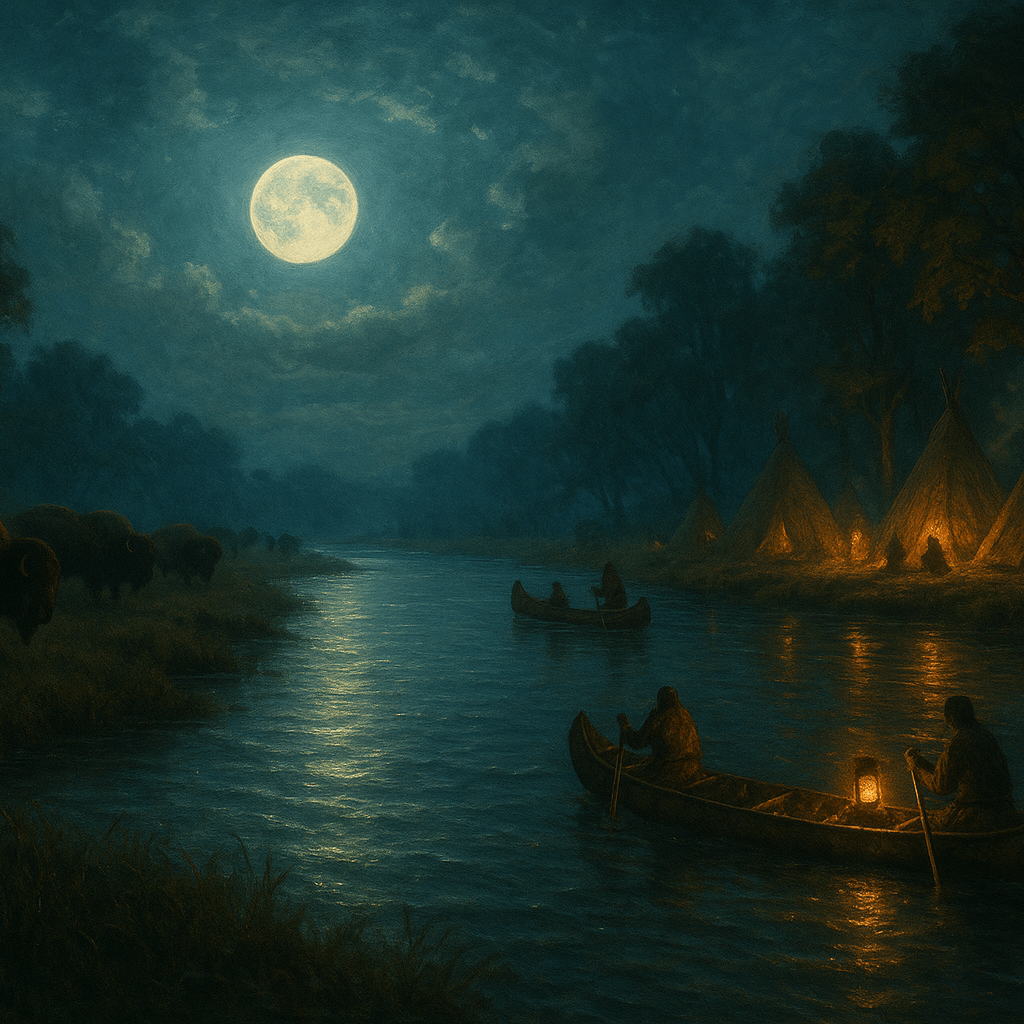
The Messipi had shown them its true direction.
So they turned back, not because the river had beaten them, but because of the warnings carried on its banks. Every village elder told them the same thing: keep paddling south and you’ll meet the Spanish, and the Spanish always take what they want. The French Crown didn’t want a war, Marquette didn’t want to become a martyr, and Jolliet certainly didn’t want to test how fast he could paddle in the face of muskets. So they slipped their paddles into the current and let the river pull them homeward.
But while their canoes scratched north against the water, the place that would one day become Chicago was living its own story; older, quieter, and far stranger than anything in their journals.
In 1673, Chicago wasn’t a town or even a cluster of huts. It was a threshold, a narrow, breathing seam between two worlds. The Chicago Portage, just a mile of mud and reed, was the hinge of the interior, the place where the continent leaned so close together that a determined traveler could lift a canoe from one great watershed and step into another. Nations had used it for centuries. They said the earth remembered every footstep; that if you walked it alone at night, you could hear the whisper of everyone who had walked it before you.
And in those years, it was busier than ever.
Long before Marquette unwittingly became Chicago’s first recorded European resident, the prairies were vibrating with the distant thunder of the Beaver Wars. The conflict had started far to the east, where the Haudenosaunee, the Iroquois Confederacy, had strained their lands dry of beaver and went looking outward. They came armed with muskets traded from Europeans, and they moved like a hard frost: sudden, sharp, reshaping everything in their path.
Nations of the Great Lakes felt them coming long before any warrior appeared at their borders. Whole villages were relocated. Old alliances cracked like ice underfoot. Clans that had lived one way for generations found themselves watching the tree line for shadows that didn’t belong.
And all of that movement, all of that fear, shifting ground, and uncertain future, flowed through Chicago.
Families fleeing eastward from the violence crossed the Portage carrying children wrapped in furs. Hunters from the Illiniwek and Miami passed through with new wariness in their steps. Miami scouts lingered at the edges of the marsh, listening for rumors. Potawatomi travelers used the Portage as a safe corridor between worlds, though even “safe” felt like a prayer rather than a promise. No one walked the Portage lightly. People said the marsh knew when you were afraid.
So while Marquette and Jolliet paddled home, their bodies aching, minds full of maps, Chicago was busy carrying the continent’s shifting heart. The Portage didn’t choose sides; it was open to all who respected it, but it brought everyone’s tensions to a head. You could feel it in the reeds. You could hear it in the slow churn of the river, as though the water itself was listening for footsteps.
Somewhere along the journey north, as if the land demanded its tax for crossing into forbidden knowledge, Jolliet’s canoe overturned in the St. Lawrence River’s Lachine Rapids. The river swallowed his journals, pages of names, sketches, observations, and warnings whole. Some say the loss was an accident. Others say the river keeps what it wants. Whatever truth was in those pages sank into the depths and stayed there.
The following year, Marquette tried to return to the Illinois Country, but illness folded him inward. Winter caught him at the mouth of the Chicago River, the same passageway used by generations before him. Too weak to continue, he collapsed into the landscape he had only heard stories about. Chicago held him through the cold months, not as a city but as a vast, watching marsh. The reeds hissed in the wind. Ice groaned on the river. Coyotes paced the edges of campfires.
In the spring, he died. His companions carried his bones north. Chicago did not keep him, but it remembered him.
Jolliet lived on, charting and trading until his name sprawled across maps he once could never have imagined. But Chicago remained as it had always been: quiet, patient, waiting. A thin thread of land connecting worlds. A place where power shifted, footsteps echoed, and ancient waterways carried secrets farther than any human voice could reach.
Prairie fires swept across the tallgrass in orange sheets, devouring everything in their path, as though clearing the ground for something far more consuming than flame. The buffalo still roamed. The marsh still whispered. The Portage still breathed in and out like a creature asleep with one eye open.
Transformation was coming, yes, but in those years, it remained just beyond the horizon. Chicago waited in the dark, knowing the world would return, not knowing how much it would take when it did.
And somewhere in the black, the land sensed the future drawing near, slow, hungry, and certain, ready to claim far more than any explorer ever had…

 The Creative Quill
Leave a comment