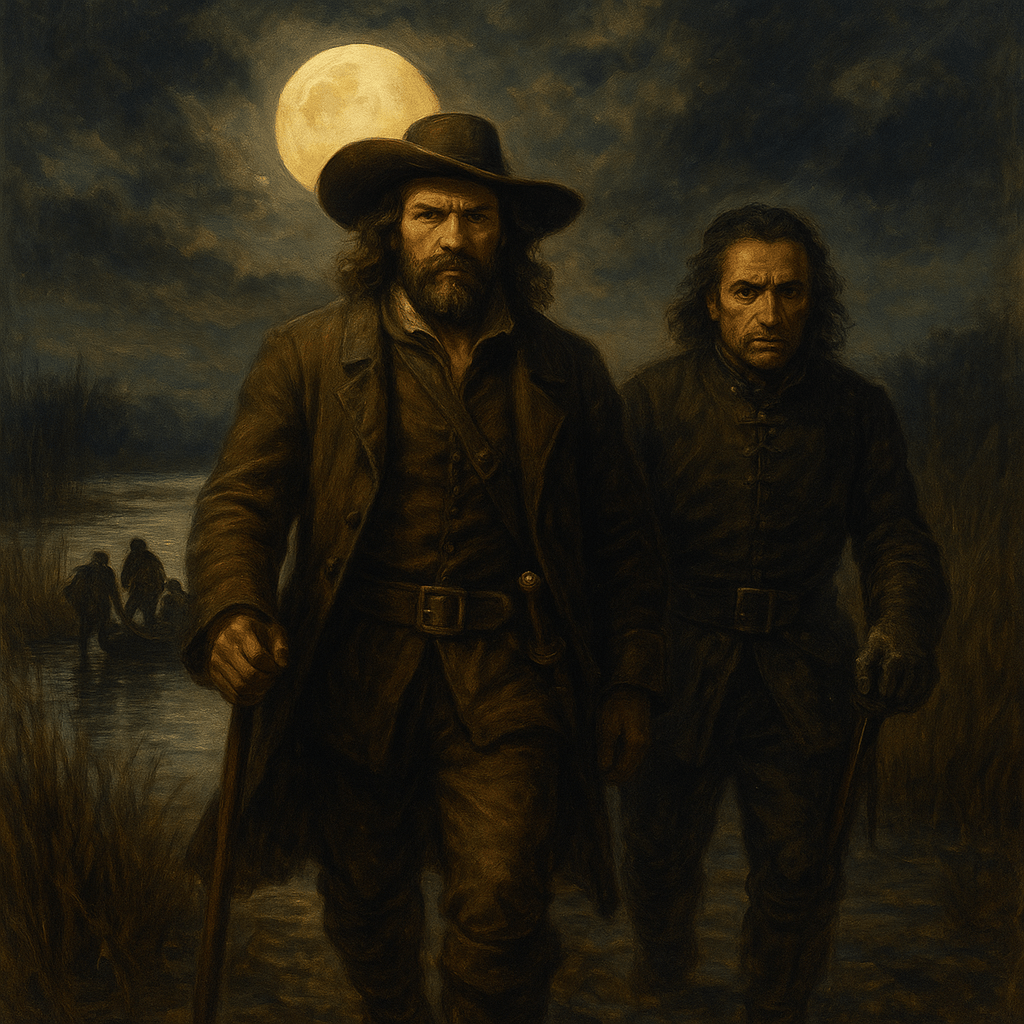
Chicago had been waiting in the dark, quiet as a held breath and still as winter mud, when the land felt new footsteps approaching.
Not the soft, hesitant ones of Marquette.
These were heavier.
Bolder.
The kind that makes even the marsh stiffen.
That man was La Salle.
People say you could feel him before you ever laid eyes on him. Animals went silent. The wind slipped sideways. Even the river seemed to hesitate, as if unsure it should let him pass. Because La Salle wasn’t a wanderer or a pilgrim, he was a storm wearing boots, and storms don’t come to admire the landscape. They come to rearrange it.
René-Robert Cavelier, Sieur de La Salle, hadn’t been born fierce, but life carved him that way. As a young man, he tried to fold himself into the Jesuit order, living under the sharp, cold discipline of scholars and priests. But his ambition was a restless thing; it strained against the walls, refused to kneel, refused to shrink. He walked away carrying their languages, their maps, and their rigor, but none of their obedience.
Whatever softness he might’ve once had froze off somewhere along the St. Lawrence.
Where other explorers carried hope or curiosity, La Salle carried will, an iron certainty that bent the air around him. He lost ships without blinking. Lost men without mourning. Lost fortunes without turning back. He challenged winters that swallowed better men whole and argued with kings as though God had appointed him their equal. Some said he didn’t trust anyone but his own shadow. Others said he didn’t even trust that.
To some, he was a visionary.
To others, a tyrant.
But to everyone in his path, he was dangerous.
And wherever he went, he brought Tonti.
Henri de Tonti had survived more battles than most people survived winters. A grenade had taken his hand, so he wore an iron claw instead. Storytellers whisper that he used it when steel wasn’t enough, or that a single tap of it on your shoulder could fold your courage in half. He’d fought in Sicily, stared down mutinies, quelled uprisings, and stayed loyal long after other men broke. He, too, was a cold, merciless, and unforgettable force. If La Salle was the storm, Tonti was the thunder that followed.
The two of them together made the earth shift uncomfortably.
They marched toward the Chicago Portage like they owned it.
But the Portage, old, watchful, ancient as bone, remembered footsteps. It held the weight of every canoe that crossed it, every prayer whispered into the cattails, every scar from a thousand generations of travelers. It was a doorway worn smooth by time itself.
Yet it had never seen men like La Salle.
Where Marquette slowed to listen, La Salle barreled forward with a confidence so loud it drowned out the marsh’s warnings. He didn’t see a sacred crossing or a living threshold. He saw a lever, something he could grip and pull until the whole interior of the continent snapped into his shape.
La Salle moved with a certainty that left no room for anyone else’s.
He thought he could bend the land.
He thought he could outsmart the rivers.
He thought he could hammer an empire into the mud.
While La Salle and Tonti trudged across the famed Portage, boots sinking, canoes groaning, those who belonged to this land watched: Potawatomi hunters with arrows across their knees, Illiniwek scouts melting into the tallgrass, Miami traders pausing mid-step, measuring the strangers with eyes that missed nothing.
La Salle and Tonti didn’t settle Chicago.
They didn’t plant flags or build walls.
But they carved their presence into the marsh just the same.
Whenever they pushed south toward the Illinois Country, or fled north from another of La Salle’s disasters, they treated the Portage like a road meant for them alone, dragging through it their barrels, their ambition, their noise.
Some winters, their men threw together rough shelters along the riverbank, wooden ribs of cabins hunched against the wind. You can almost see the thin trails of smoke, and frozen breath. The mud swallowed their boots whole while the land stared back, silent and unimpressed.
La Salle traveled with crowds of carpenters, priests, musketeers, men with debts chasing fortune, and men with no fortunes left to chase. They didn’t move so much as surge, like a tide that shifted the shape of the shoreline behind it. When La Salle wasn’t there, Tonti was, the Iron Hand crossing the marsh again and again to mend alliances, fetch supplies, or haul messages between the Great Lakes and the Illinois River.
The Potawatomi and Illiniwek saw them more than once. Some watched from the tallgrass, silent as owls. Others approached cautiously, studying the strangers who seemed determined to trample the Portage.
They didn’t build a fort here.
They didn’t claim the marsh.
But their footsteps changed the rhythm of the ground.
Their canoes widened the water’s mouth.
Their ambition turned the Portage into a glowing line on every French map that mattered.
And long before Chicago had streets or towers or names, La Salle and Tonti made sure the world understood this place was not just a crossing.
It was a door.
A door worth fighting over.
A door that the land would one day regret opening.

 The Creative Quill
Leave a comment