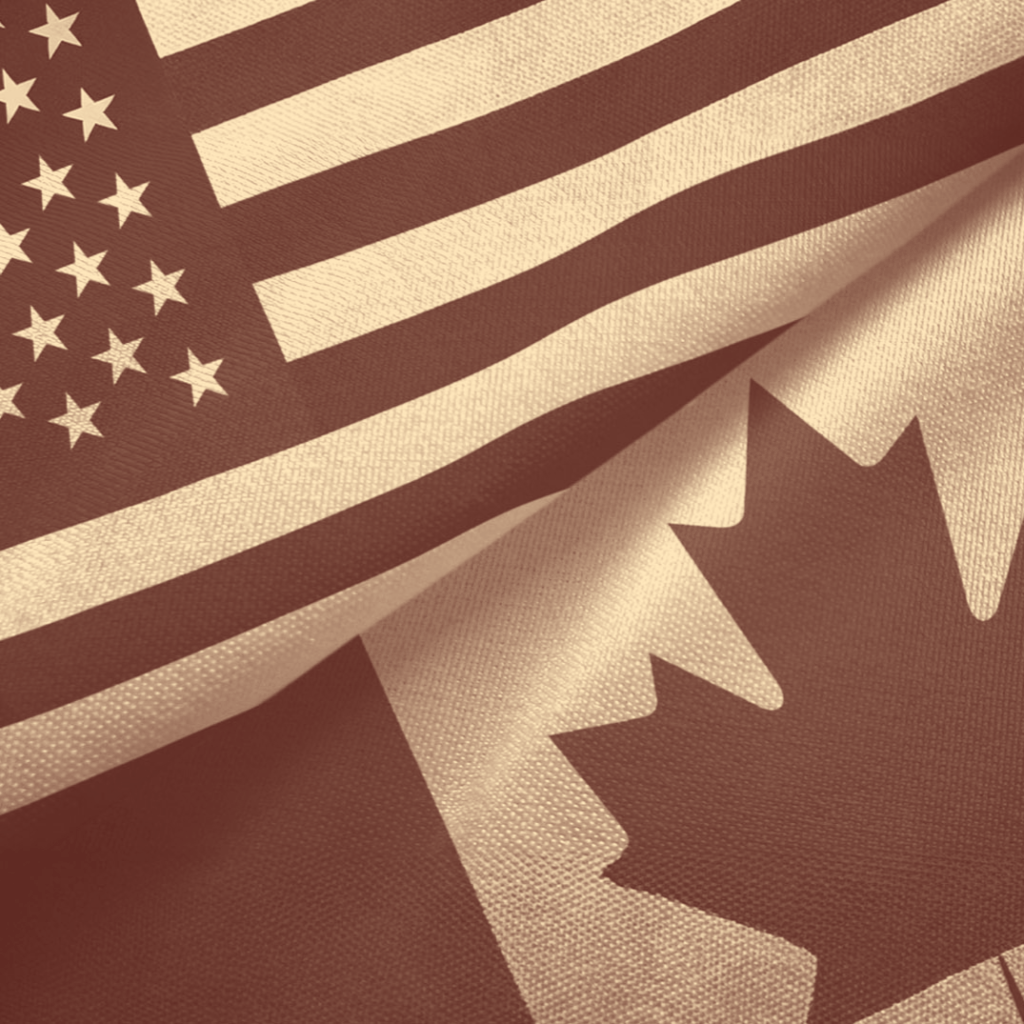
There are family vacations, and then there were our trips to Canada. They weren’t necessarily vacations. Half the journey involved contraband, emotional unraveling, and a trunk full of empty seltzer bottles rattling around like we were running an illegal recycling side-hustle where every bump made our car sound like a sad little maraca in a band of one.
Growing up, our trips to Canada were more like homecomings. Not the Hallmark-movie kind with bunting and banners, but in the deeper, bone-level way that comes from returning to the place where your people are. Canada was where life made sense, where every voice sounded familiar, and where the rhythms of family felt like the only language we ever truly spoke. The U.S. was where we lived, but Canada was where we belonged. Crossing that border didn’t feel like international travel; it felt like stepping back into ourselves.
Our departures from Chicago never happened at regular human hours. No, no. We specialized in chaos. Sometimes my parents pulled us out of school at lunchtime. Other times, we were woken at 3 a.m., tossed into the car like we were being evacuated by poorly trained circus handlers, and shipped north through the dark while the rest of the world slept peacefully, unaware of the ‘don’t tell customs’ portion of the itinerary.
And those bags of empty seltzer bottles? The Meijer store in Jackson, Michigan, gave us ten cents per return. Ten whole cents! Why? Nobody knows. Nobody asked. Nobody cared. We were basically bootleg environmentalists hustling our way up north. Eventually, the novelty wore off, and everyone realized an extra $4.30 was not worth riding with a rogue tide of half-crushed seltzer bottles sloshing around like they were auditioning for Pirates of the Caribbean: The Recycling Edition. But those bottles were one of many benchmarks on our pilgrimage north.
The most significant sign we were getting close?
The Belle Tire.
Not the smiling mascot. The colossal tire itself, rising out of the Detroit landscape like some rubber deity. This thing was lit with spotlights as if it were the Mount Rushmore of the Motor City, and to us, it absolutely was. One glimpse of that glowing white lettering, BELLE TIRE, and we knew the border was near.
Then came our mandatory exit: Livernois Avenue, home of the same gas station, the same building, and the same pump. The only pump located far enough from the road to avoid starring in a reenactment of a true crime documentary. Nothing says “family tradition” quite like picking the gas pump least likely to land you on a ten o’clock news report of a drive-by shooting.
Then came the smuggling.
Because Canada had strict alcohol regulations, and my family, being Italian, being human, being us, brought ‘gifts’. Gifts that were, let’s say, not legally allowed to be carried over the border by civilians without a liquor distribution license. So my father, in a feat of Mediterranean ingenuity, would either (a) pull behind the gas station where the security cameras mysteriously never pointed, or (b) pull onto the shoulder of the highway and pop the hood to stash an entire duffel bag of contraband liquor inside the engine compartment.
Honestly, that man could’ve worked for the CIA.
We’d pass these landmarks long before Eminem made them iconic. The crumbling overpasses and the endless industrial skyline. It was the kind of scenery that whispered, ‘Yes, this is exactly where a rap icon would be born.’
Finally, like Custer’s last stand, the moment that ended our US portion of the trip. It was the moment that made it all worth it:
The glow of the Ambassador Bridge.
Those lights meant home.
Because growing up, Canada wasn’t a vacation spot. It was our real home, the place where family existed, where comfort lived, where we belonged. The U.S. was always the second location, the place you slept while waiting to return somewhere warmer, louder, and more fully yours.
Crossing the bridge, we’d search for the University of Windsor building, because that meant one thing: the finish line was creeping closer. The very first stop was the McDonald’s just over the border. This was the place where we used the bathroom, and my dad un-smuggled his cargo. This is where we became part of the Canadian landscape, unfolding with the enthusiasm of travelers arriving on sacred ground.
Then, the always long and tedious trip up the 401 highway.
Four more hours of the most uninspired landscape God ever created. Flat. Empty. Devoid of anything except an occasional farmhouse that looked like it was losing its will to live. We considered it spiritual preparation. A humility walk. A desert of boredom.
About halfway to Toronto, we’d hit Hamilton, where my mom’s best friend’s parents lived. They were always our midway sanctuary, offering us the driest cookies known to man, cookies that turned our mouths into barren salt flats and made us contemplate the edibility of nearby tree bark. But they also had an oil lamp, which provided endless entertainment.
It wasn’t just an oil lamp. It was a gold, gaudy, slowly spinning shrine that looked like Liberace had designed a night-light for the Vatican. In the center, it featured a solemn plastic Virgin Mary, slowly twirling behind shimmering oil bead curtains, as if she were headlining at the Vatican Lounge. The whole thing gurgled and dripped oil as holy tears and mild electrical violations powered it. Every time we visited, this sacred relic of flammable spirituality became the attraction.
We’d sit there hypnotized, watching it rotate like a holy disco ball until one of us (fine, it was me), operating on peak childhood stupidity and sheer travel boredom, reached out to catch a droplet of hot oil mid-drip. It was miraculous that any of us left Hamilton with fingerprints.
After we had sufficiently dehydrated ourselves and tested the limits of common sense, we hit the road again. Hamilton is beautiful; mountains, waterfalls, scenery that belongs on postcards. Unfortunately, none of that can be seen from the 401. But there was a ski hill, and seeing it was the final confirmation that we were nearly there.
Somewhere after Hamilton and before our internal clocks gave up, we’d start scanning the horizon for the real landmarks, the ones that meant we were finally breaking free from the endless farmland purgatory. First came the Labatt’s brewery, with its glass-front building proudly displaying the stainless-steel machinery inside, like a beer-making museum exhibit for children who had absolutely no business being that invested. But to us, those gleaming tanks meant civilization and that we were getting closer to home. And then came the holy grail of all road-trip sightings: Pearson Airport. The moment we spotted a plane dipping low over the highway, we’d unravel completely. It was the unmistakable confirmation that Toronto was finally within reach and that the waiting, whining, and slow emotional deterioration inside that car were almost over. From that point on, no one sat properly, no one stayed calm, and all remaining parental authority evaporated into the Canadian air.
Suddenly, we blinked and the Keele Street exit.
Butterflies.
Chaos.
Unrestrained excitement.
We practically vibrated out of our seats as we turned down the road to my grandparents’ subdivision. When the familiar hedges and the giant cherry tree came into view, all hell broke loose. If we could’ve sprouted wings and flown straight to the front door, we would’ve.
The visits themselves? A blur of cousins, aunts, uncles, and espresso moka pots working overtime. My grandparents kept an entire armada of coffee pots in rotation, each one brewing the liquid fuel that powered Italian hospitality. The espresso cups, washed by hand, lost a layer of porcelain every trip. We were high on Palmolive fumes, and our hands were so dry and stiff they could’ve been used as kindling.
My grandparents had two cantinas, each with its own magical universe. The first was the dry-goods cantina, a pantry of wonders overflowing with imported chocolate, good cereal, and every snack we were never allowed to have at home. I treated my grandmother’s chocolate stash like a long con, slowly thinning it out over the course of each trip so she wouldn’t notice the disappearing inventory.
The second cantina? That was sacred ground. Tucked beside the laundry room, it held the wine barrels, the salami, the prosciutto, and the holiest of holy, the cheeses. It was like a year-round pioneer pantry that would have made any small Italian winery or neighborhood deli weep with jealousy. This second room was strictly off-limits, mostly because if anyone let us kids in there unsupervised, they’d most definitely find us sitting cross-legged on the floor, gnawing on a prosciutto leg like feral raccoons.
Another ritual of every trip was the pilgrimage, yes, pilgrimage, to the corner convenience store. It didn’t matter if it was blistering heat, sideways sleet, or wind strong enough to exfoliate our faces; we walked that half-mile like tiny warriors on a quest. The store was owned by a Chinese family who somehow tolerated us raiding their two-by-two-foot kingdom every single day. We cleared out chocolate bars, ketchup potato chips, and the good Canadian candy we couldn’t find south of the border. When we were old enough, we graduated to buying scratch-off lottery tickets, convinced that Canadian soil would improve our odds. It didn’t. Our “winnings” never exceeded five or ten dollars, which we promptly reinvested into more chocolate and chips. Financial literacy was not part of the vacation curriculum.
We squeezed a lifetime into those 3–5 days because that’s all my father could survive before his internal battery drained to zero.
But the best part?
Nighttime.
The chorus of farting, snoring, and shifting bodies echoed throughout the house. My sister and I always shared a bed. Our whispered giggles were the pure contentment of being exactly where we belonged.
And then,
The moment we dreaded.
Departure day.
Always late at night.
Always dramatic.
Always unbearable.
We wailed. We sobbed. We cried until the border. Then cried some more until we fell asleep from emotional exhaustion, damp-faced and devastated.
The return was always a funeral procession, minus the casseroles. A silent, heavy drive back to a place that never felt as warm as the one we’d left.
We stopped again in Jackson, Michigan, so my mom could buy her beloved chow chow mustard, the only thing she’d ever accept as consolation for leaving her homeland of relatives, espresso, and fully stocked cantinas.
And then we were back home.
Or… the place we slept until the next trip.
Whichever.
But those memories? They stitched us together.
They were the glue, the chaos, the soundtrack of our childhood.
And a few weeks later, sometimes a month if my father needed recovery time, we’d do it all over again.

 The Creative Quill
Leave a comment