
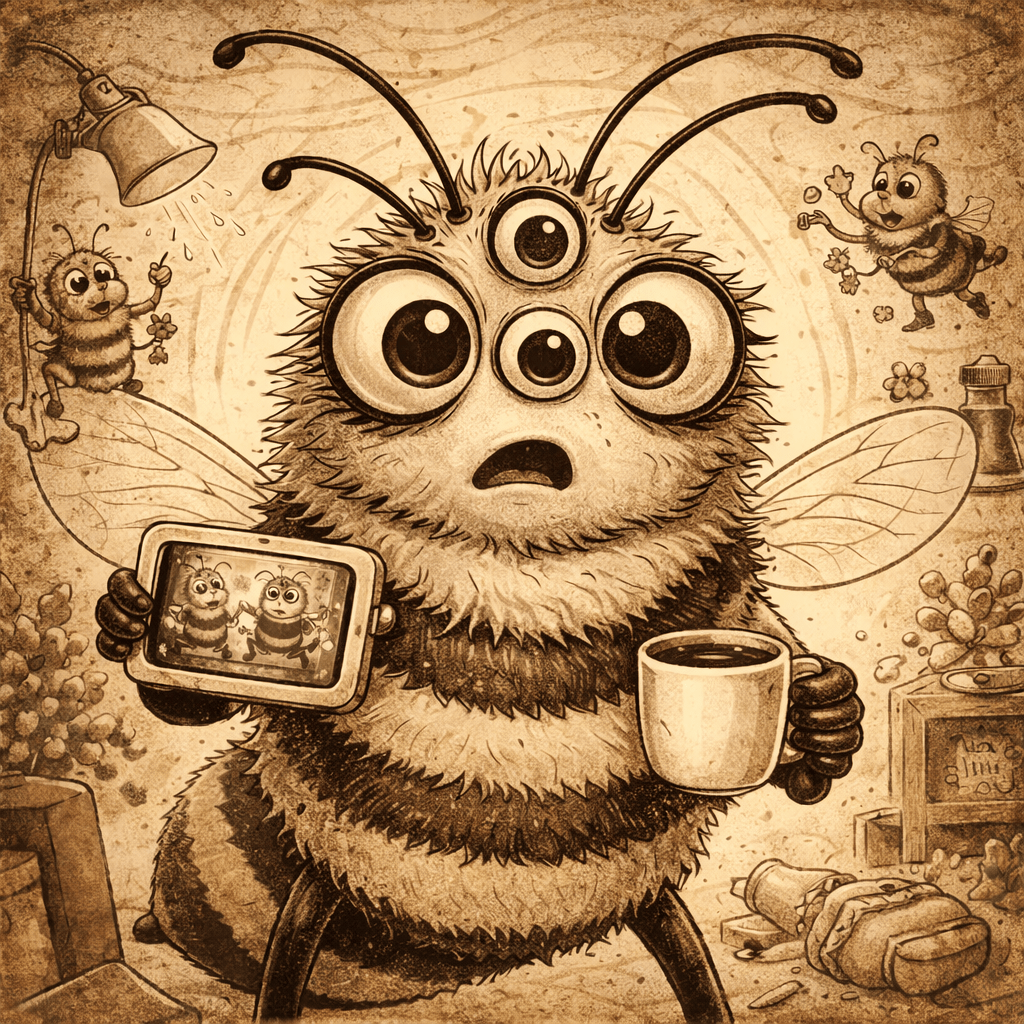
Bees have five eyes.
Five.
Three small ones perched on top of their heads that detect light and help them avoid predators swooping in from above, and two larger, visible eyes in front that help them navigate, recognize shapes, and generally not crash into things. It’s efficient. Purposeful. Evolution really showed off there.
Mothers, on the other hand, are said to have eyes everywhere. Eyes in the backs of our heads. Eyes that see through walls. Eyes that activate the second a child even thinks about doing something questionable. According to legend, we know everything: what you’re doing, where you’re going, who you’re with, and what poor decision you’re about to make three minutes before you make it.
This is a lie we tell ourselves to survive.
When my kids were little, I truly believed I had a decent grasp on the mischief they were capable of. I knew when things were too quiet. I could sense chaos brewing the way animals sense storms. I had that low-grade maternal radar that buzzed when something felt… off.
What I did not have, what no amount of eyes, including a hypothetical sixth or seventh, could have provided, was omniscience.
Because years later, as adults, my children have started casually dropping stories into conversation that absolutely wreck my sense of reality.
Stories like this: my two boys once stuffed their baby sister into a toy box. Or into the hollow base of an IKEA chair. Details are fuzzy, because apparently trauma editing applies retroactively to mothers as well. What is crystal clear is this: they then sat on the chair and played video games while she screamed.
Screamed.
For help.
And I didn’t know.
Somewhere in my house, my daughter was imprisoned in Scandinavian furniture while I was probably folding laundry, thinking I was doing a solid job at motherhood.
That illusion didn’t end with childhood.
Years later, because time, maturity, and frontal lobe development are apparently optional, my daughter showed me a text she received from her friend. The message was brief, ominous, and included the word moron, which is never a comforting way to start parental correspondence.
She said some idiot was claiming he could jump over a bonfire without getting burned.
The idiot, it turned out, was her brother.
Then there was the picture.
I stared at her phone in silence, the way you do when you’re deciding whether to intervene, disown, or fake your own death and start over under a different name. I won’t pretend I wished actual harm on my child, but I will admit there was a fleeting moment where I considered whether fire might succeed where years of parenting, rules, and reason had clearly failed.
Just a little singe. A light lesson. Nothing permanent. Something memorable.
And this is the part no one includes in the mythology of motherhood: even when the evidence is sent directly to your phone, even when the danger is glowing, crackling, and visible from space, there is still absolutely nothing you can do except watch, breathe, and resist the urge to text, ‘ you better hope those flames save me the trouble of killing you when you get home!’
This is not a generational flaw. This is not a failure of supervision. This is simply the universal truth that children, especially when left unsupervised, grouped together, or introduced to open flames, are deeply committed to testing the limits of survival.
Tell me again about eyes in the back of my head.
This is the part where society expects me to spiral into guilt, but honestly? If you raise more than one child, you know the truth: siblings are feral when unsupervised. You can have rules, routines, structure, and consequences, and the moment your back is turned, they revert to Lord of the Flies with better snacks.
And before anyone gets too comfortable judging my children, let me be very clear: this is not a generational flaw. This is a children are idiots issue.
Because when I was growing up, my siblings and I engineered what we called a “doggie elevator.”
I already know you’re concerned. You should be.
We took a large book bag, tied a rope to the handle, stuffed our dog inside it, and lowered him from my bedroom window to my brother or sister waiting below.
Yes, this required removing the screens from the storm windows.
Yes, this was wildly unsafe.
Yes, the dog loved it.
The dog loved it.
He wagged. He volunteered. He leaned into the bag like, “We doing this again?” Which, frankly, says more about the dog than it does about us.
Had my parents discovered this operation mid-elevator, they would have absolutely thrown us out the window next, then made us clean up the mess our dead bodies made on the sidewalk below. And honestly? They would’ve been justified.
So when I hear about toy box prisons and IKEA chair confinement, I don’t think, How did I miss this? I think, Ah. The circle of stupidity is complete.
Here’s the thing no one tells you about parenting: knowing everything is impossible. Bees get five eyes because survival demands it. Mothers get instincts, intuition, and anxiety, but we do not get surveillance footage. We do not get a live feed of every dumb decision our children make when we’re not looking.
And thank God.
Because if we did, none of us would sleep. Ever.
We would combust under the weight of all the near-misses, the improvised death traps, the creative uses of household objects that somehow didn’t result in ER visits. The human race survives not because mothers see everything, but because children are weirdly resilient and luck does a lot of heavy lifting.
So, yes, bees get five eyes because survival depends on seeing danger before it arrives. Mothers don’t get that luxury. We don’t see the fire until it’s already lit, the jump already attempted, the chair already occupied, the screaming already underway. What we get instead is hindsight, bright, unforgiving, and usually delivered years later in casual conversation. And maybe that’s enough. Because if we truly saw everything coming, we’d smother them before they ever learned to leap, to climb, to test, or to survive. So we do what mothers have always done: we stand back, hope the flames don’t win, and trust that luck, resilience, and whatever invisible force keeps idiots alive will carry them through long enough to grow up and tell the story while we quietly add it to the list of reasons we deserve a medal, a drink, or both.
 thecreativequill.net
Leave a comment