After DuSable left, Chicago did not rush to fill the space he’d made.
The river still bent the same way. The marsh still breathed. Trade still passed through, but without the quiet steadiness that had held things together. The place felt thinner, like a house after someone important moves out, everything still there, but not arranged with care anymore.
Chicago had learned how to hold someone.
Now it learned what absence feels like.
The United States noticed the absence almost immediately.
On paper, the land already belonged to them. Treaties had been signed far away. Boundaries had been drawn by hands that had never sunk into this mud. The six square miles at the mouth of the river had been set aside, reserved, and labeled. Chicago had been promised without being asked.
What the paper didn’t understand was that this place had never responded to declarations.
So in 1803, the United States did what empires always do when listening fails. It built something solid and called it certainty.
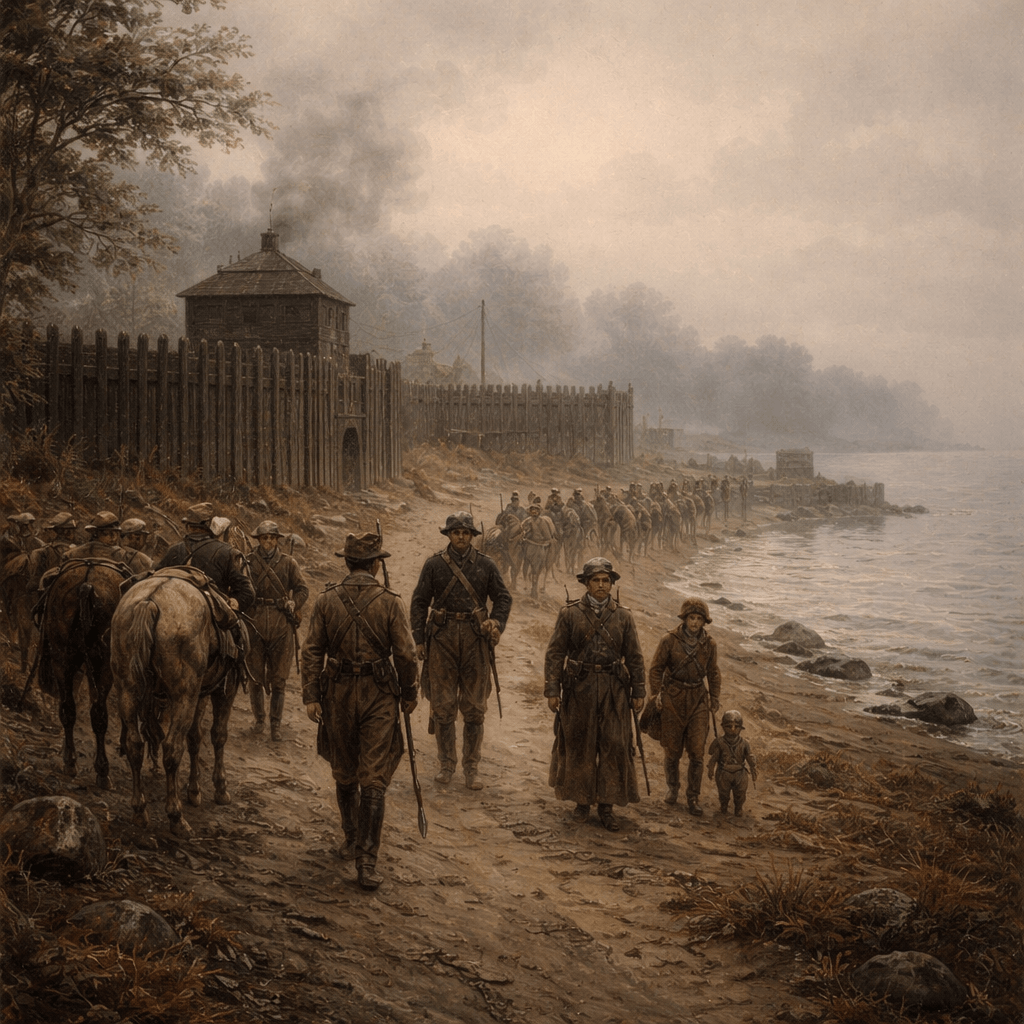
Fort Dearborn rose at the river’s edge, not because Chicago needed protection, but because the country needed control. Timber walls. Armed men. Orders that assumed obedience. The fort didn’t arrive to negotiate. It arrived to stay.
The land stiffened.
Where DuSable had folded into the rhythm of the place, the fort interrupted it. Canoes slowed. Meetings shortened. The Portage narrowed again, not in width, but in trust. The fort watched the river the way suspicion watches a room, always alert for movement it didn’t understand.
Those who lived nearby understood immediately that something had shifted.
The Potawatomi had dealt with forts before. They knew what they meant. A fort was not just a building; it was a promise that more would follow. Settlers. Roads. Lines that could not be stepped over without consequence.
The fort’s presence asked questions without waiting for answers.
At first, there was restraint. Polite distance. Trade that felt more like an obligation than an exchange. The soldiers were told they were there to keep peace, but peace has a way of unraveling when it’s enforced at gunpoint.
Chicago did not erupt.
It withdrew.
Supplies became harder to come by. Communication thinned. Allies grew cautious. The fort, so sure of its purpose, found itself surrounded not by open hostility, but by silence. When evacuation orders finally came in August of 1812, they were framed as a solution, a clean withdrawal, a safe passage south, an orderly retreat under the assumption that authority would still be respected.
That assumption was fatal.
The United States was now at war with Britain. Fort Dearborn was deep in contested territory, far from support, and surrounded by Indigenous nations, many of whom were allied with or sympathetic to the British.
The fort was evacuated because it could no longer be held.
Fort Dearborn stood too far from help, too short on supplies, and surrounded by people who no longer recognized its authority. Orders came down from the east, assuming the land would still make room.
It didn’t.
The land had stopped listening long before the order was written. The people who controlled the ground had never agreed to guarantee passage. What the soldiers carried out of the fort was not safety, but the belief that command alone could move them through a place that now refused to make room.
Orders arrived late. Supplies arrived later. By the time evacuation orders came in August of 1812, Fort Dearborn was already cut off. The relationships that once made movement possible were gone.
They were not.
The troops left the fort and moved south along the lakeshore, carrying soldiers, civilians, and the brittle confidence that authority alone could guarantee passage. The land watched them go.
What happened next would later be labeled a massacre. Names would be argued over. Responsibility debated. But Chicago understood it in simpler terms.
Force had tried to leave without listening.
The column broke. Lives were lost. The fort was burned. Smoke rose where certainty had stood only days before. And just like that, the United States’ grip on Chicago loosened.
For a time, the place emptied again.
Grass grew where boots had marched. The river resumed its patience. Chicago did what it had always done when power failed, it waited.
This part is important.
Chicago was not conquered into becoming a city. It resisted long enough to be reshaped instead.
When American forces returned a few years later, they came quieter. More deliberate. The fort was rebuilt. Settlers followed. Treaties multiplied. Removal followed agreement like a shadow.
The city did not forget what it had learned.
It simply buried it.
By the time Chicago was officially “founded,” the story had been cleaned up. Beginnings were moved to safer dates. The people who had lived here longest were relocated. DuSable became a footnote instead of a foundation. Fort Dearborn became a marker instead of a warning.
Chicago learned how to grow fast.
It learned how to build higher.
It learned how to move forward without looking down.
But beneath the streets and the straightened river, the old lessons remained. That belonging matters. That listening works longer than force. That land remembers behavior, not paperwork.
DuSable had shown Chicago one way to begin.
The fort showed it another.
And the city that followed would spend centuries moving between those two truths, never quite able to choose which to believe.

 thecreativequill.net
Leave a comment