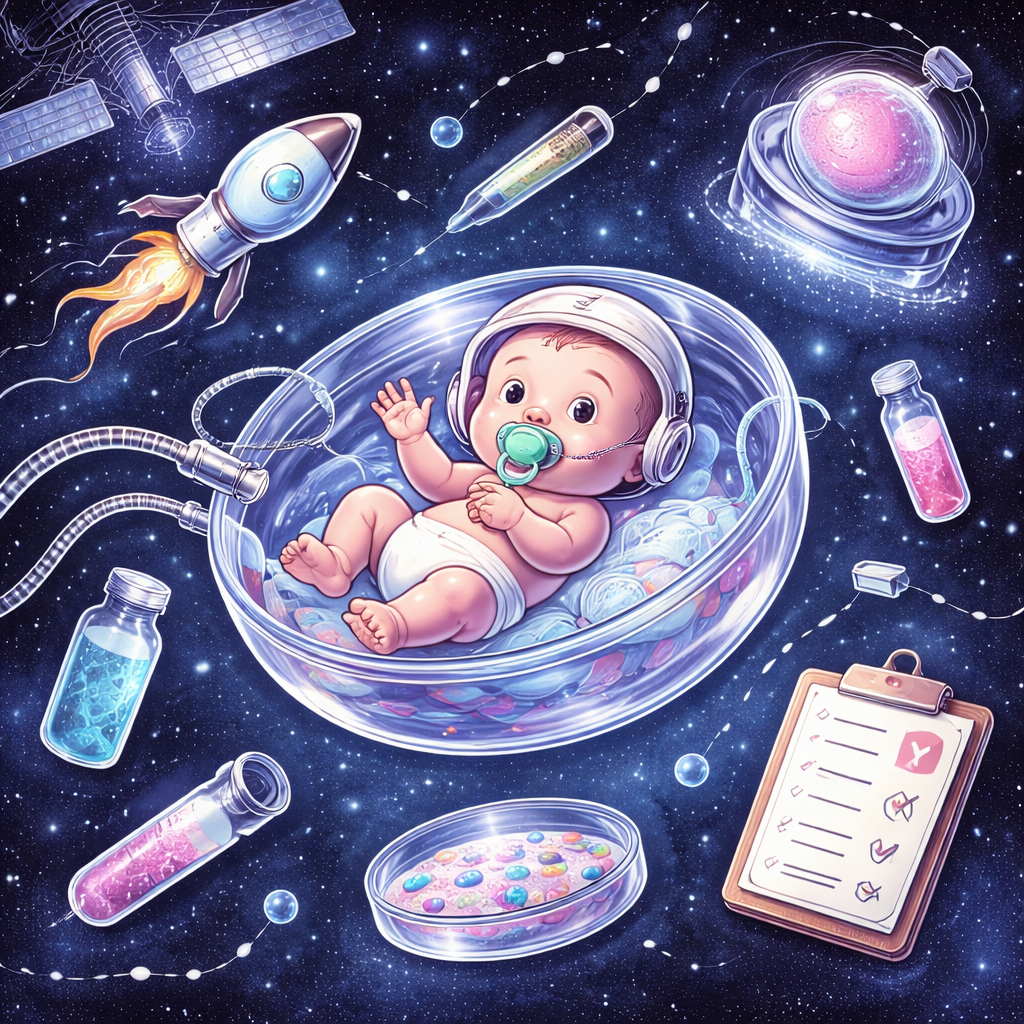
So, this is where we are now.
Not curing diseases we barely understand.
Not fixing childcare, maternal health, or the small detail of people being able to afford children on Earth.
No. Space babies. That’s the priority.
I stumbled across an article this morning about scientists flying nonviable human embryos and eggs into the sky so they could experience “short intervals of weightlessness” while researchers studied whether humans might someday reproduce in space.
Let me be clear: this is not satire. This is real. This is funded. This is being discussed seriously by very smart people with lab coats and press releases.
And I am dumbfounded.
Apparently, we have reached the point in human history where the logical next question after “Can we survive space travel?” is “Cool, but can we fertilize eggs up there?”
Why.
Why is this a priority?
We’re told this research is necessary because billionaires want to colonize Mars. Because fertility rates on Earth are declining. Because humanity must expand beyond its “natural habitat.”
First of all, calling Earth our “natural habitat” like it’s a starter apartment we’ve outgrown is… a choice.
Second, if fertility rates are declining on Earth, perhaps, just throwing this out there, we could look at the reasons people are choosing not to have children here. Cost. Healthcare. Climate anxiety. The fact that raising a child feels like a high-stakes endurance sport with no hydration stations.
But no. Instead of addressing any of that, we’re loading embryos onto planes, looping them through the sky like delicate scientific carry-ons, and asking, “But what if gravity is optional?”
I don’t understand the rush. We haven’t even figured out if long-term space travel destroys muscle mass, bone density, mental health, or basic sanity, and we’re already talking about IVF clinics in orbit.
The article mentions sperm that don’t swim properly in microgravity. Eggs whose structure gets damaged when gravity is removed. Embryos that may or may not develop on the same timeline they do on Earth.
This is not promising. This is not a green light. This is biology gently but firmly saying, “Have you considered not?”
And yet, the response appears to be: Okay, but what if we just keep trying?
I’m old-fashioned, apparently, because when human cells start malfunctioning in an environment, I take that as a hint. A boundary. A suggestion from nature that maybe reproduction belongs in places where bodies evolved to exist.
Instead, we’re framing this like an engineering challenge. As if pregnancy is just another system to optimize. As if gestation were a software bug that could be patched with a better nutrient mix and a sturdier mini lab.
There’s also the small matter of ethics, which everyone in the article keeps circling without landing. The 14-day rule. The question of whether embryos would develop faster or slower in space. The uncomfortable realization that our existing ethical guidelines may not apply once you remove gravity.
That’s not exciting. That’s alarming.
If your research raises the question, “Do our moral frameworks still function off-planet?” maybe pause. Maybe sit with that. Maybe don’t treat it like a minor regulatory inconvenience.
And let’s talk about the marketing optimism here. Startups hoping to one day sell IVF services to space colonists. Investors are nervous about controversy but intrigued by the “future market.” Billionaires volunteering their genetic material like this is a donation bin at the edge of the universe.
This isn’t visionary. It’s hubris wrapped in sci-fi language.
I’m not anti-science. I’m not anti-exploration. I love curiosity. I love research. I love questions.
But not every question needs to be answered immediately, and not every technological capability needs to be exercised just because it exists.
Sometimes, restraint is intelligence.
We are still struggling to support healthy pregnancies on Earth. Still failing mothers in hospitals. Still debating access to basic reproductive care. Still acting shocked when biology reminds us it has limits.
And yet, here we are, staring into space and asking whether embryos can survive without gravity.
Maybe the real question isn’t whether humans can reproduce in space.
Maybe it’s why we’re so eager to escape Earth before learning how to take care of life here.
Because if the future of humanity depends on floating IVF labs and ethically ambiguous embryos drifting above the planet, we might want to reconsider what problem we’re actually trying to solve.
For now, I’ll remain firmly grounded.
Gravity intact.
Judgment fully operational.
(If you are interested in reading the full article, here is the link: https://archive.ph/Z5iYN#selection-1071.0-1409.258)

 The Creative Quill
Leave a comment