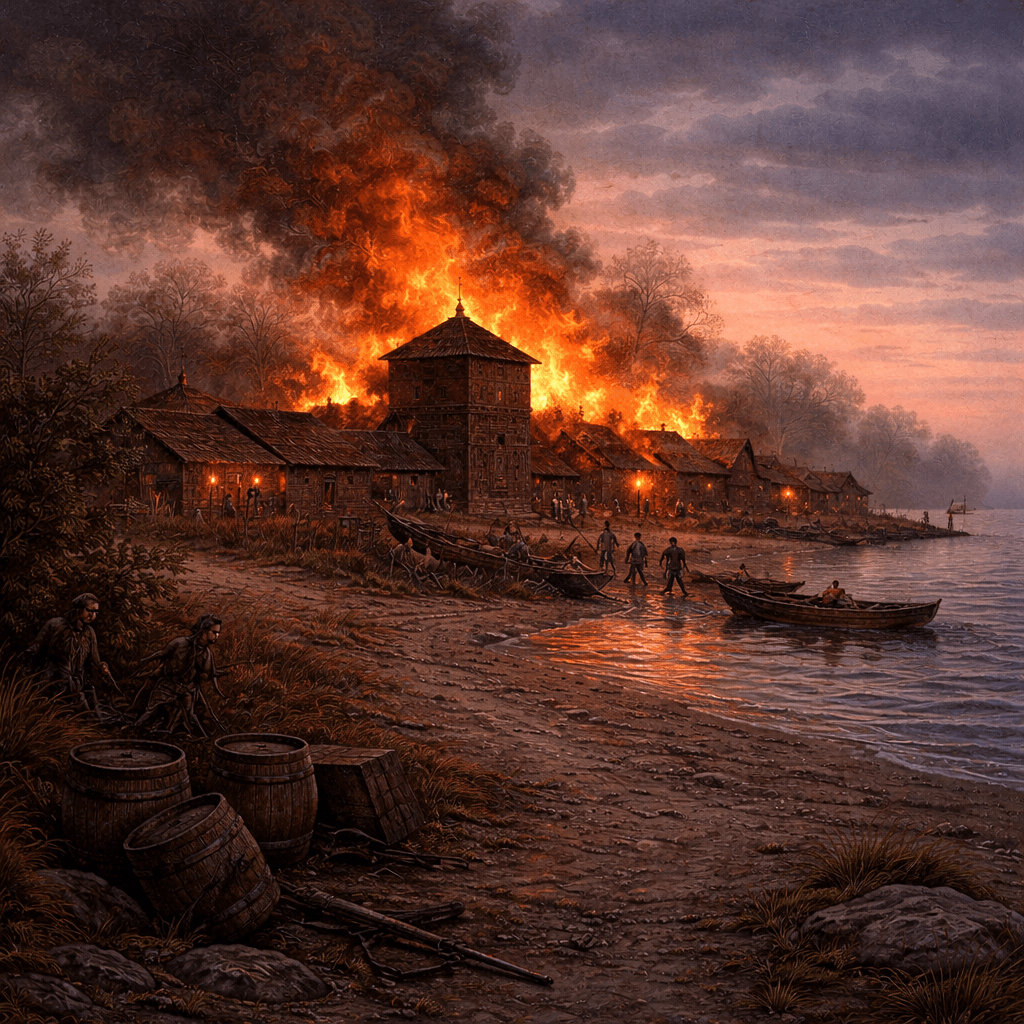
By the early 1800s, the United States Army decided this restless crossing of mud, water, and memory needed structure. Not conversation, or relationships. Not timber, or orders. A perimeter drawn in straight lines where the land preferred curves was the vision.
So they built Fort Dearborn.
The original fort stood on the south bank of the Chicago River where it meets Lake Michigan, near the footing of the Michigan Avenue Bridge, just steps from where the Wrigley Building and Tribune Tower stand today. Crowds pass through daily with little sense of what once occupied that ground. Now it’s glass, traffic, and constant motion. Back then, there were no towers or bridges. This was a place where the land watched back and showed no interest in being arranged.
Captain John Whistler was the man sent to make it real. He was a career soldier, practical and methodical, not someone interested in poetry or symbolism. History handed him both anyway. He was the grandfather of painter James McNeill Whistler, whose Arrangement in Grey and Black No. 1 (better known as Whistler’s Mother) hangs in the collective memory of anyone who has ever wandered through an art museum. It’s a strange lineage when you think about it. One man measuring timber and sightlines on a frontier marsh, another measuring shadow and restraint on canvas. Both, in their own ways, arranging quiet into form.
The fort itself wasn’t grand. Early Chicago rarely was.
Four cabins rose near it, fragile gestures of permanence in a place that had never promised stability. One belonged to a fur trader named LeMai, a figure who would later surface again in the city’s commercial story as trade hardened into something more structured, more transactional, and more permanent. At the time, though, it was just another structure pressed against uncertainty.
The installation was named after HenryDearborn, Secretary of War under ThomasJefferson. Naming things was part of the process. It always is. Empires name what they intend to keep. The act doesn’t guarantee success, but it signals intention, and intention was exactly what the United States was planting here.
Because this wasn’t just about defense.
It was about presence.
Control of waterways.
Observation of movement.
A declaration that Chicago was no longer just a crossing, but a point worth guarding.
The soldiers who occupied it weren’t building a monument. They were building leverage. The river carried traders. The lake carried goods. The Portage still whispered opportunity to anyone listening. And the young nation understood what empires before it had learned the hard way:
If you hold Chicago, you influence everything moving through it.
Fort Dearborn marked a shift.
Not the beginning of the city, that had roots long before, but the moment federal authority drove a stake into its shoreline and said: This place matters enough to defend.
Fort Dearborn did not exist to decorate the shoreline.
It served a purpose that was both simple and enormous. The fort watched movement. It monitored trade. It marked the federal presence at a crossing that had never belonged to a single authority. Canoes, pelts, grain, rumor, and allegiance all passed through this narrow mouth of water, and the young United States wanted eyes on every bit of it.
Soldiers stationed there regulated river traffic, brokered trade relations, and attempted to stabilize a region that was anything but stable. Messages moved through its gates. Goods changed hands nearby. Travelers measured their route by its presence. It functioned less as a battlefield installation and more as a checkpoint of influence, quietly asserting that the nation intended to remain.
But presence and belonging are not the same thing.
The fort stood where relationships had once governed passage. It imposed structure where conversation had previously mattered more than authority. That difference lingered in the air around it, shaping every exchange, whether spoken or not.
For a time, the timber walls held.
Then the wider world intruded.
When the War of 1812 reached the interior, the fort’s isolation became undeniable. The conflict did not arrive as cannon fire at its gates, but as thinning supplies, fractured alliances, and the slow realization that what had been a symbol of control began to feel like exposure.
Orders finally came to abandon the post. The orders suggested that authority would guarantee safe passage, that agreements would endure under pressure, and that leaving would restore stability.
Instead, the column encountered resistance that shattered that certainty. Lives were lost. The retreat dissolved into chaos. The fort itself was burned, its presence erased almost as quickly as it had been asserted.
Chicago did not erupt.
It did what it often does.
It absorbed the moment.
Grass reclaimed space. Trade routes adjusted, and the land resumed its own cadence. The fall of Fort Dearborn did not diminish Chicago’s significance; if anything, it confirmed it. No one fights to hold what does not matter.
The site would not remain empty long.
Once a place demonstrates its value, absence rarely persists.
Someone always returns to try again.

 The Creative Quill
Leave a comment