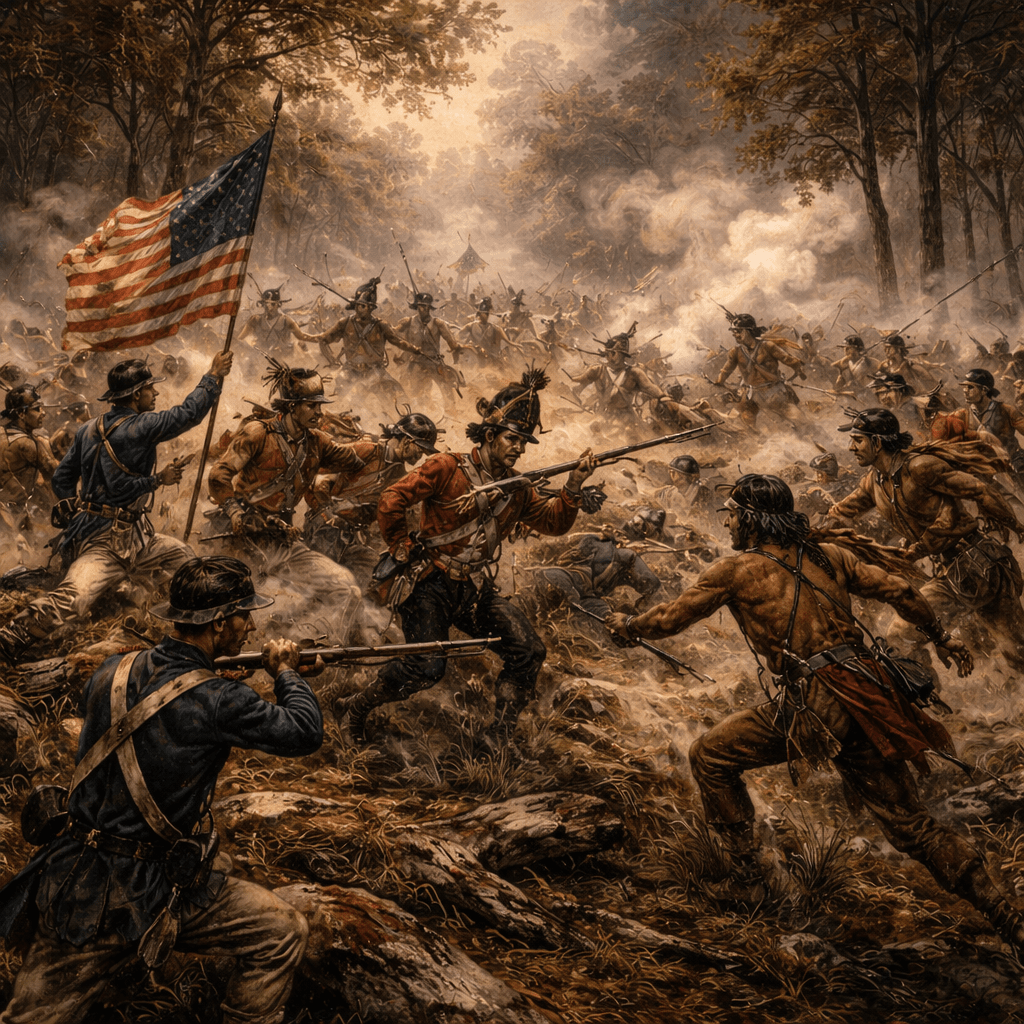
After the fort burned, Chicago did not scream.
It went quiet.
No American flag marked the river’s mouth. No soldiers paced either side of the timber wall meant to keep the world out. The shoreline, stripped of timber and certainty, returned to wind and watching. For a time, there was no federal presence here at all, just the marsh, the lake, and the uneasy awareness that something larger was moving beyond the horizon.
The War of 1812 was not a distant quarrel between presidents and kings. It pressed against the Great Lakes like weather.
And the weather was coming from the north.
The version most Americans remember of the War of 1812 is simple: Britain versus the young United States, naval battles, burning Washington, and Andrew Jackson in New Orleans.
But here in the Northwest Territory, the conflict was something else entirely.
It was a struggle over whether American expansion would continue unchecked, or whether Indigenous nations could stop it.
For leaders like Tecumseh, the war was not about imperial rivalry. It was about survival.
Tecumseh was a Shawnee leader who moved across the Great Lakes and Mississippi Valley, forging a united front against American expansion. He believed the land was shared and that no single nation had the right to surrender it nor could it be sold off piece by piece.
The land was held collectively, and no individual tribe had the authority to sell territory to the United States because it belonged to all.
That idea directly challenged American treaty strategy, which relied on isolating tribes and negotiating land cessions piecemeal.
If the confederacy held, expansion slowed.
If it fractured, the frontier moved.
Britain, eager to weaken American growth, aligned itself with Indigenous forces across the Great Lakes. It was a brilliant and necessary strategy. Indigenous fighters knew the terrain, the waterways, the vulnerabilities. They understood the geography of Fort Dearborn long before Washington did.
And they understood what its presence signaled.
Fort Dearborn was meant to secure American interests in the region and project permanence. But permanence is a bold claim on contested ground.
When news reached the fort in August 1812 that war had been declared, the garrison received orders to evacuate.
The departure did not go as planned.
As soldiers and civilians left the fort, they were attacked by Potawatomi warriors. What followed has long been labeled the “Fort Dearborn Massacre.” But history is often tidied by the language of those who write it.
From the Indigenous perspective, this was not random violence.
It was resistance.
Years of relentless occupation and broken agreements. A military outpost was planted at the mouth of the river, where it was never meant to stand. A war that threatened to tip the balance permanently.
Chicago’s first major moment in American history was not triumphant.
It was bloody.
The fort was burned.
For a time, American presence in the region receded.
And for a brief, fragile moment, it looked as though Indigenous resistance might succeed.
But wars are not decided by single battles.
In 1813, Tecumseh was killed at the Battle of the Thames in Canada. His death shattered the fragile unity among Indigenous nations, collapsing the most serious organized resistance to U.S. expansion in the region. Without that unified front, American control of the Northwest Territory accelerated and moved forward with far less opposition.
By the Treaty of Ghent in 1814, the war formally ended, but Indigenous sovereignty in the Northwest was not secured.
The American frontier surged westward with renewed certainty.
The War of 1812 was not just a skirmish on the edge of a young nation. It was a decisive test of whether Indigenous nations could hold their ground against a government determined to expand.
They nearly did.
And that “nearly” changed everything.
Because from the beginning, Chicago was not born out of peaceful expansion.
It was carved from conflict.
And every time the city reinvents itself, it does so on ground that remembers.

 The Creative Quill
Leave a comment