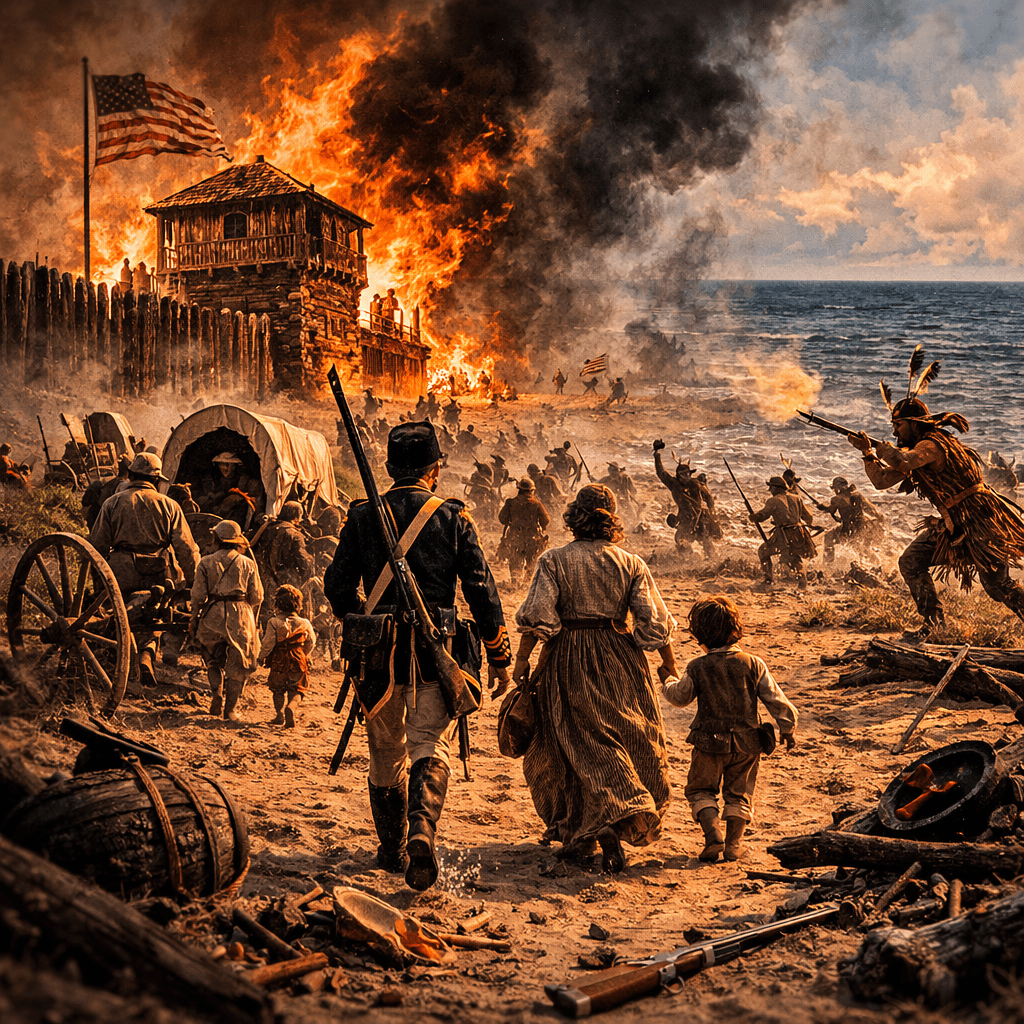
On the morning of August 15, 1812, the gates of Fort Dearborn opened, and the people of Chicago began walking south along the shore of Lake Michigan.
The settlement they left behind contained barely fifteen homes and a wooden fort beside the river.
By the end of the day, much of it would be gone.
The order to abandon the post had come weeks earlier. Captain Nathan Heald, commander of Fort Dearborn, had been instructed to evacuate the garrison and lead the soldiers and civilians south to Fort Wayne.
Before leaving, Heald was ordered to destroy the fort’s surplus arms and supplies so they would not fall into enemy hands.
Barrels were broken open. Muskets were thrown into the river. Gunpowder was ruined. Ammunition scattered. Whiskey meant for trade was distributed in hopes of easing tensions with nearby Potawatomi bands who had begun gathering near the settlement.
The destruction of the supplies did not go unnoticed and would have consequences beyond the walls. Some Potawatomi leaders had been led to believe that the weapons and goods would be given to them as part of a safe-passage agreement. When the muskets were thrown into the river and the ammunition destroyed, many interpreted the act as a broken promise. Tension that had been simmering around the settlement hardened quickly.
Word traveled quickly across the prairie and through the trading networks that surrounded the Chicago River.
By mid-August, the small outpost was being watched.
Just days before the evacuation, a familiar figure arrived from Fort Wayne to escort the departing column: Captain William Wells.
Wells was no ordinary officer. As a young man, he had been raised among the Miami tribe and adopted by the great Miami leader Little Turtle. He spoke Indigenous languages fluently and knew the region’s people and terrain better than most American officers.
According to several accounts, Wells blackened his face with gunpowder before the march began, a frontier signal that he did not expect to survive the day.
Shortly after sunrise on August 15, the column moved out of the fort.
Fifty-four soldiers marched under Heald’s command. With them traveled the civilians of the settlement: wives, children, traders’ families, servants, and laborers who had built their lives along the riverbank.
The road followed the edge of Lake Michigan.
To the east stretched open water under the summer sky. To the west, low ridges of sand and prairie grass rose. The fort’s palisade could still be seen behind them as the column began moving south along the shoreline.
Today, that same route would carry someone down Michigan Avenue and toward the Near South Side of Chicago.
The fighting took place near what is now 18th Street and Calumet Avenue. The column approached a stretch of dunes where warriors had already gathered.
In 1812, it was open sand and tall grass.
Today, the site is marked by Battle of Fort Dearborn Park, surrounded by city streets and apartment buildings.
As the soldiers advanced, figures began appearing along the ridgeline.
At first, only a few.
Then more.
Men standing silently along the dunes, watching the column approach.
Captain Wells rode near the front of the line. He had seen enough of the frontier to understand what the officers behind him did not.
This was not a hunting party.
It was an ambush forming.
Moments later, the quiet shoreline erupted into gunfire.
What followed was swift and chaotic.
The line of soldiers collapsed almost immediately under the sudden attack. Wagons overturned in the sand. Horses bolted across the prairie. Families scattered as the fighting spread along the shoreline.
Captain Wells fought beside the soldiers until he was killed in the battle, dying in defense of the column he had come to escort. His name would later remain attached to Chicago’s map in Wells Street, a quiet reminder of the frontier violence that once unfolded along the lake.
By the time the fighting ended, thirty-eight soldiers and fourteen civilians lay dead along the lakeshore.
The survivors were taken prisoner.
Behind them, Fort Dearborn stood empty.
Later that day, the Potawatomi returned to the riverbank settlement and set the fort ablaze. The timber walls and buildings burned until little remained but ash and blackened posts.
Before the war, Chicago had consisted of roughly fifteen scattered homes along the river.
After the destruction of the fort and the violence along the lakeshore, only four would remain standing.
Yet even in the midst of the devastation, acts of protection still appeared.
Alexander Robinson, a Potawatomi leader familiar with the settlement’s trading families, intervened to help members of the Kinzie family escape the aftermath of the battle. With his assistance, they were able to leave the ruined settlement and reach safety.
By the end of the summer of 1812, the small community that had grown along the bend of the Chicago River had been nearly erased.
The fort was gone.
The settlement scattered.
The riverbank quiet again.
But Chicago had not disappeared.
It was only waiting to begin again.

 thecreativequill.net
Leave a comment