
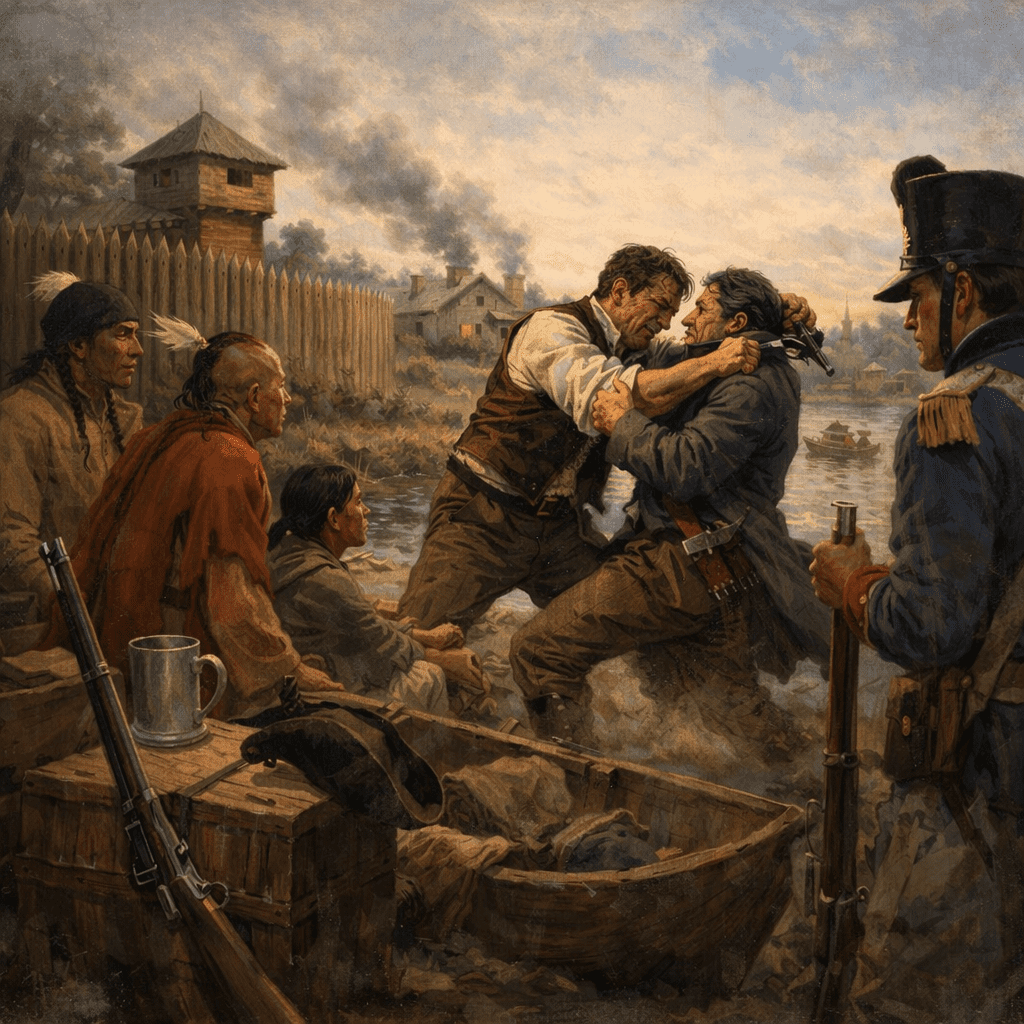
The settlement never pretended to be a city.
It was a scattering of cabins along a bend in the river, fifteen private homes before the war. Timber walls. Fences that leaned. Smoke rising when the wind allowed it.
On the south bank stood Fort Dearborn, near where Michigan Avenue now crosses by way of the DuSable Bridge. The fort did not dominate the landscape. It sat slightly back from the river on higher ground to avoid flooding. Everything inside could be crossed in under a minute.
Across the water, roughly where Pioneer Court stands today, rose the trading house first built by Jean Baptiste Point du Sable. By 1812 it was operated by John Kinzie, who had purchased the old Du Sable property and later folded Le Mai’s cabin into his growing trade. Its shelves held goods that had traveled farther than the settlement itself.
Movement between fort and trading house was constant. Canoes crossed daily, carrying soldiers and civilians alike. Interpreters moved between communities, and trade with the Potawatomi unfolded outside formal military space.
The entire American presence of soldiers, officers, traders, wives, and children, was small enough to be taken in with a single sweep of the riverbank. Fifty or sixty souls lived inside the fort. A handful of trading families laid roots along the opposite bank. Anonymity did not exist.
Inside Kinzie’s store, barrels lined the walls and furs hung from beams. The room smelled of damp wood and tobacco.
Butter was fifty cents a pound.
Flour, ten cents.
Corn ran as high as two dollars and fifty cents a bushel, and tea was forty shillings a pound; a luxury import worth months of a soldier’s pay.
Nothing here was casual. Every item had crossed distance to reach this river mouth.
Inside the fort, officers’ wives kept house within timber walls. Soldiers drilled in a yard no larger than a modern courtyard. Livestock shifted in rough enclosures. Children moved between cabin and shoreline with the freedom small places allow.
And surrounding it all, not in the distance, not as backdrop, was Indigenous ground. Potawatomi presence older than the palisade, older than the idea of a fort, older than the word Chicago spoken in English.
This was not an empty frontier waiting to be claimed. It was inhabited ground, and yet a different order was beginning to take hold along the riverbank.
By 1812, war with Britain had been declared. News traveled slowly. Tension did not. British traders still moved north of the lakes. Tecumseh’s confederacy pressed against American ambition. Supplies inside the fort were counted more carefully. Letters east multiplied.
Daily life continued.
But the settlement remained small enough that conflict had nowhere to dissolve. When a man raised his voice, others heard it. When a contract shifted, everyone felt it. When suspicion entered a room, it did not leave quietly.
Chicago was not yet a city. It had no charter, no mayor, no grid. It had timber, trade, and proximity.
By June of 1812, the tensions inside the fort were no longer abstract.
Nathan Heald commanded the post. Discipline and order rested with him.
Matthew Irwin wrote letters to the east, documenting what he believed were irregularities in trade and influence within the fort.
Across the river, Kinzie had secured the sutler’s contract, granting him exclusive rights to supply the soldiers. His family ties reached into the officer ranks. His trading networks extended north toward British territory.
Moving between these worlds was Jean La Lime, interpreter, trader, long-time acquaintance of Kinzie, and at times aligned with Irwin’s complaints about favoritism and corruption.
A dispute had been brewing between the two old friends, in letters, in contracts, in whispered accusations, long before the men faced one another near the fort’s western gate. It was threaded through trade, authority, and loyalty.
On June 17, 1812, near the western edge of the palisade, Kinzie and La Lime confronted one another.
Witnesses would later disagree about who advanced first. Some claimed La Lime carried a firearm. Others insisted Kinzie approached armed with a knife. The sequence hardened quickly. Clarity never followed. The record never settled.
La Lime was stabbed and died.
Kinzie was wounded.
He fled north, first into the surrounding woods, then toward Milwaukee, and eventually farther west into Indian Territory. In a settlement this small, his absence was immediate and unmistakable.
A hearing was conducted in his absence. There was no civil court in Chicago, no municipal authority to absorb the shock, so the decision rested within the military structure that already governed the fort.
The ruling: self-defense.
It was the first recorded killing at the Chicago River settlement, but the settlement continued to move forward.
The war, however, did not pause for internal disputes.
In August of 1812, orders came down: destroy the surplus. Abandon the post. March south.
The war was not finished with Fort Dearborn.
Leave a Reply