
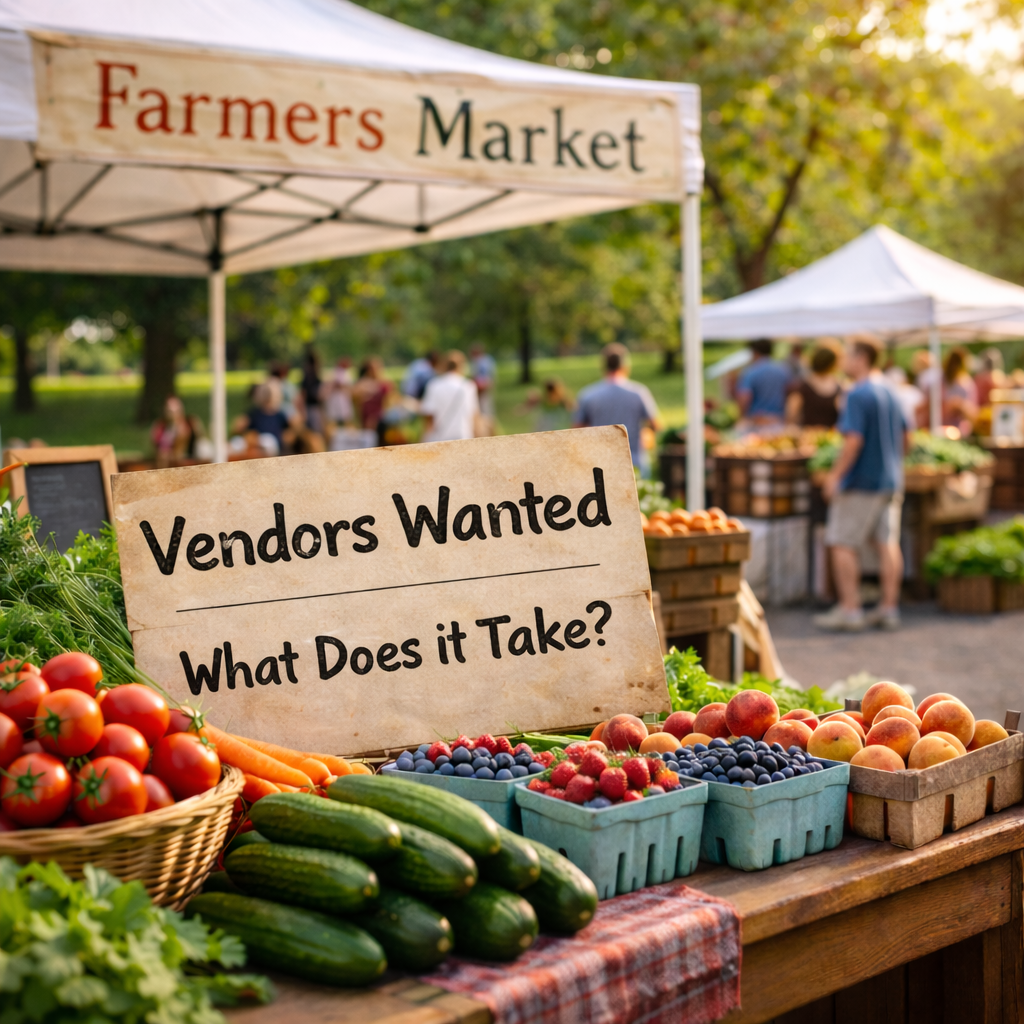
The idea sounds simple enough: bake the bread, bottle the honey, harvest the greens, load up the car, and spend Saturday morning charming strangers from behind a folding table.
In reality, getting into a farmers’ market takes more than a cute tent and a dream.
With the new Eckhart Park Farmers Market launching June 6 in West Town and organizers actively looking for produce vendors, farmers, food entrepreneurs, and artisans, this is a good moment for anyone wondering whether their goods belong at a market table. The short answer: maybe. The longer answer involves applications, paperwork, insurance, health rules, and making sure what you sell actually fits the market. Eckhart’s inaugural market is scheduled for Saturdays from 9 a.m.-1 p.m. through Sept. 19 at 1330 W. Chicago Ave., and the market is still recruiting vendors.
Farmers’ markets are part small-business opportunity, part regulatory obstacle course. The good news is that Chicago does give vendors a path in. The less charming news is that the path usually includes forms, documentation, deadlines, and category-specific requirements. For City of Chicago markets, vendors apply annually, and acceptance is based on factors such as product uniqueness, local relevance, seasonal integrity, professionalism, and prior history with the market when applicable.
That means simply having something to sell is not always enough. Markets want to know what it is, where it comes from, how it was made, whether it adds variety, and whether it fits the event’s character. Chicago’s 2026 info packet says the city is especially open to categories such as fruits and vegetables, bakery items, eggs, cheese, meat and poultry, flowers, plants, honey, prepared foods, soap, skincare, wool and mohair products, value-added goods, and even certain wild-gathered products.
For first-time vendors, the first question is usually not “How much can I make?” It is “What exactly am I allowed to sell?”
That answer depends on both the market and the product.
If you are a grower selling fruits, vegetables, flowers, or plants, you may be asked for a growing calendar, a farm map, and organic certification if applicable. If you sell eggs, there may be additional licensing. If you make jams, jellies, baked goods, honey, sauces, or prepared foods, expect to provide ingredient lists and copies of any applicable certifications or licenses. Vendors offering food samples in Illinois may also need a Farmers Market Food Product Sampling Handler Certificate through the Illinois Department of Public Health. IDPH says the certificate applies to people who unpack, cut, slice, prepare, or distribute food samples, and is valid for 3 years. (Information for USDA Farmers Market Food Safety Tips can be found here. For further information about Illinois’ Farmers Market food safety guide, click the link.)
Then there is insurance, which is where many casual dreamers meet reality.
For City of Chicago markets, accepted applicants are generally required to provide proof of insurance. Follow this link for more information on insurance, liability, and regulations. The city’s 2026 packet lists minimums and additional requirements for some locations
And because this is Chicago, no one is pretending every market works the same way.
Some markets are run by the city. Others are run by neighborhood groups, nonprofits, chambers, or partner organizations. That matters because each one may have its own application process, deadlines, fees, insurance expectations, and vendor mix. Chicago’s vendor FAQs make clear that many markets across the city are independently operated, even though DCASE (Department of Cultural Affairs and Special Events) manages some of the best-known ones.
That brings us back to Eckhart Park.
For vendors hoping to get in front of shoppers on the Near West Side or in West Town, Eckhart may be appealing precisely because it is new. New markets are still shaping their identity, building their vendor base, and figuring out what neighborhood regulars want most. According to organizers, produce vendors and farmers are especially needed, though other food vendors and merchants are also part of the mix. The Eckhart Park Advisory Council website says vendor applications are now open until May1.
So what does it really take to sell your goods at a farmers market?
It takes a product that belongs there. It requires documentation proving you are legitimate. It takes enough organization to survive application season. And it takes a willingness to treat the market not like a hobby table, but like a real business.
It also helps to read every rule before you click submit.
A market may love your candles, cookies, hand-poured syrups, or salsa, but if the category is full, your insurance is missing, your labels are incomplete, or your paperwork lands late, that dream of selling out by noon can die in a PDF attachment before it ever reaches a folding chair.
Still, for the right vendor, farmers’ markets can be one of the most direct and human ways to build a business. You meet customers face to face. You explain what you make. You test products in real time. You learn quickly whether people want another loaf, another bouquet, another jar, another dozen.
And if Eckhart Park’s launch says anything, it is that Chicago neighborhoods are still hungry for markets that feel local, lively, and rooted in the people around them. For sellers with something fresh, handmade, or genuinely worth bringing to the table, this may be the season to apply.

Leave a Reply