
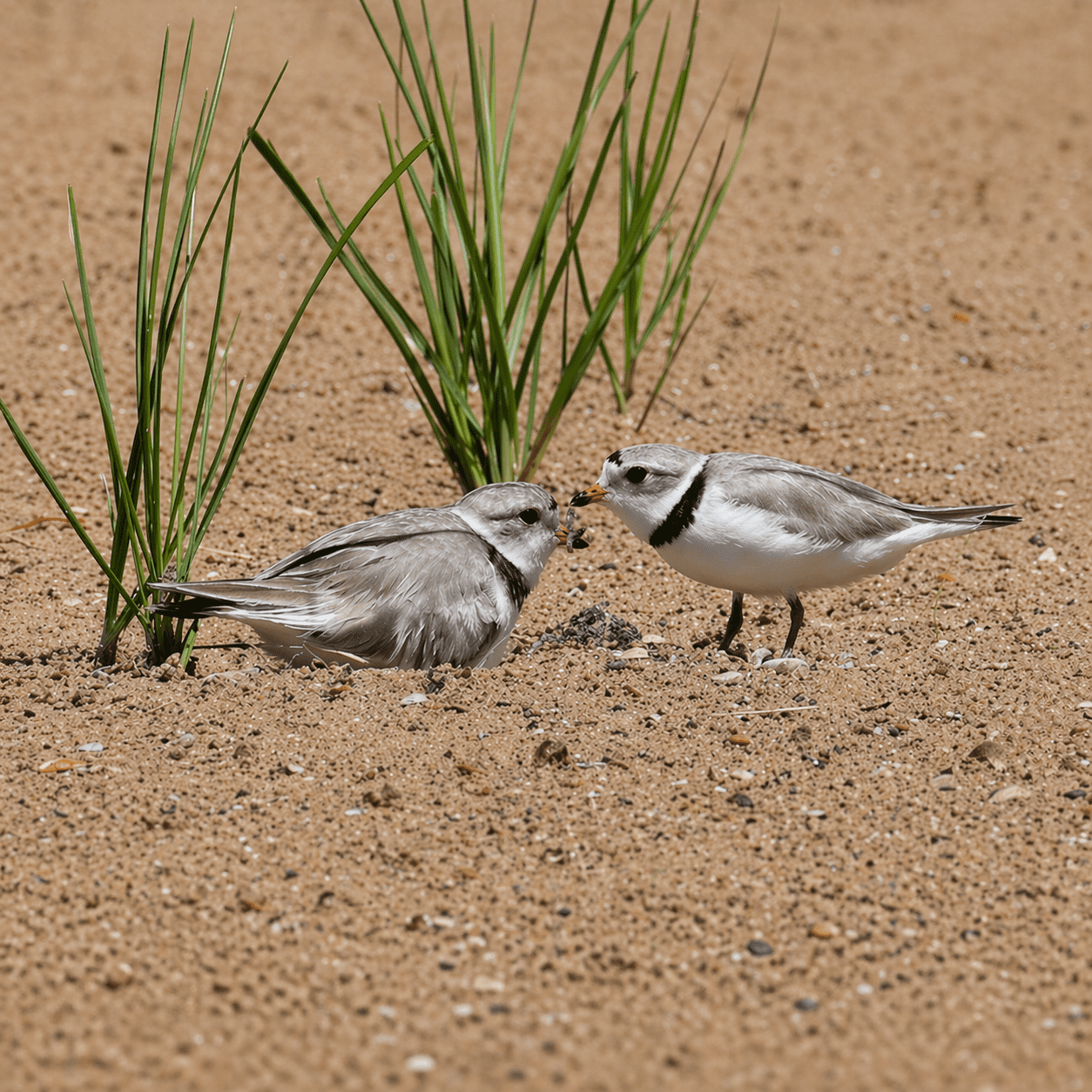
By the time Rose first saw him, the wind had already touched him everywhere.
It had traced the fine line of his feathers, lifted the pale softness of his breast, and ruffled the dark band at his throat with the careless intimacy of something that believed it had known him forever. He stood near the edge of the water like a creature born of light and sand, quick and wary, impossibly small against the vast shimmer of Lake Michigan. There was nothing tame about him. Nothing safe. He was wildness in miniature, all restless motion and instinct and distance traveled. He had come north on ancient longing, carrying in his tiny body the memory of the Texas coast and the stubborn pull of return.
And Rose, graceful Rose, felt the world narrow to the space between them.
She had known distance, too. She had ridden the long ache of migration from Florida, crossing sky and storm and danger to arrive at this loud, improbable shore where the city pressed itself against the lake in a riot of heat, laughter, and motion. Montrose Beach was no place for softness. It belonged to sunburned shoulders and rattling coolers, to music and bicycles and the heedless sprawl of human summer. Yet there he was, standing on the sand as though all the noise had peeled away and only he remained. It was not reason that drew her to him. Romance never bothers much with reason. It was recognition. It was inevitability. It was the first electric pull of a love story already writing itself.
His name would become Monty.
Hers would be Rose.
And because fate occasionally indulges itself in absurd perfection, even their names sounded destined. Monty and Rose. He, with his weathered little heroism, she with her softness and steel. Before the city knew them, before strangers began speaking of them with a protectiveness bordering on devotion, they were simply two endangered piping plovers meeting again on a stretch of beach that should have been far too coarse for tenderness. They had first been linked near Waukegan in 2018, but Montrose would become the true stage of their story, the place where instinct ripened into loyalty and a fleeting pairing deepened into legend.
If Rose had been a woman in one of those glossy old paperbacks, she might have told herself not to trust him at once.
He was too striking. Too wind-battered and self-possessed. Too obviously shaped by a life beyond safety. He belonged to open distances, to storms, to tides, to the dangerous freedom of migration. He was not the sort of hero one could keep. But then, truly irresistible heroes never are. They arrive marked by risk. They make permanence feel like the boldest fantasy of all.
And Monty, for all his rough-edged wildness, turned toward her with the unmistakable attentiveness of a creature who knew exactly what mattered.
That was how it began.
Not with spectacle.
With attention.
With nearness.
With the quiet, breathless miracle of two small beings choosing one another on a beach full of reasons not to.
In 2019, Monty and Rose became the first piping plovers to nest in Chicago and Cook County in 71 years. It was a fact, yes, but facts are such dry little containers for something that felt so lushly improbable. What it meant, in the language of romance, was that after decades of absence, after long silence, after every practical reason to pass Chicago by, love landed on Montrose Beach and decided to stay.
The city never stood a chance.
At first, there was only curiosity. Then fascination. Then the kind of helpless emotional investment that overtakes people when they realize they are witnessing not just wildlife, but devotion. Chicago watched Monty and Rose the way readers linger over beloved lovers who keep finding one another against impossible odds. Volunteers gathered. Monitors kept vigil. Fences rose around their nesting area like the boundaries of some private kingdom. The beach remained noisy, crowded, imperfect, but a little sacred now too, because two tiny endangered hearts had chosen it as the place where their future would be made.
Rose settled into the work of loving with the kind of elegance that makes it look effortless even when it is not.
Monty, restless but steadfast, remained close.
Together they moved through the oldest rituals in the world: guarding, waiting, building, enduring. Theirs was not a glittering, careless kind of passion. It was deeper than that. It was made of return. Of shared burden. Of choosing the same fragile hope day after day. Perhaps that was why Chicago loved them so fiercely. They did not perform romance. They embodied its hardest truth: that love is not merely attraction, but vigilance. Not merely beauty, but labor. Not merely desire, but the brave insistence on building something tender in a world lined with threat.
And threats were everywhere.
Predators. Crowds. Loose dogs. Careless feet. Storms. Noise. The full brute force of human interruption.

Yet they returned.
That is what made them mythic. Not one season, but three. Three summers of choosing Montrose. Three summers of finding one another again despite winter separation, distance, and danger. He in Texas. She in Florida. Then north again, drawn back not just by instinct, but by that same faithful little patch of lakefront where their bond had taken root. Again and again, they came home to each other. Their nesting success also mattered beyond the sweep of the story: Great Lakes piping plovers are federally endangered, and their population, once below 20 breeding pairs, had climbed to nearly 90 pairs by 2025. Monty and Rose became proof that survival itself could feel romantic when it was this hard-won.
For a while, it was easy to believe they would go on forever.
That is always the lie love tells most beautifully.
It whispers that because something is rare, it must be protected by the heavens. That because it has already overcome so much, it will surely be spared the cruelest ending. Rose might have believed such a lie herself if her story had been written in silk and dialogue. She might have lifted her gaze to the horizon and thought, surely not us. Surely not after all this.
But the wild does not spare what we love merely because we love it.
In 2022, Rose did not return.
No line in this story cuts deeper.
She did not return.
Monty came back to Montrose alone, to the same water, the same wind, the same aching strip of sand where their love had once unfolded in plain sight. Absence changed everything. The shore was still beautiful, but beauty without the beloved becomes a kind of wound. And then came the second heartbreak, sharper for following so close behind the first: Monty returned, only to be lost that May after a sudden illness. The hero returned, but the heroine did not. Then the hero fell as well. If some editor had written it that way, readers might have called it too cruel. Life, as usual, did not concern itself with reader satisfaction.
Chicago mourned them with all the raw sincerity of a city caught off guard by its own softness.
Because Monty and Rose had done something extraordinary. They had made a hard place tender. They had made human beings protective rather than possessive. They had turned one busy public beach into the setting for yearning, loyalty, and grief. They had reminded a city that even in a place of steel, traffic, and noise, devotion could still arrive feather-light and ask to be cherished.
And because true romance is greedy for legacy, the story did not end there.
A son returned.
Imani, one of Monty and Rose’s surviving chicks from 2021, came back to Montrose in 2023, then again in 2024, 2025, and this spring, like memory refusing to die. He carried none of his parents’ fame at first, only their bloodline and their improbable instinct for home. In time, he found his own mate, Sea Rocket, and suddenly the old ache of loss was threaded with something gentler, more dangerous, more hopeful: continuation. In 2024 came Nagamo. In 2025, Bean, El, and Ferris arrived, with Bean and El surviving. Love, broken once, had not vanished. It had altered, deepened, and begun again.

So perhaps Monty and Rose were never just birds.
Perhaps they were always what romance has always known how to recognize: two fragile souls finding one another in an inhospitable world and choosing, despite everything, to build a life there.
That is what made their story so intoxicating.
Not that it was cute.
Not that it was famous.
Not even that it was rare.
It was that it was earnest. Risky. Loyal. Windswept. Brief. Beautiful. It held all the elements of grand passion, only scaled down to the size of two tiny birds on a Chicago beach. The dangerous hero. The luminous heroine. The impossible setting. The watchful crowd. The seasons of devotion. The devastating loss. The heir.
Montrose still fills with summer. The city still crowds the shoreline. The lake still flashes silver beneath the sun. But somewhere in the dunes, beneath the noise and motion, the old mood remains. A hush. A memory. The lingering heat of a romance that changed the character of a place.
The wind still comes first.
It slides over the water, over the grass, over the warm sand.
And in that wind, if one is willing to believe in such things, Rose can still feel him.
The wild little hero waiting at the edge of the lake.
The one she crossed a continent to find.
The one Chicago named Monty.
The one she loved on Montrose Beach.
Leave a Reply