
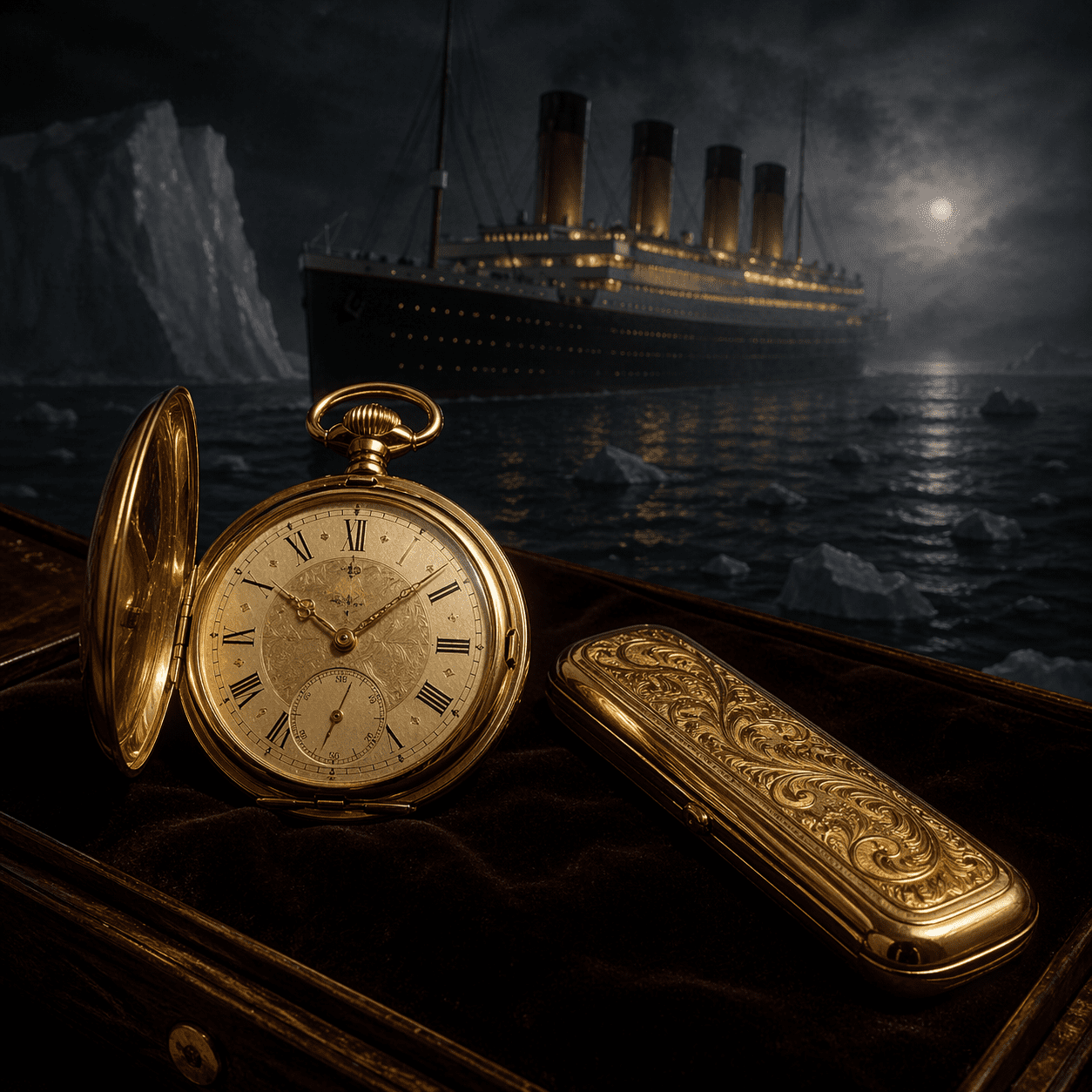
Chicago did not just auction off a pocket watch this week. It sold a piece of suspended time.
At Freeman’s auction house in the West Loop on Wednesday, April 22, John Jacob Astor IV’s 18-karat Patek Philippe pocket watch hammered at $800,000 and sold for a final price of $1 million with buyer’s premium. His gold pencil case sold for $204,800. More than the gold itself, bidders were chasing a direct connection to one of history’s most famous tragedies.
That is what makes this story more interesting than a standard auction result. Plenty of expensive things change hands in Chicago. Fewer arrive carrying the last known hours of a man who stood on the deck of the Titanic, watched his pregnant wife lowered away in Lifeboat No. 4, and never saw New York again.
The watch and pencil had remained in the Astor family’s hands for more than 120 years before this sale, which Freeman’s described as its first time at auction. That long family custody matters. In the world of Titanic artifacts, the history of ownership is not a side note. It is the difference between a relic and a rumor.

John Jacob Astor IV is usually reduced to the same label: the richest man on the Titanic. True enough, but not nearly the whole story. He was also an inventor, a novelist, and a builder whose name was already stitched into New York long before the ship ever left port. He helped shape the city’s hotel world, wrote a science-fiction novel, and held patents of his own. Long before the Atlantic turned him into legend, Astor had already built a life big enough that practically demanded a mythology of its own.
Then came the marriage that made him gossip-page bait. In 1911, after divorcing his first wife, Astor married Madeleine Force, an 18-year-old socialite nearly 30 years younger than he was. The match set off exactly the kind of scandal Gilded Age society claimed to despise while devouring every detail of it. The couple spent time abroad in part to escape the gossip, and while they were away, Madeleine became pregnant. They boarded the Titanic in Cherbourg on April 10, 1912, bound for America.
That detail changes the emotional weather of the whole story. This was not simply a millionaire returning from a glamorous tour. It was a husband and wife on their way back for a birth, carrying all the ordinary hope that makes catastrophe feel especially cruel. Britannica’s timeline notes that when Lifeboat No. 4 was prepared, Madeleine, about five months pregnant, was helped aboard by Astor. He asked whether he could accompany her. He was refused. He did not argue. He stepped away.
And that is where the watch stops being jewelry and becomes a witness.
Not a witness in the legal sense. Witness in the older, heavier sense. It was there. It rode in the pocket of his blue serge suit while the ship struck the iceberg. It remained with him as the band played, as lifeboats were lowered half full, as first-class certainty dissolved into cold black water. When Astor’s body was recovered by the cable ship Mackay-Bennett days later, officials found on him the watch, the gold pencil, and other personal effects. Those objects crossed from luxury items into something stranger: they were survivors without breath. That may be why the sale landed so hard.
The craftsmanship also mattered, of course. Patek Philippe and Tiffany & Co. are not exactly names that need introduction. But no bidder was chasing this watch because it was the best technical object in the room. They were chasing the unbearable intimacy of it. The initials on the case. The documented chain of family ownership. The knowledge that this small, elegant machine was once tucked against the body of a man who believed, at least for a little while, that his wife would be safe and he might still follow her.
There is also something fitting about this sale happening in Chicago, a city that has always understood the seductive power of objects with a backstory. Chicago loves its architecture, its ruins, its relics, its places where history feels like it might still be hiding in plain sight behind a brick wall or under a layer of polish. So, of course, there is something almost theatrical about Astor’s watch resurfacing here, in the West Loop, more than a century after the Atlantic closed over the Titanic at 2:20 a.m. on April 15, 1912.
And yet the sale also says something less glamorous. The market keeps proving that the Titanic memory is not fading. It is maturing into an industry of grief, fascination, and possession. In 2024, a different watch associated with Astor sold for about $1.5 million, and that same year, a watch gifted to Carpathia captain Arthur Rostron set a new Titanic memorabilia record at nearly $2 million. The appetite is still there. Maybe stronger than ever. People do not just want the story. They want to hold a piece of it, display it, inherit it, and, if they can afford it, own it.
Still, there are worse things than wanting to touch the past. Especially when the past arrives in such a precise and haunting form. A gold watch. A gold pencil. Two objects made for the routines of a rich man’s day: appointments, notes, signatures, errands, and plans. Then history stepped in and changed their job description forever.
Now they no longer tell time.
They tell about time, about the Gilded Age, about wealth, about the illusion of safety, and about the strange democracy of disaster. They remind us that even the richest passenger on the most famous ship in the world could not buy one more hour.
Leave a Reply