
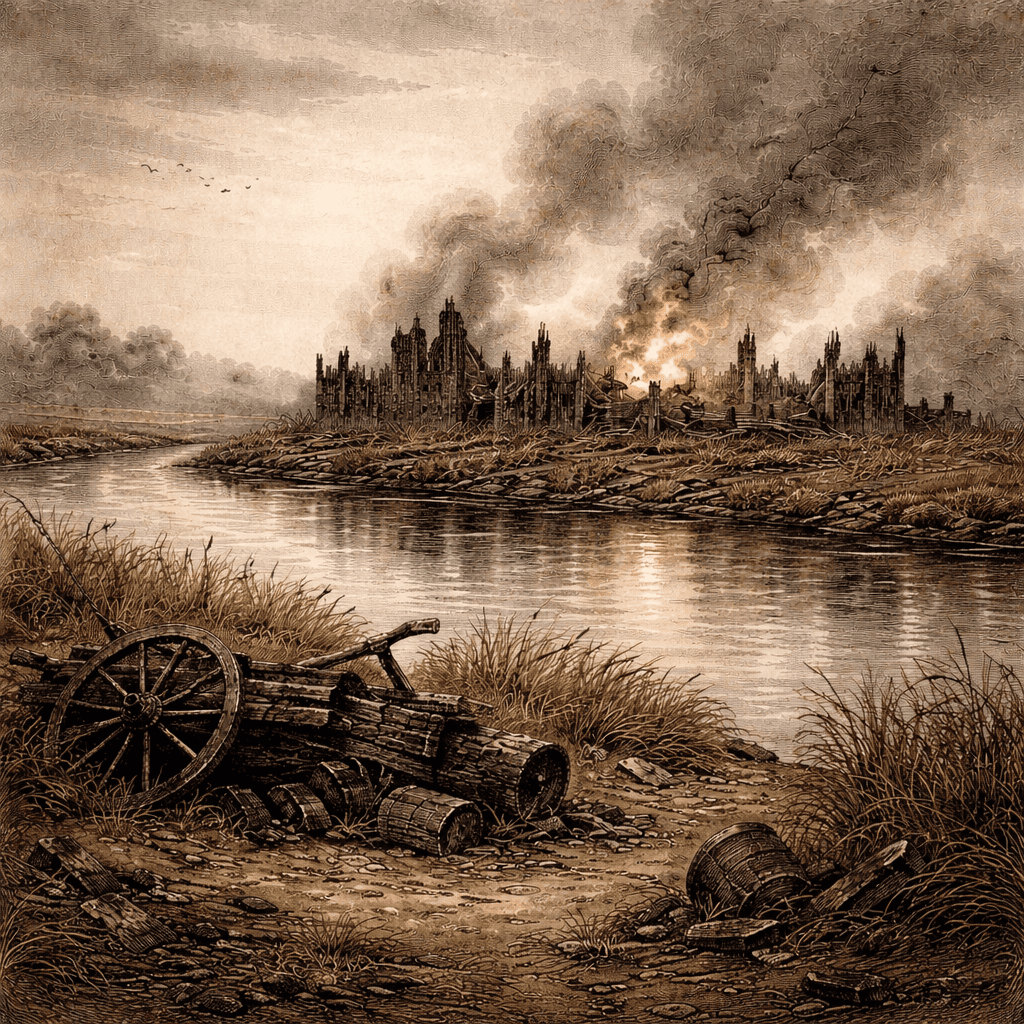
On the afternoon of August 15, 1812, the smoking timbers of Fort Dearborn drifted out over the prairie and the waters of Lake Michigan.
By then, the fighting along the dunes south of the Chicago River had already ended. What had begun that morning as an evacuation from the fort had turned into a violent clash that wiped out the little settlement beside the river.
By nightfall, everything was gone.
The wooden walls of the fort had burned. Barracks and storehouses collapsed into ash. Wagons that had once rattled through the settlement lay overturned in the sand along the lakeshore. Soldiers, settlers, and traders who had lived beside the river were either dead, taken prisoner, or scattered across the frontier.
Chicago, if it could be called that in those days, had nearly vanished in a single day.
Before the battle, there had been perhaps fifteen homes along the riverbank.
After the smoke cleared, only four buildings remained standing.
A strange quiet settled among the ruins and ashes.
For the next four years, the mouth of the Chicago River looked less like a settlement and more like a relic.
The prairie wasted little time reclaiming what people had tried to build. Paths disappeared beneath tall grass. Fences sagged and fell. Wind from the lake pushed sand and weeds across the blackened ground where the fort had once stood.
Travelers who passed through the region sometimes stopped beside the river and looked over the remains.
Charred timbers.
Collapsed palisade walls.
An empty bend of water flows quietly toward the lake.
It was hard to believe that only months earlier, soldiers had drilled there, traders had argued over prices, and children had played beside the riverbank.
Had Chicago died, or was it simply taking a breath from the world, waiting for its next chapter?
One lonely structure still stood near the north bank of the river: the trading house tied to the family of frontier trader John Kinzie.
Kinzie himself had fled the region after the battle, but the building remained.
Some old accounts say voyageurs and traders moving through the Chicago Portage occasionally used the cabin as a temporary shelter. Imagine it for a moment: a single weathered house beside a wide prairie river, its doors creaking in the wind while travelers passed through the silent portage between the Great Lakes and the Mississippi watershed.
No voices.
No wagons.
Just the wind moving through tall prairie grass.
The world may have forgotten, but the land still remembered the road.
That road, the Chicago Portage, was the reason the place could never remain empty forever.
Long before a city stood there, the route linking Lake Michigan to the Des Plaines and Illinois Rivers had been one of the most important pathways through the interior of the continent. Canoes, traders, and travelers continued to slip quietly through the region even while the settlement itself lay abandoned.
The river, as it always had, kept drawing people back.
With it came stories.
Frontier stories of bravery and survival traveled faster than soldiers.
One of the most widely repeated centered on the death of William Wells.
Wells was a complicated figure even by frontier standards. As a young man, he was raised among the Miami and adopted by the renowned Miami leader, Little Turtle. By 1812, he had returned to serve the United States as a soldier and scout, a man who understood both sides of the frontier better than most officers.
According to several accounts, Wells blackened his face with gunpowder before riding out with the evacuation column, a grim signal among some frontier fighters that they did not expect to return.
He was killed during the fighting along the dunes.
Stories spread across the frontier that warriors removed his heart as part of a ritual meant to absorb the courage of a respected enemy. Whether every detail of the tale was true or embroidered over time, the story clung to Wells’s memory and became one of the darker legends tied to Chicago’s earliest battlefield.
Frontier history, like a campfire tale, tends to hold onto its shadows.
Not every story from that day ended in tragedy.
Several survivors owed their lives to the intervention of Potawatomi leader Alexander Robinson, who helped members of the Kinzie family escape the chaos that followed the battle. Through his actions, they were able to leave the ruined settlement and reach safety.
Other captives were carried far from the river, eventually reaching Detroit, which at the time was under British control during the War of 1812.
For many of them, the Chicago River became only a distant memory.
By the time the war ended in 1814, the ruins of Fort Dearborn had been standing empty for nearly two years.
The Chicago River continued flowing quietly past the burned ground. Traders still passed through the portage. But the settlement itself had not returned.
American officials, however, understood that the mouth of the river could not remain unclaimed forever.
In 1816, the United States negotiated the Treaty of St. Louis with the Ottawa, Chippewa, and Potawatomi nations. The agreement ceded a strip of land ten miles north and south of the Chicago River, placing the strategic portage firmly under American control.
American officials understood something about the Chicago River that few people outside the frontier fully grasped. Whoever controlled that narrow portage between the Great Lakes and the Mississippi River system controlled one of the most valuable transportation corridors in North America.
Soon afterward, soldiers returned to the skeletal ruins beside the river.
Charred timbers lay scattered across the ground where the fort had once stood. Prairie grass had begun to grow through the blackened earth.
And there, beside the quiet river, the United States Army began building again.
The second Fort Dearborn would rise from the ashes of the first.
Chicago, nearly erased from the map in 1812, was about to begin its story all over again.
The river, after all, had been waiting.
Leave a Reply