
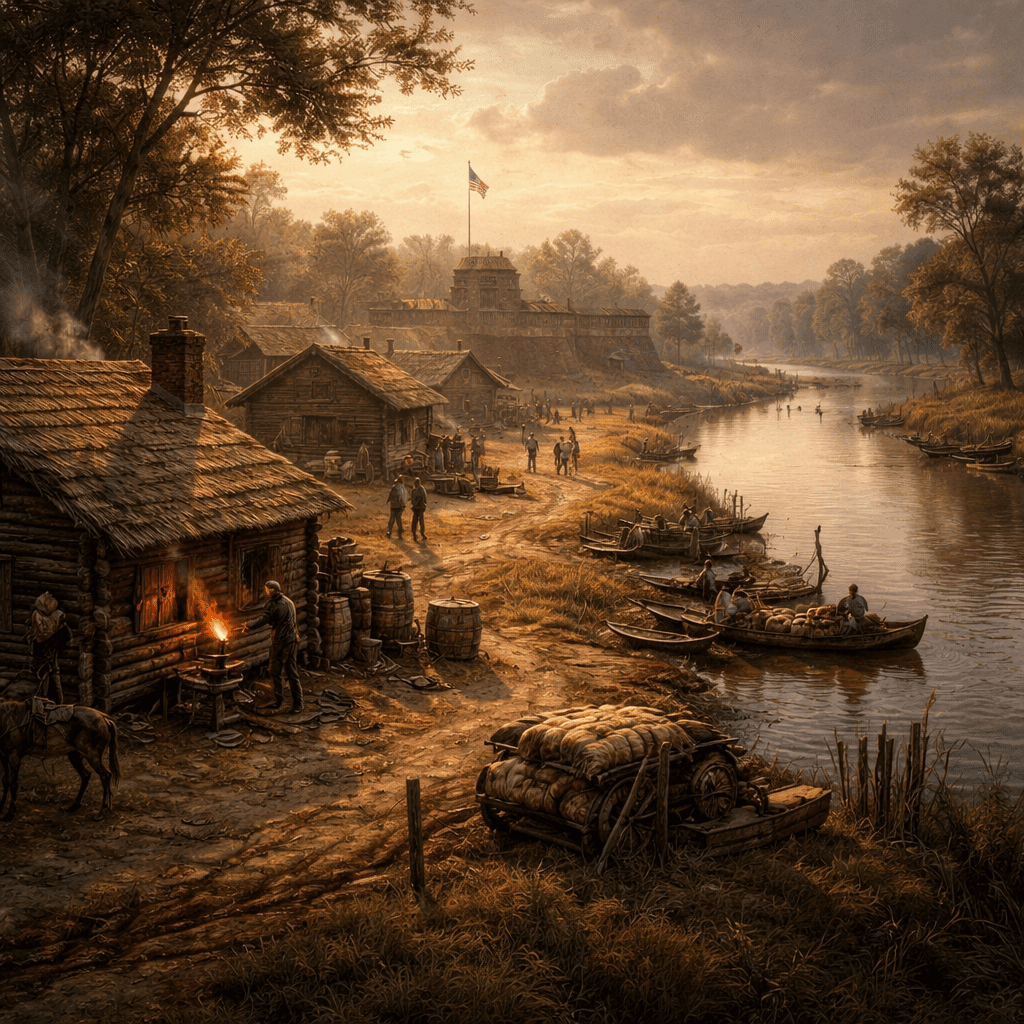
The war had burned that rough little outpost down, but it had not destroyed the wind-beaten patch of ground.
That is the thing about Chicago, even in its earliest days. Before it was a city, before it was a headline, before anyone ever tried to sell it as destiny, it was already a place that refused to stay dead. The ashes of Fort Dearborn still lay in memory, the prairie still bent under the wind, and the river still did what rivers do best: ignore human grief and keep moving.
So when the War of 1812 ended and the soldiers came back in 1816 to rebuild Fort Dearborn, they were not returning to a blank page. They were returning to a warning. They were raising fresh timber on haunted ground.
And with them came the first stark signs that Chicago was beginning again, not in glory, but with hammers, sweat, and necessity, the way frontier places always begin. Long before Chicago filled with traders, speculators, and dream sellers, it needed a man with a hammer, a fire, and a steady hand. David McKee came to serve as a government blacksmith and opened the area’s first blacksmith shop as the settlement began to gather beyond the rebuilt fort. On that raw military outpost at the edge of mud and water, iron mattered more than speeches. Guns needed tending, tools needed shaping, horses needed shoes, and wagons needed repair.
And John Kinzie, slippery as ever, came back too.
He had already survived more than most frontier men could have boasted without sounding like liars. After the destruction of Fort Dearborn, Kinzie made his way to Detroit. In 1813, the British arrested him for treason and put him aboard a ship bound for England. What happened next had the shape of legend, though it was lived in flesh and bone. When the ship moored in Nova Scotia during a storm, Kinzie escaped. Somehow, perhaps miraculously, he made his way back to American-held Detroit by 1814. By 1816, he had returned to Chicago with his family, ready to take up his place again in the fur trade and in the half-wild world forming around the rebuilt fort.
Then came something quieter, and perhaps more lasting.
William Cox, a discharged soldier, opened what old accounts remember as Chicago’s first regular school. The fort had barely risen again from its own ruin, and already someone was trying to teach children their letters at the edge of the wilderness. Not in a polished schoolhouse with a bell tower and neat windows, but in a place where danger was still recent enough to have names and faces. The little log building, once used as a bakery, stood at the edge of the Kinzie settlement, behind the garden, near what is now the corner of Michigan Avenue and Pine Street. Cox taught the Kinzie children and the children of that small settlement clustered around the fort. Chicago did not begin with soldiers and traders alone. It began, too, with parents who expected a future.
That return says as much about early Chicago as any treaty ever could.
Still, the treaties mattered.
In 1816, the Treaty of St. Louis handed the United States control of a crucial corridor linking Lake Michigan to the Illinois River. On paper, it was just another yielding of land in a long, sorrowful chain. In truth, it was one of those quiet moments on which much would turn. The government was not merely reclaiming a fort. It was securing the route that would one day make a canal possible and turn this muddy outpost into the narrow gate between the Great Lakes and the Mississippi Valley. Chicago’s destiny, if one insists on using that word, was not born in romance. It was surveyed, ceded, and measured in corridors of land.
And then, in 1817, Jean Baptiste Beaubien came down from Milwaukee and entered the story.
Beaubien belonged to the fur trade world the way smoke belongs to fire. He arrived in Chicago to work in that trade and soon established himself as one of the settlement’s central early figures. Long before the town had any right to call itself a town, much less a city, men like Beaubien were already using Chicago as a commercial foothold: small, muddy, cobbled together, but useful. He would become connected to the American Fur Company, and his early post helped knit Chicago back into the wider trading web that linked the lakes, the prairies, and the interior. The outpost was still rough enough to be more encampment than settlement, but men like Beaubien understood what mattered: the location, the movement, the exchange. Chicago was valuable long before it was beautiful.
The life that returned after the war did not come back all at once. It came back in fragments.
A fort.
A forge.
A school.
A trader’s post.
A family bold or foolish enough to return.
A government increasingly determined to hold the ground.
A handful of children learning their lessons in a place that had recently watched people die for trying to leave it.
And beneath all of it, the older truth remained. This land was not suddenly important because Americans rebuilt a fort on it. It had been important long before that. Native nations knew it. Traders knew it. The French knew it. The British knew it. The Americans simply arrived late and then acted as though discovery had happened the moment they noticed.
The Chicago of 1816 and 1817 was not yet a city on the rise. It was a scar beginning to heal. It was a little cluster of cabins, commerce, memory, and military purpose gathered beside a river that still behaved more like a swampy argument than a civilized river fit for town life. But already the outlines were there for anyone with the sense to see them.
Iron.
Children.
Trade.
Land.
Return.
Those are not glamorous beginnings.
They are better than glamorous. They are true.
And maybe that is the real beginning of Chicago after the war: not the dramatic burning of the fort, not even the rebuilding itself, but the stubborn decision of people like McKee, Cox, Beaubien, and Kinzie to act as if this bruised little outpost was still worth the trouble.
Because once they returned, Chicago did what it would keep doing for generations.
It started over.
And then it started over again.

Leave a Reply