Ah, baseball season. America’s pastime, America’s game, the grand old game, the show, and in my book, America’s largest organized nap. I am sure the sport inspires deep passion in plenty of people, but for me, the main attraction has always been the food.
Back in college, I had a friend whose father worked for the Secret Service, and for reasons I never fully questioned, that translated into free tickets to games and social events. One year, we landed seats for the Crosstown Classic, Chicago’s favorite excuse for public baseball tribalism. Cubs fans, White Sox fans, endless trash talk, and everyone is absolutely convinced their side is morally superior.
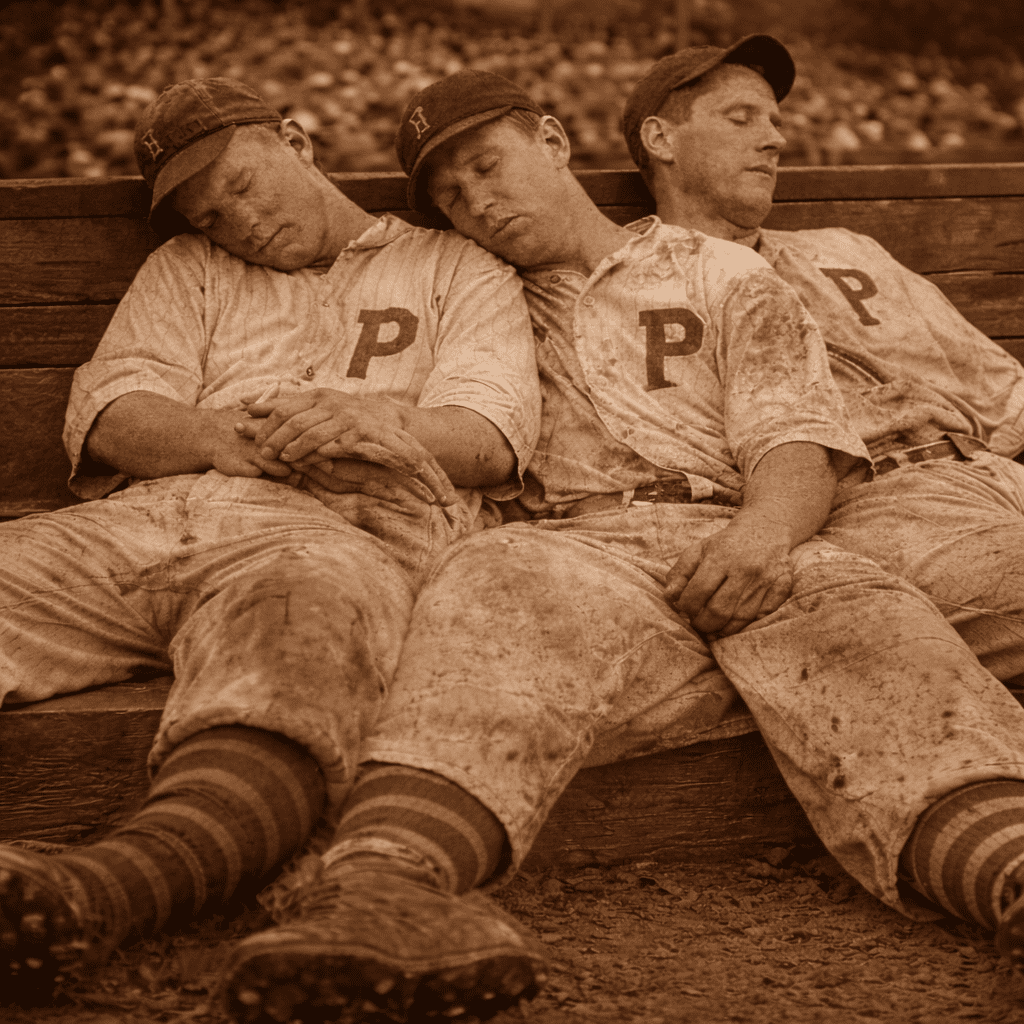
Our seats were incredible, three rows behind home plate. We showed up armed with sunscreen and enough money for beer and hot dogs, which, as far as I was concerned, was the real game plan. We ate, we drank, and by the third inning, we were dead asleep.
Somehow, we managed to wake up for the seventh-inning stretch, participate just enough to seem respectable, and then drift back into our ballpark coma before trudging back to the car. A truly punishing day at the park.
This was not the first time, nor would it be the last, that this little ritual repeated itself. To this day, an afternoon at the ballpark automatically turns into an afternoon of gloriously slovenly behavior. And because the universe clearly has a sense of humor, I married a baseball fanatic.
My husband grew up next door to Wrigley Field. For him, summer meant alleyball, neighborhood kids everywhere, and the occasional Cubs player stepping out to play catch with the local packs of children.
That kind of nostalgia goes a long way in explaining baseball’s hold on people, because if the game relied on speed alone, it would have been dead years ago.
Baseball did not become America’s pastime because it is fast. If anything, speed is the last word that comes to mind. Baseball has always been less about nonstop action and more about tradition, ritual, and habit. It is a sport built on counting pitches, tracking ERAs, and dissecting batting averages, which is not exactly the kind of thing that screams fun to the uncommitted. For Pete’s sake, even the bases are numbered. I know three people who get truly excited by numbers: two are engineers, and the other is a math teacher. Thank goodness hot dogs and beer somehow taste better at the ballpark, because without them, it is hard to say what else would lure some people back. Although, to be fair, a weekday day game has always been a pretty solid excuse to miss work.
It is too slow. Too long. Too full of rules that sound made up by men arguing in wool pants in 1845. And yet here we are. Baseball still clings to American life like mustard on a hot dog, refusing to be replaced by faster, louder, flashier things.
Its roots trace back to older bat-and-ball games, but by the mid-1800s, organized rules helped turn a scattered pastime into something recognizable, repeatable, and deeply American. Clubs formed, rules were written, and before long, baseball was spreading through cities and small towns alike, embedding itself into summer, family tradition, neighborhood pride, and a national identity that loved ritual almost as much as competition.
It hardly needs a tidy origin myth. It was built the way many American traditions were built, gradually, noisily, and with plenty of people insisting they were the ones who really started it.
Baseball is, when you strip away the nostalgia and statistics, basically a game of big boys playing in the dirt. Expensive uniforms, professional contracts, packed stadiums, and at the center of it all, men sliding around in dust like recess never really ended, which may be part of its charm. I still don’t get it.
There is something almost ridiculous about that when you stop and think about it, and maybe nothing captures baseball’s strange mix of tradition and absurdity better than the fact that before a single Major League ball is used, it gets rubbed down with mud.
Not just any mud, of course. A very rare and highly guarded, secretive mud. Lena Blackburne Baseball Rubbing Mud to be exact. It has been used in the majors since the 1930s to take the slick gloss off new baseballs and improve pitchers’ grip. Its source remains deliberately secret, though its story is usually traced back to a former player and coach, Lena Blackburne, who remembered a particularly fine, dark mud from Pennsauken Creek, a Delaware River tributary in South Jersey. What began as a practical fix for shiny, slippery baseballs became one of the game’s oddest and most beloved traditions.
Because after all, baseball is not just a sport. It is a museum with hot dogs. A place where people casually discuss earned run averages, pine tar, obscure playoff formats, mysterious mud, and songs everybody knows even if they cannot remember all the words to our national anthem. So before anyone starts acting too confident, here are a few questions to separate the real fans from the people who just show up for the snacks and the seventh-inning singalong.
Baseball Trivia for People Who Think They Know Baseball
1. What year was Major League Baseball officially founded?
Answer: 1903 is the cleanest answer for modern MLB as we know it, though the American League itself was founded in 1901 and the first official World Series was played in 1903.
Baseball loves nothing more than making a simple question require a footnote.
2. What is MLB’s championship series called?
Answer: The World Series.
An ironic contradiction considering all the teams involved are from the United States.
3. What is the maximum number of innings in a regulation game?
Answer: Nine.
After that, everybody is in extra innings, extra stress, and possibly extra beer.
4. What is the oldest active MLB ballpark?
Answer: Fenway Park.
Still standing, still iconic, and still treated like a cathedral by people willing to pay a fortune for a hot dog and a sunburn.
5. What playoff round leads directly into the World Series?
Answer: The League Championship Series: the ALCS or NLCS.
In other words, the final doorway before October heartbreak becomes fully national.
6. What is a perfect game?
Answer: A game in which one pitcher retires every opposing batter without allowing a hit, walk, hit batter, or baserunner of any kind. MLB notes that there have only been 24 perfect games in AL/NL history.
It is basically baseball’s version of spotting a unicorn. For the rest of us, a perfect game would be upgraded stadium seating with recliners and DoorDash delivered right to our seats.
7. How many teams are in the MLB?
Answer: 30.
Enough to inspire loyalty, rage, bad predictions, and family arguments at holidays.
8. What is the most common material used for bats, and why?
Answer: Wood. In modern MLB, maple has largely become the preferred wood because it is dense and strong, while ash and birch are also used.
Nothing says timeless sport quite like men choosing lumber with the seriousness of medieval weapon makers.
9. What is a cycle?
Answer: When a player hits a single, double, triple, and home run in the same game.
It is the baseball version of completing a scavenger hunt while everyone politely loses their minds.
10. What is the distance between each base in a standard diamond?
Answer: 90 feet.
Ninety feet between bases, and somehow still a mile when somebody is trying to beat the throw.
11. What award goes to the league’s best fielder at the end of the season?
Answer: The Gold Glove Award.
A little recognition for the players who make the hard plays look easy.
12. The designated hitter bats in place of what position?
Answer: The pitcher.
Which makes no sense to me, given that the pitcher should be an expert on pitches.
13. Which base is stolen the most? Why?
Answer: Second base because it puts the runner in scoring position
14. During which inning is “Take Me Out to the Ball Game” traditionally sung?
Answer: The seventh inning stretch or the bottom of the seventh.
A tradition that somehow finds thousands of people confidently singing every word, even though half of them could not get through the national anthem without mumbling.
15. What is a full count?
Answer: Three balls and two strikes.
The baseball equivalent of a dramatic pause before somebody does something expensive.
16. How many defensive players are on the field for one team at a time?
Answer: Nine.
Nine. Not ten. Not a nice, even number. Just nine, because baseball refuses to make anything simple.
17. Which position player is known as No. 1 on the diamond?
Answer: The pitcher.
18. How many pitchers are usually in a starting rotation?
Answer: Five.
Five, so each starter has time to rest between outings because even baseball realizes that pitchers cannot throw forever without a break.
19. What is a fielder’s choice?
Answer: A play on which the defense chooses to try for an out on another runner instead of the batter-runner, allowing the batter to reach base.
In plain English: you got on base, but nobody is giving you full credit for it.
20. What is a sacrifice fly?
Answer: A fly ball that is caught for an out but allows a runner to score after the catch.
A strangely noble little moment in a sport not otherwise known for emotional generosity.
How did you do? My resident expert husband, who learned to catch before learning to walk, scored a fifteen. Not bad.
Still, for all its history and loyal following, baseball has always occupied a category all its own.
Football is violence with branding.
Basketball is speed, swagger, and momentum.
Hockey is ice dancing performed by people with anger issues.
Baseball, on the other hand, is ritual. It is memory. It is statistics, superstition, nostalgia, and the stubborn belief that a man adjusting his batting gloves seventeen times before a pitch is somehow essential to the integrity of the sport.
It has always been a strange mix of history, ritual, precision, and nonsense, which is exactly why people keep loving it. It is a game built on numbers, but somehow still powered by memory, superstition, and mud from a secret location. Honestly, what is more American than that?

Leave a Reply