
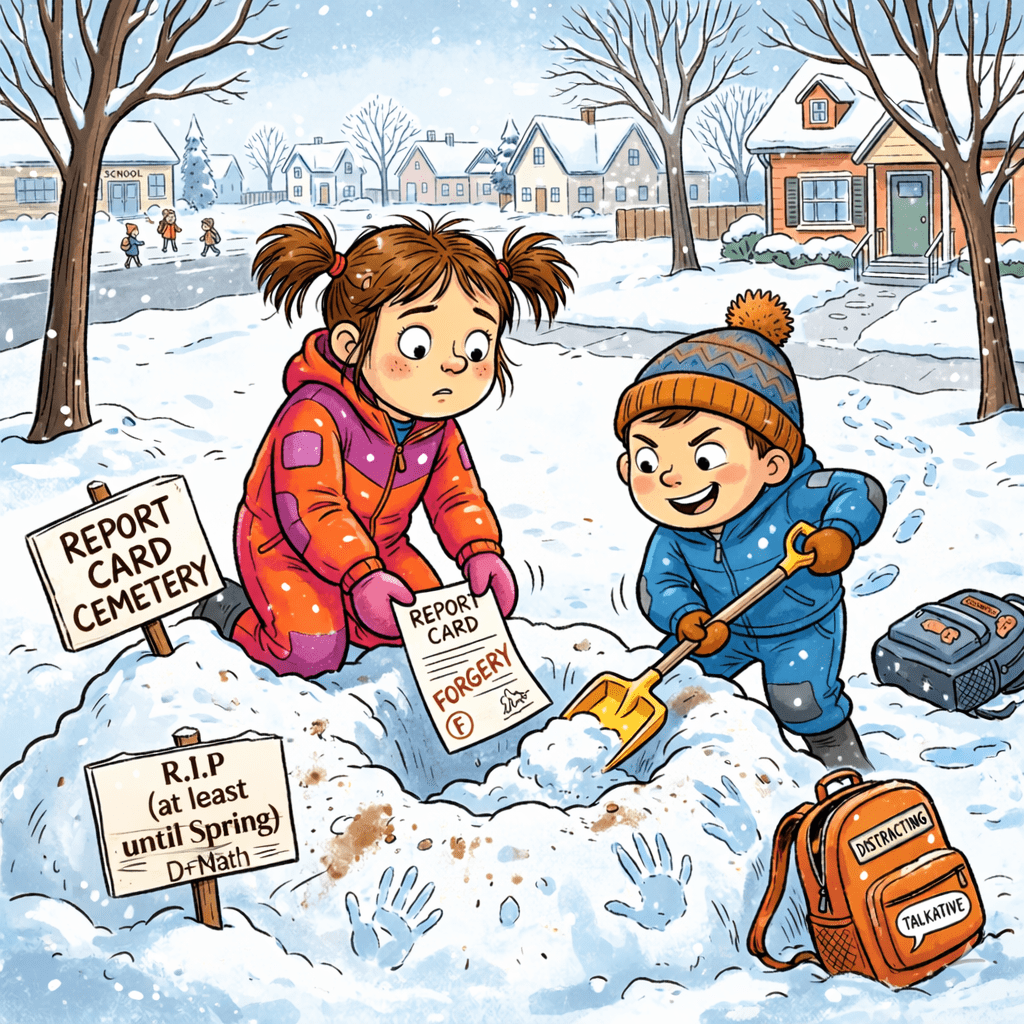
There are few sounds in childhood more terrifying than a teacher saying, “It’s report card day! Take this home and have your parents sign it.”
That thin sheet of folded paper had the power to ruin an entire weekend.
My report cards all said basically the same thing, year after year, as if every teacher I ever had had gathered in a secret meeting and agreed on a standard script for me. The wording varied, but the theme never did: Anna talks too much. Anna does not pay attention. Anna is easily distracted. Anna could do better if she applied herself, which was teacher code for this child appears to be here against her will.
Honestly, fair enough.
I talked too much. I did not pay nearly enough attention. Sometimes I did not pay attention at all. School, for me, was less a place of learning and more an exercise in endurance. I was in survival mode. If I did not find some way to pass the time, I was going to die of boredom right there at my desk under the watchful eye of a teacher, or whichever exhausted adult had drawn the short straw that year.
My brother, though, was operating on an entirely different level.
I was distracted. He was distracting.
He was not bad. He was not a menace. He was not the kid setting fires in the bathroom or throwing chairs through windows. He just was not mentally all there. His body may have been sitting in class, but his mind had left the building sometime around September and did not return until June.
Which meant report card day was never just report card day.
It was judgment day.
Back then, schools did the unthinkable. They handed report cards directly to children and trusted them to get those cards home, present them to their parents, and bring them back signed. That system alone should have disqualified an entire generation of adults from ever criticizing kids for making poor choices.
It left room for imagination, and if you were my brother, endless possibilities.
He treated report card delivery like a creative writing assignment. Grades could be adjusted with shockingly little equipment. An F could become an A with a scrap of carbon paper and enough nerve. A D could edge its way toward respectability with the careful use of a slab of pink eraser. He even took a crack at signing for our mother, who, according to the kind of excuse-making logic only children think is convincing, had apparently been on her deathbed since pre-K.
I watched all of this with the awe one reserves for either artists or criminals.
Still, the best part of report card day was not the forgery. It was the walk home.
We lived in the exact middle of our own small academic disaster. The elementary school was one mile north. The middle school was one mile south. Our house sat right at the midpoint, which meant no matter which school we were coming from, we had exactly one mile to delay the inevitable.
And delay it we did.
We counted steps. We counted sidewalk cracks. We threw our backpacks as far as we could and walked to where they landed, then threw them again, turning one mile into our own personal Hundred Years’ War. We stretched fifteen minutes into an hour through pure commitment to not arriving.
But winter report card days were the stuff of legend.
Those days were not ordinary walks home. They were full productions.
There were snow angels in every front yard we passed, on both sides of the street, whether the homeowners approved or not. There were snowball fights that quickly turned personal. There was face washing in snowbanks, retaliatory shoving, dramatic accusations, and enough carrying on to make it look like we had escaped a mountain expedition instead of math class.
But the true masterpiece, the thing that elevated winter report card day into art, was the hunt for the perfect snow pile.
That hunt began the minute we left school grounds.
We were not just looking for any old pile of plowed snow. No. This required standards. The bank had to be deep enough to bury a report card completely. It had to be far enough from school that no teacher would ever stumble upon it. It had to be far enough from home that if the temperature climbed overnight and the thing thawed loose, the soggy evidence would not be recognizable enough to somehow find its way back to us.
Location mattered. Depth mattered. Cover mattered.
This was the strategy.
We searched with purpose, scanning every mound like archaeologists in reverse. We did not want to uncover anything. We wanted something gone.
And once we found the right snowbank, the burial began.
Mittened hands dug a tunnel into the cold center of the pile. The report card was folded, slid into the hollow, and packed over with fresh snow until every trace of it disappeared. Then came the finishing work. The surface had to be smoothed. The edges had to be blended. No suspicious dents. No sloppy scrape marks. The whole thing had to look natural, untouched, innocent.
A stranger walking by would see a dirty suburban snow pile.
We saw a vault.
It was beautiful, really. Two underwhelming students roaming the neighborhood like tiny mobsters, looking for the perfect place to make the evidence disappear.
By the time we got home, our gloves were soaked, our faces were frozen, and the report card was, ideally, resting in a cold grave somewhere between school and the driveway. For a few glorious hours, maybe even over an entire weekend, there was peace. The truth had been postponed. Judgment had been delayed. Winter, for once, was on our side.
Of course, nothing stayed hidden forever. Report cards have a way of resurfacing, whether from a backpack, under a bed, or by way of the dreaded teacher phone call, an outcome our young brilliance never bothered to account for. But that walk home was its own little act of resistance. It was dread, imagination, and childhood panic all rolled into one long mile.
I may have been a terrible student. My brother may have been worse. But if there had been a grade for creative avoidance, strategic delay, and advanced snowbank concealment, we would have brought home straight A’s.
Signed, of course, by our poor dear mother who suffered from everything from trembling hand disease to progressive, irreversible blindness.

Leave a Reply