
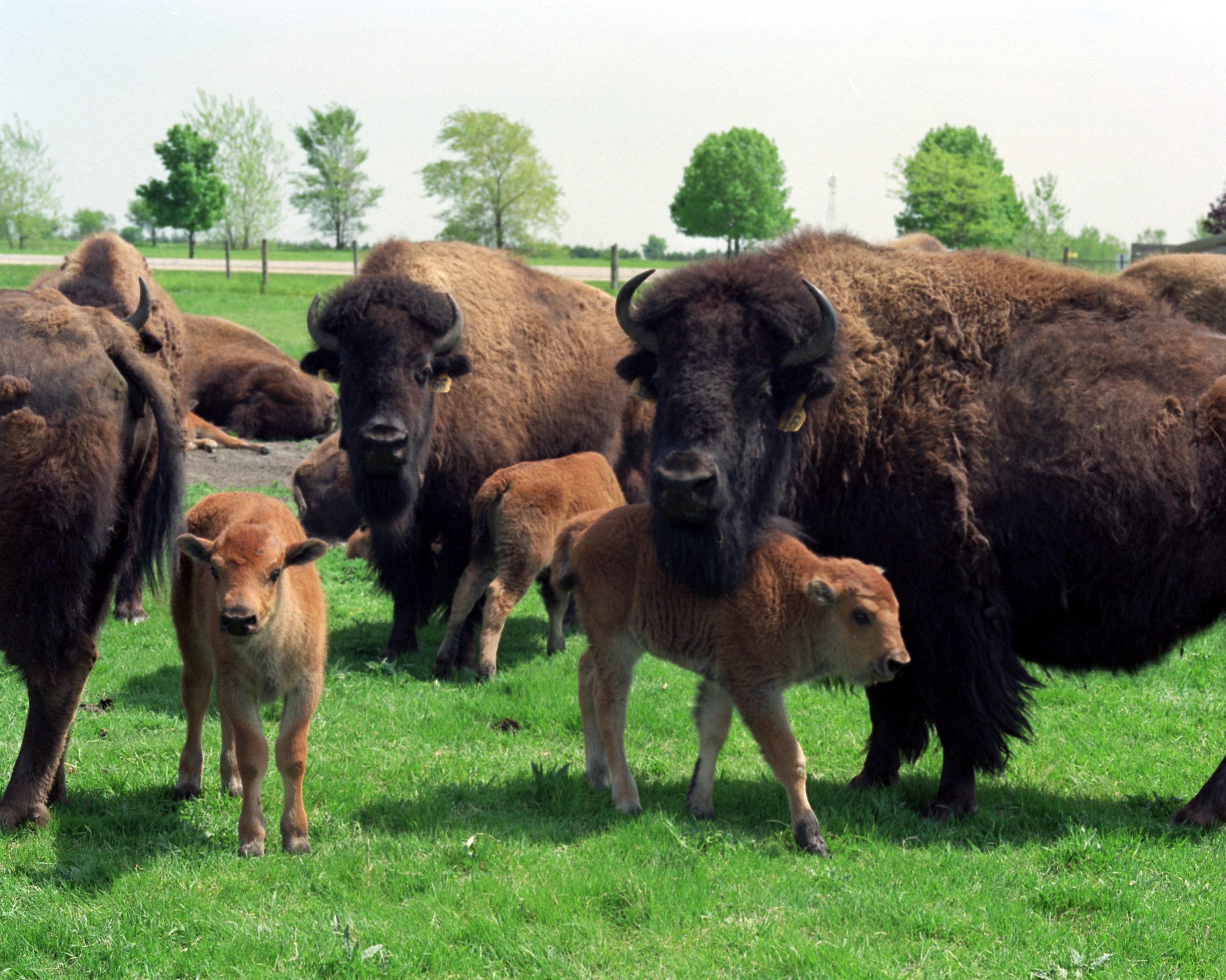
For the first time in more than 200 years, bison are once again setting hoof on prairie in Kane County, and frankly, it is about time. After two centuries of plows, pavement, and people treating the prairie as just empty space waiting to become something else, one of its original architects has returned to the Burlington Prairie Forest Preserve.
In December, six bison were released onto the land in a major restoration effort led by the Forest Preserve District of Kane County, the American Indian Center of Chicago, and Ruhter Bison, which manages the herd day to day. The project had been years in the making and was tied to the district’s 2024 Land Acquisition & Preserve Improvement Referendum. Officials described the moment not simply as an animal release, but as the return of a species that once helped shape Illinois itself.
That matters because Illinois may be the Prairie State, but it has very little prairie left to brag about. Less than one-tenth of one percent of the state’s original prairie remains, a staggering loss that took countless native plants and animals down with it. Bison are not just large, shaggy symbols of the American past. They are a keystone species, meaning they help create and maintain the conditions that allow prairie ecosystems to thrive. Their grazing patterns keep dominant grasses in check, and their wallowing creates depressions that can hold water and form tiny habitat pockets for other species. In other words, they are not just living on the prairie. They are helping run it.

But this story is bigger than ecology, and Kane County officials have been clear about that. The American Indian Center of Chicago has framed the return as a rematriation, the homecoming of relatives rather than simply the placement of animals on a preserve. At the private welcoming ceremony, the land was blessed, songs were shared, and community members gathered to mark a return that carried both spiritual and historical weight. For many Native people, bison are inseparable from culture, survival, teaching, and identity. Their near-eradication was not an accidental footnote of westward expansion. It was tied directly to the violent disruption of Native life. That is part of why this return feels so meaningful. It is not just restoration of land, but of relationship.
And while Kane County’s herd is new, it is not entirely alone. Bison have quietly been holding down a few corners of northern Illinois for years now, which means the Burlington Prairie herd joins a small but growing suburban bison club.
The best-known local herd is probably at Fermilab in Batavia, where bison have lived since 1969. They were introduced by the lab’s first director, Robert Wilson, who saw them as a symbol of both the Midwestern prairie and the spirit of the scientific frontier. Fermilab’s herd is a familiar favorite, but Kane County officials note that those animals live on grass pasture, not tallgrass prairie. That distinction matters. Burlington Prairie marks the return of bison to the kind of ecosystem they historically helped shape in Kane County, not simply the return of bison to the county map.

There are also bison at Lords Park Zoo in Elgin, another Kane County location, though that setting is, of course, an exhibit rather than an active prairie restoration site. Kane County has been careful to point out the difference: Burlington Prairie is about bison living on tallgrass prairie and participating in the ecological work of that landscape. It is less “look, buffalo” and more “look, the prairie is finally getting one of its original workers back.”

Beyond Kane County, Midewin National Tallgrass Prairie near Wilmington has become one of the region’s major bison success stories. The U.S. Forest Service introduced 27 bison there in 2015 as part of a restoration experiment, and the herd has since become one of the best-known examples of prairie-scale bison recovery in Illinois. Visitors can sometimes spot them, though, as any self-respecting bison knows, visibility is on their terms, not yours.
Then there is Nachusa Grasslands in north-central Illinois, where The Nature Conservancy reintroduced bison in 2014. That herd was the first conservation herd reintroduced to Illinois, and it has played a major role in prairie restoration on more than 4,000 acres of remnant and restored grassland. The bison there roam across a large landscape, often proving that a truly wild-looking animal still knows how to be inconveniently hard to spot when people come hoping for a majestic photo.

And in McHenry County, the Conservation District has partnered with Ruhter Bison at Pleasant Valley Conservation Area in Woodstock, where bison have been used as part of a grassland habitat strategy. There, too, the goal is not novelty. It is restoration. Grazing and wallowing by bison can improve soil health, habitat quality, and biodiversity in ways that mechanical management simply cannot replicate.
So yes, the suburbs now have bison. Not in an Old West theme-park sort of way, but in a much more interesting way: as part of a growing recognition that prairie restoration works best when the prairie gets some of its original muscle back.
That is what makes Kane County’s herd so compelling. Burlington Prairie is not just adding a charismatic animal to the landscape. It is restoring ecological processes, acknowledging Native stewardship, and reminding modern Illinois that the prairie was never empty land. It was a living system, and bison were one of its headline acts.
The six newcomers at Burlington Prairie are still acclimating, and public viewing has been phased in carefully so the animals can settle into their new home. But their arrival already signals something larger. After generations of absence, the prairie has gotten back a little of its swagger. And honestly, the place wears it well.

Leave a Reply