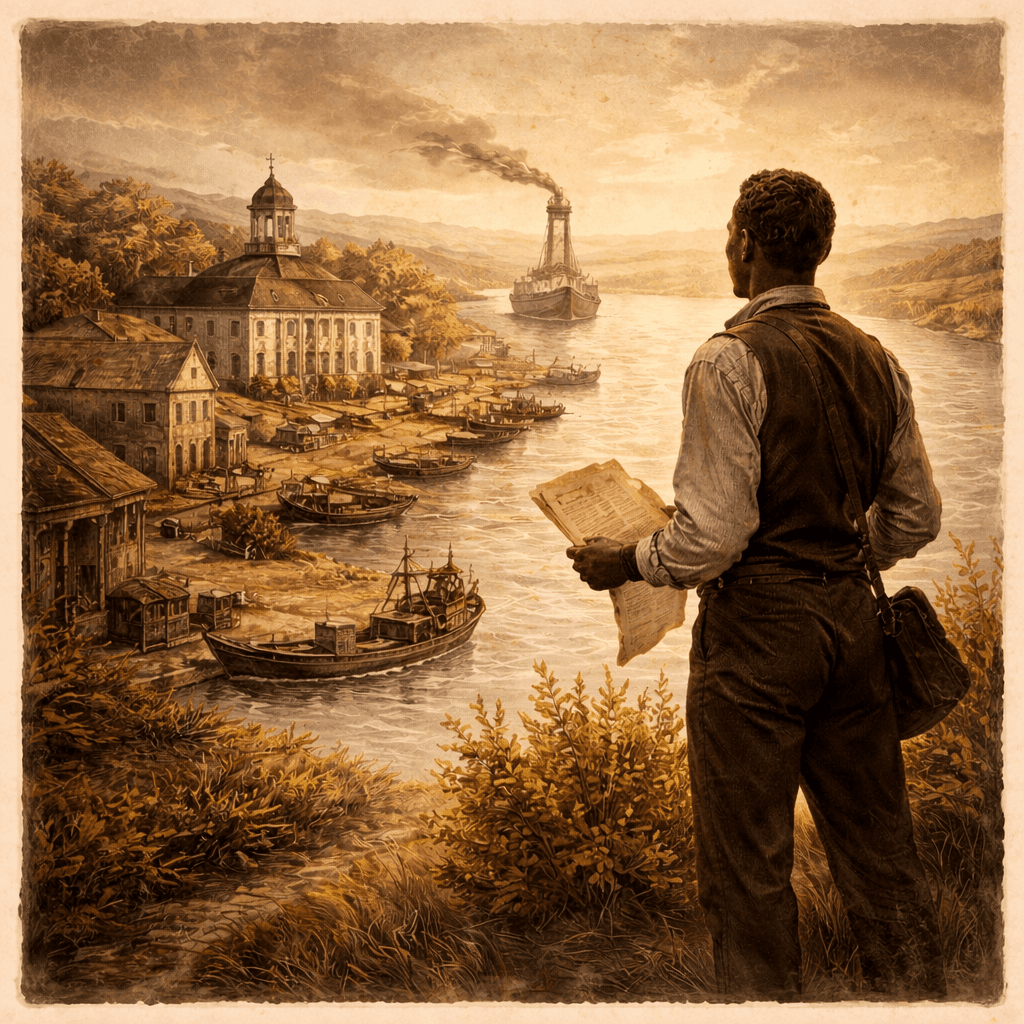
In the year 1818, Illinois was admitted to the Union as the twenty-first state, and the men who marked such things called it a beginning. They set their names to a constitution. They arranged the machinery of government. They fixed their first capital at Kaskaskia, down in the far southwestern corner of the state near present-day Chester, where the Mississippi moves with the old patience of something that has seen nations come and go and has not once mistaken them for permanence. It was a place that already felt old even then, a river town with French bones and frontier dust, the sort of place that seemed to understand before most people did that power rarely arrives without a bargain tucked inside it.
Illinois entered the Union as a free state. That is how the record introduces it. But history, when spoken low and told true, has a way of leaning closer to the fire and admitting that some words are made to shine brighter than the lives beneath them.
Illinois was free in the manner of many young American promises: announced with dignity, shadowed by condition, and bent before it could stand straight. Before the ink had time to settle, there were those in Congress who said the 1818 Constitution did not go far enough to forbid slavery. Slavery was prohibited in language, yes, but not altogether in practice. Exceptions were preserved for slavery tied to earlier French settlements, and indentured servitude remained in place, which was bondage dressed in the respectable tailoring of law. So the state crossed its own threshold carrying a wound it would not name. It wanted the blessing of freedom without the sacrifice of giving up dominion.
That contradiction did not sit quietly. It went to work almost at once. What is buried, if not confessed, will soon enough rise in its own form.
Within three months of statehood, the first Black Law was passed. That swiftness tells its own plain truth. There was no season of innocence. No brief hour in which Illinois meant one thing and only later drifted toward another. The law came early, like frost in a valley, settling over the ground before some had even understood the weather had changed. Signed by Governor Shadrach Bond in 1819, it required free African Americans entering Illinois to produce a certificate of freedom and to register with the county clerk in the place where they meant to reside. Without the proper papers, a Black person could be treated as a runaway slave and cast back into bondage or sold. Those who hired Black workers without such papers could be fined.
These laws did not merely regulate. They warned. They did not merely record. They threatened. They turned daily life into a narrow crossing, where one missed document could become a calamity.
The law also allowed the whipping of servants judged “lazy, disorderly, or misbehaving,” and made it illegal to bring enslaved people into Illinois for the purpose of freeing them. In that last clause, the whole contradiction stands plain as a bare tree in winter: a free state that feared freedom when it arrived in Black hands.
The old Northern comfort, that easy notion that slavery belonged elsewhere, to somebody rougher, somebody crueler, somebody farther south, does not hold up well in this light. Illinois was not built in the image of the plantation states, but neither was it innocent of their logic. It belonged to that colder, more evasive fellowship of places that liked the language of liberty so long as liberty could be rationed. Early Illinois opposed slavery in the broadest public language while building laws meant to keep Black people out, pin them down, or leave them one misstep away from ruin.
The state archives themselves note that no northern state may have had stricter or more discriminatory Black Laws than Illinois. The courts later admitted, in their own fashion, that while many white Illinoisans opposed the spread of slavery, they did not want African Americans settling permanently among them. So the matter was not simply slavery or freedom. It was power deciding how near Black life might come, and under what conditions it might remain.
Even the constitution’s more generous provisions reveal the shape of the age. It was considered liberal for its time because it expanded voting rights for white men without property restrictions and curbed the governor’s power. White democracy widened. Black liberty narrowed. And there it is again, that old American rhythm. One gate opened. Another was barred. White democracy was broadened while Black freedom was hedged, measured, watched, and made fragile by design. It is one thing to read that in the archive. It is another to feel how familiar it sounds.
Far to the north, Chicago was still only the rough beginning of itself, more outpost than city, a settlement set between water and prairie, with Fort Dearborn standing where greater noise and ambition would one day gather. The future had not yet shown its hand in brick, smoke, and iron. There was no city then in the way we know it now. No towers catching the late light. No hard glitter of commerce in the river. But the laws written in Kaskaskia did not stay by the Mississippi. The judgments made there did not die in that river town. They went with Illinois wherever Illinois went.
So when Illinois joined the Union in 1818, it did not arrive as a clean-handed free state stepping nobly into history, nor did it step cleanly into the keeping of freedom. It came into being as many places do: under a bright declaration and a darker understanding. It named liberty in its public voice while asking Black people to carry proof of their own. It called itself free while preserving the old instruments of control in altered form. The state was young, but the instinct was ancient. And if you listen closely enough, past the official speeches and the commemorative glow, you can still hear the older truth moving underneath it like river water in the dark.

Leave a Reply