
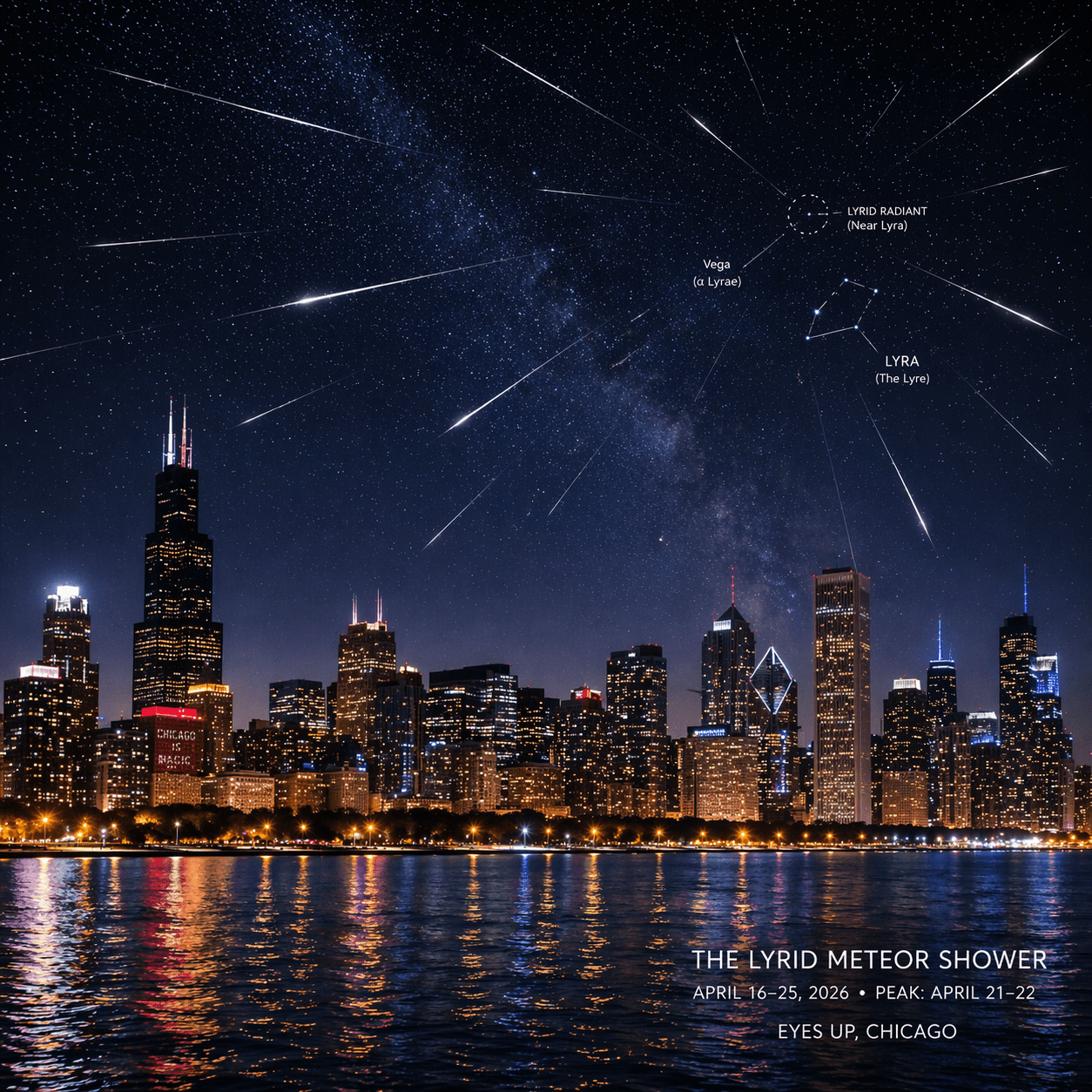
Chicago spring is a scam and a seduction all at once. One day it is sunshine and patio plans, the next it is 42 degrees with a wind off the lake that seems unnecessarily aggressive. But every now and then, the season delivers something worth the drama. Enter the Lyrid meteor shower, now active and building toward its peak, ready to streak across the sky above Chicago and the surrounding suburbs.
The Lyrids are one of the oldest recorded meteor showers in human history, which feels appropriately grand for something so simple and so lovely. Every April, Earth passes through the dusty debris trail left behind by Comet C/1861 G1 Thatcher, and those tiny bits of comet junk hit our atmosphere and light up as meteors. In 2026, the shower is active through April 30, with the best viewing expected on the night of April 21 into the early hours of April 22.
This is not the meteor shower for people demanding nonstop fireworks and a celestial Broadway production. The Lyrids are usually more understated than that, producing around 10 to 20 meteors per hour on a typical peak night, though they are known to toss in the occasional bright fireball just to keep things interesting. Think of it less as cosmic excess and more as a spring night reward for people willing to put on a jacket and look up.
The timing works in our favor this year. Moonlight should be much less of a problem than it can be in other years, which means darker skies and a better shot at seeing even the fainter meteors. That matters because not every Lyrid arrives like a showoff. Some flash by quickly and quietly, more whisper than spectacle.
For Chicagoans hoping to catch the show without driving halfway across Illinois, the Adler Planetarium recommends the lakefront as a better local option. Spots like Montrose Beach, Foster Beach, Rainbow Beach, 12th Street Beach, and South Shore offer open views and slightly darker skies than you will get wedged between streetlights and apartment buildings. No, it will not be pitch black. This is still Chicago. But the lake helps by giving the sky a little breathing room.
For suburban skywatchers, the Palos Preserves in Willow Springs is one of the stronger nearby choices. Adler points to the preserve as a standout local stargazing area with less light pollution than the city. It is the sort of place that makes you remember the sky is actually full of stars and not just aircraft and civic disappointment. Just be smart and check access hours before heading out.
If you are willing to make more of a night of it, Illinois has darker destinations farther out. The Illinois Department of Natural Resources highlights stargazing spots across the state, and Middle Fork River Forest Preserve in Champaign County remains Illinois’ first International Dark Sky Park. That is more of a road trip than a casual weeknight outing, but if you are serious about seeing the night sky without city glow muscling into the frame, it is worth knowing about.
As for knowing whether you actually spotted a Lyrid, the clue is where it appears to come from. Find Vega glowing in the northeastern sky, then watch the darker sky around and away from it. That is the neighborhood the Lyrids call home.

That area rises higher after midnight, which is why the best time to watch is usually between midnight and dawn. If the meteor seems to shoot outward from that part of the sky, there is a good chance it is a Lyrid. If not, it may be a sporadic meteor, which is just astronomy’s way of saying an uninvited guest still made the party better.

The best viewing advice is wonderfully primitive. Get away from as much artificial light as possible. Give your eyes time to adjust. Bring a blanket or a chair, and dress for the kind of cold that arrives the second you convince yourself it is not that bad. Then be patient. Meteor watching is part astronomy, part stubbornness, and part luck.
And because the internet cannot resist being cute, there is also a fun little bonus to try before you head outside. Search “meteorite” or “Chicxulub” on Google, and an asteroid animation may streak across your screen and make the page shake. It is not the actual Lyrid shower, obviously, but it is still a ridiculous little delight. I could not confirm an official Google post about it, so treat it as a playful Easter egg rather than holy writ.
So if Chicago gives you a clear night, take the hint. The Lyrids are here, spring is trying its best, and the sky is offering something far better than another night scrolling indoors. For a few late-April hours, the best show in town will not be on a stage, in a stadium, or behind a restaurant reservation. It will be overhead.

Leave a Reply