
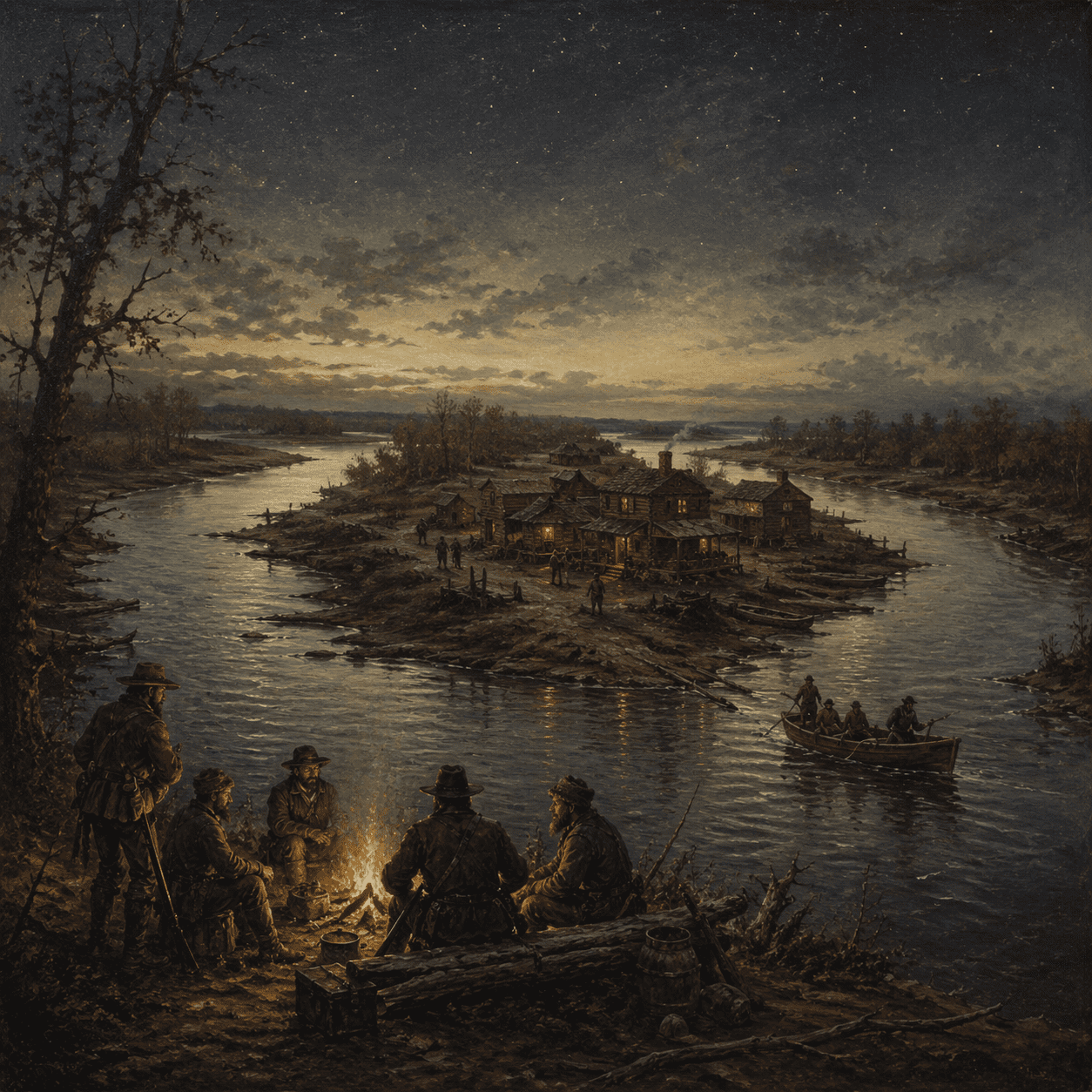
There are times in a place’s life when it does not yet know what it is becoming.
Our story has arrived at such a time.
After the blood and fire of the fort years, after the old trading paths had already been worn hard by canoes, boots, bargains, and betrayal, there came a quieter season. Not peaceful. Quiet does not always mean peace. Quiet can be the pause a thing takes before it changes shape. In the 1820s, the fur trade that had fed this place for so long began to weaken as animal populations shrank and the old commerce lost some of its strength.
The fort itself no longer carried the same fixed certainty after the troops left Fort Dearborn in 1823, and the settlement was left to sit with its own thin pulse and muddy edges. What remained was wet ground, rough cabins, animal paths, and a settlement so slight you might miss it if the wind shifted. Chicago, not yet a city, was a camp still deciding whether it would become a town.
Families who did not pass through but decided to stay began to give the settlement its first real sense of permanence.
Among them were the Clybourns. They did not arrive as men of legend. They came as working people, and like so many who helped shape early Chicago, they made themselves useful before they ever made themselves known.
Archibald Clybourn followed his half-brother to Chicago in 1823. Still a young man, still looking west the way restless men often did when they believed the land might offer them more than the life they had left behind, what he found here must have convinced him quickly. In 1824, he turned back toward Virginia, gathered up his people, and brought them west to the muddy edge of a place not yet finished. They settled along the North Branch, where the settlement thinned into rougher country and the river still dictated the terms of daily life. In time, that pocket of ground came to be known as “New Virginia.”
In his first years in Chicago, Archibald traded with Native people, learning early that survival on this edge of the prairie required more than one skill and more than one way of making a living. By the mid-1820s, he had already entered civic life, serving as a constable and later as a school trustee and justice of the peace. But office alone did not build Chicago. Men still had to work close to the ground, and Clybourn did. By the late 1820s, he had turned to butchering and built a slaughterhouse along the North Branch. Before Chicago became a place of polished ambition, it was a place of blood, sweat, trade, and labor done with both hands.
And there at the forks, inland from the lake, where the branches of the Chicago River came together, another center of life was taking shape. Wolf Point*. Rough, still half-formed, but already it had begun to gather the scattered pieces of a settlement into one place. Cabins, taverns, ferries, roads, rumor, trade, all of it drifted toward the water. Long before Chicago learned to stand upright in brick and stone, it leaned toward that fork in the river. People came because movement brought them there. Goods came there. News came there. In a settlement still loose at the edges, Wolf Point felt like a pulse.

Among the men gathering at Wolf Point was Samuel Miller, an early tavernkeeper and riverman. He and his brother John opened a store on the north bank at the forks, and before long, they enlarged it into a tavern that stood in competition with the Wolf Point Tavern across the branch. Even then, little Chicago was beginning to learn one of its permanent habits: rivalry. This was not merely a matter of drink. In a settlement so small that every traveler mattered, the contest was over traffic, trade, gossip, and presence. Each place watched the other over the water, waiting for the next arrival, the next coin, the next scrap of news carried in on muddy boots.
In 1829, Miller and Clybourn were authorized to operate the first ferry across the Chicago River, running between Miller’s place and the Wolf Point Tavern. It was a practical thing, and in a place like early Chicago, practical things mattered most. The ferry stitched one uncertain shore to another. It carried people, talk, business, and habit back and forth across the water. And men like Miller and Clybourn, without ever fully knowing it, were helping turn Wolf Point from a rough outpost into something that more closely resembled a town.
Today, that may sound like an old footnote. Then, it was a lifeline. In those years, crossing water was no trivial thing. A ferry was more than a passage. It was a connection. It stitched one uncertain shore to another and gave early Chicago one more thread by which to hold itself together.
But the deepest change was not the ferry, nor the blacksmith, nor even the families beginning to settle their weight into the ground.
The deepest change began as an idea whispered over maps.
A canal.
*In modern-day terms, Wolf Point is the spot in downtown Chicago where the North Branch and South Branch of the Chicago River meet to form the main stem that runs east toward Lake Michigan. It is the forked junction of the river in the River North / West Loop edge area. If one were to stand near the Merchandise Mart and look at the river coming together, that’s Wolf Point.

Leave a Reply