
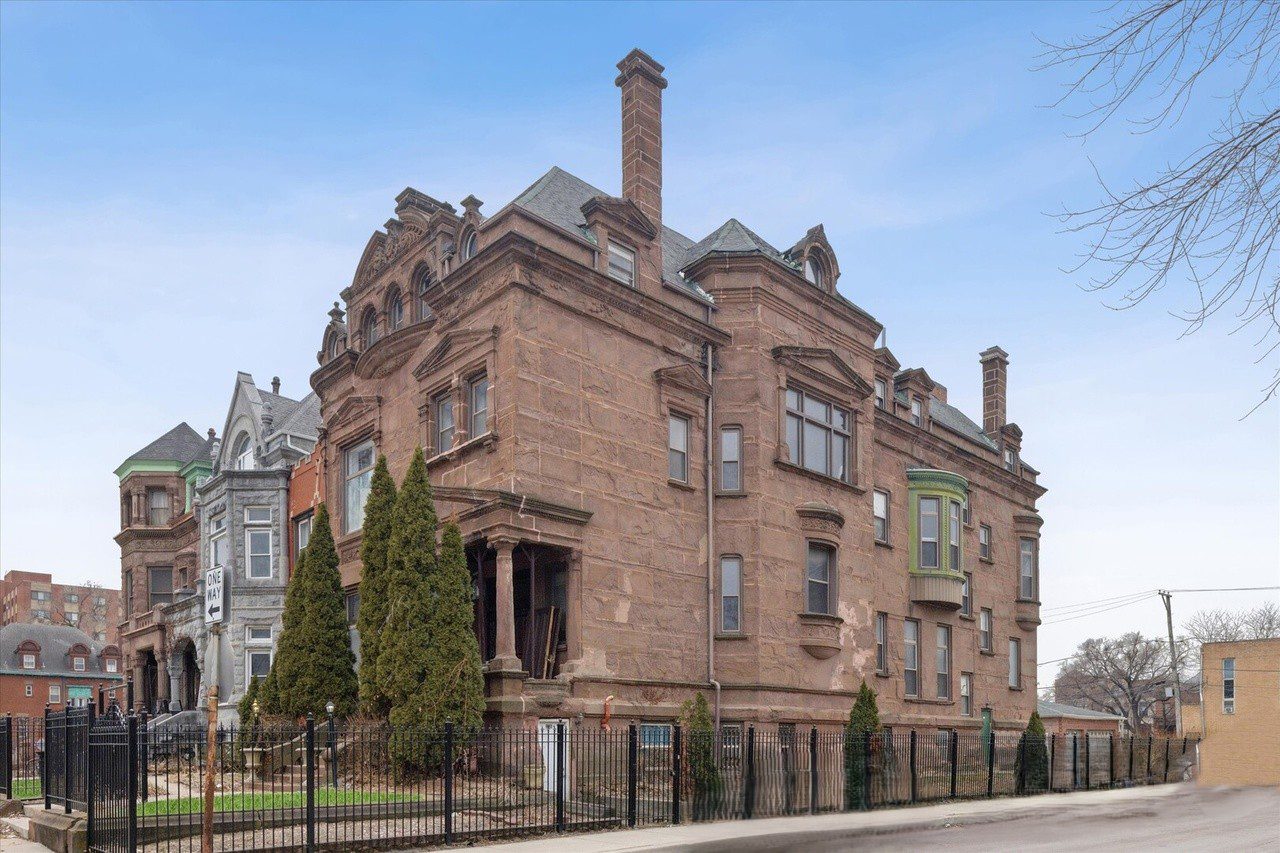
Before it was a Bronzeville landmark-in-waiting, before it became a hospital, before preservationists started watching its next move, the mansion at 3736 South Michigan Avenue was built to impress.
The massive brownstone is almost stubbornly intact. It rises from the street with the kind of presence that does not ask to be noticed. It expects it.
Built in 1890, the 11,108-square-foot Victorian mansion comes with eight bedrooms, ten bathrooms, eleven fireplaces, a ballroom with skyline views, three-car garage, and more than a century of Chicago history tucked into its walls. Despite the $1.2 million price tag, this is not just another old house with good bones and expensive woodwork.
This is one of Bronzeville’s great survivors.
When the home was built, the area was known as Grand Boulevard, a South Side corridor where Chicago’s wealthy industrialists, meatpackers, grain dealers, and businessmen built homes meant to announce success from the curb. This mansion was built for Adolph J. Lichtstern and his wife, Marion.
Lichtstern was a German-born businessman connected to the Chicago Board of Trade and grain trading. He was the kind of man whose fortune was tied to the markets that helped feed and fuel the growing city. This was not a modest starter home with a nice porch. This was a house built by someone who wanted Chicago to know he had arrived.
And the house said it loudly.
The columns, pediments, ornate parapet, grand staircase, chandeliers, pocket doors, and heavy woodwork were not accidents. They were architectural declarations. This was a home built during an era when Chicago’s newly rich wanted permanence, grandeur, and a little theatrical flair. The city had burned, rebuilt, then boomed.

Like many wealthy families of the period, the Lichtsterns eventually moved north, reportedly making their summer home in Glencoe their full-time residence by the late 1910s.
The mansion they left behind was about to begin a very different second act.
By 1926, the Lichtstern mansion had a new purpose. Dr. Ulysses Grant Dailey, one of Chicago’s leading black surgeons, bought the mansion and the house beside it and turned the two properties into Dailey Hospital and Sanitarium.
What had once been built to show off Chicago wealth was now being used to treat patients, house medical work, and give young doctors a place to build their careers. That is quite a second act for a mansion.
The grand rooms that had once belonged to a private family became part of a working hospital in the heart of Bronzeville.
Dailey was no small figure in Chicago medicine. Born in Louisiana in 1885, he came to Chicago for medical school, earned his degree from Northwestern in 1906, and trained at Provident Hospital under Dr. Daniel Hale Williams, one of the most important surgeons in the country. Williams became Dailey’s mentor, and the two remained closely connected for decades.
At the time when Dailey opened the Bronzeville hospital, medical care in Chicago was still deeply divided by race, access, and opportunity. A hospital like Dailey’s mattered. It gave Bronzeville another place for medical care and gave young Black physicians a place to work, train, and build their names.
The hospital stayed open until 1932, when the Great Depression made it impossible to keep going. Like many ambitious Chicago ventures, Dailey’s hospital eventually ran into forces bigger than itself.
After the hospital closed, Dailey returned to Provident Hospital, where his career continued to grow. He later became a senior attending surgeon, chief of surgery, president of the National Medical Association, and one of the few Black doctors of his era elected to the American College of Surgeons.
So yes, the house has fancy fireplaces and a ballroom.
But it also has a résumé.
That is what makes the current sale feel bigger than a real estate listing. The Lichtstern mansion carries several Chicago stories at once: old money, South Side ambition, Bronzeville history, medical history, real estate drama, and the stubborn survival of one very large house.
Preservationists are watching closely. The mansion has an Orange rating in the Chicago Historic Resources Survey, meaning it has architectural features or historic associations that could make it significant within the surrounding community. That does not automatically make it a landmark, but it does put the property in the category of buildings worth paying attention to.
And this one has earned the attention.
The mansion is also located within the Bronzeville-Black Metropolis National Heritage Area, a federally recognized area tied to the neighborhood’s enormous influence on Chicago’s cultural, social, business, and civic history. Within a short distance are landmarks connected to some of the city’s most important stories, including Roberts Temple Church of God in Christ, where Emmett Till’s funeral was held, and the Ida B. Wells national monument.
That is the thing about Bronzeville. The history is not tucked away in one building or one plaque. It is layered into the streets.
The Lichtstern mansion is part of that layering.
According to the MLS listing, the main house includes six bedrooms and six bathrooms across three levels, with two additional ground-level living quarters. The attached guest house, at 3738 South Michigan Avenue, includes two bedrooms and two baths. The ornate details have somehow survived more than 130 years of Chicago weather, changing ownership, shifting neighborhood fortunes, and the general human habit of tearing things down when they become inconvenient. That survival is not a small thing.
In the late 20th century, the mansion was divided into multiple units and, at one point, housed many occupants. By the mid-1990s, when longtime owner Tracye Brogden and her then-husband bought it, the house needed serious work. It had been partially boarded up, the roof leaked, and parts of the property had fallen into disrepair.
But the bones were still there.
Brogden restored much of the home’s historic character, including pocket doors, fireplaces, woodwork, and other details that could easily have been lost. In a city where older buildings disappear quietly and are only “missed” after it is too late, that kind of stewardship matters.
Now, the question is: what happens next?
The right buyer could see the mansion as a private home, an investment property, a boutique space, a preservation project, or some combination of all of the above. The wrong buyer could see only square footage, land, and redevelopment potential.
That is why preservationists are paying attention.
Bronzeville has already lost too much of its built history. Every surviving mansion, church, theater, hospital, club, and apartment building helps hold the neighborhood’s larger story in place. Some archives are paper. Some are brick. Some come with grand staircases, stubborn fireplaces, and rooms that have seen more than any listing description can explain.
The Lichtstern mansion is one of those places.
It began as a Gilded Age showpiece. It became a hospital. It survived decades of change. Now, after years in private hands, it is back on the market, waiting for someone to decide what kind of future it gets.
A house like this does not need to become a museum to matter. It does not need velvet ropes or a plaque in every room. But it does need someone who understands that preservation is not just about saving old buildings because they look nice in photographs.
Sometimes preservation is about keeping the evidence from disappearing.
And the Lichtstern mansion still shows it is worth saving.
Leave a Reply