
In high school, I worked at a sports bar pizzeria that had takeout, which is really just a fancy way of saying I spent Friday and Saturday nights trapped next to a phone bank while hungry people yelled toppings at me like I was negotiating a hostage release.
I was only allowed to work Friday and Saturday nights, which sounds cute until you realize those are the two nights when everyone in America orders pizza.
From the second I walked in at 4 p.m. until about 8 p.m., the phones rang off the hook. There was no dinner break. There was no bathroom break. There was barely time to breathe between one person asking for extra sausage and another insisting their pizza be “well done, but not burnt,” which is the kind of instruction that makes a teenager briefly consider law school.
But we didn’t complain.
We put our heads down and worked. We answered phones. We wrote tickets. We took abuse from people who acted like a missing side of ranch was a personal betrayal from God.
And every Friday night, around 10 p.m., came the call.
The poker game.
The poker game call was legendary. Not because anyone knew who was winning, losing, cheating, or hiding cards up their sleeve, but because their takeout order was long enough to require its own congressional hearing. It was never just pizza. No, these men ordered full dinners. Entrees. Sides. Sauces on the side. No onions. Extra peppers. Light sauce. Heavy cheese. Dressing cups. Bread. And emotional damage for dessert.
Their order was three takeout tickets long.
All the girls knew about it. On Fridays, once the phones slowed down, the owners would start sending the phone girls home one at a time. And every single girl begged to leave before 10 p.m., just to avoid the poker order.
I never got sent home.
Ever.
Funny how the remaining survivors were suddenly in the bathroom when that call came in. Meanwhile, I was always at my post, mostly because I was usually in trouble for something and had learned that wandering away from the phone bank was a good way to make whatever crime I had committed worse.
Naturally, I took the call.
The first time, I did not yet understand the lore.
The man on the other end started rattling off the order so fast I thought he was being chased. After about thirty seconds, I told him I only had two hands and could not write as fast as he talked.
He laughed.
Then he talked faster.
So I told him to keep going because if he talked fast enough, I could mess up the whole order and make it a surprise.
He thought that was adorable.
From then on, I was requested every Friday night. Apparently, they liked my spunk, which is what older men used to call it when a teenage girl had not yet learned to hide her sarcasm behind professionalism.
Eventually, I looked forward to the call. I knew the rhythm. I knew the chaos. I knew that even if I made a mistake, they would not care. There were no screaming phone calls. No threats. No one demanded a manager because the veal parmesan had the wrong vegetable.
We worked until 1 a.m. By the time my two best friends and I finished cleaning, closing, messing around, and pretending we were much cooler than three girls covered in pizza grease had any right to be, we strolled out of there around 3 a.m.
Every weekend.
For minimum wage.
And somehow, we survived.
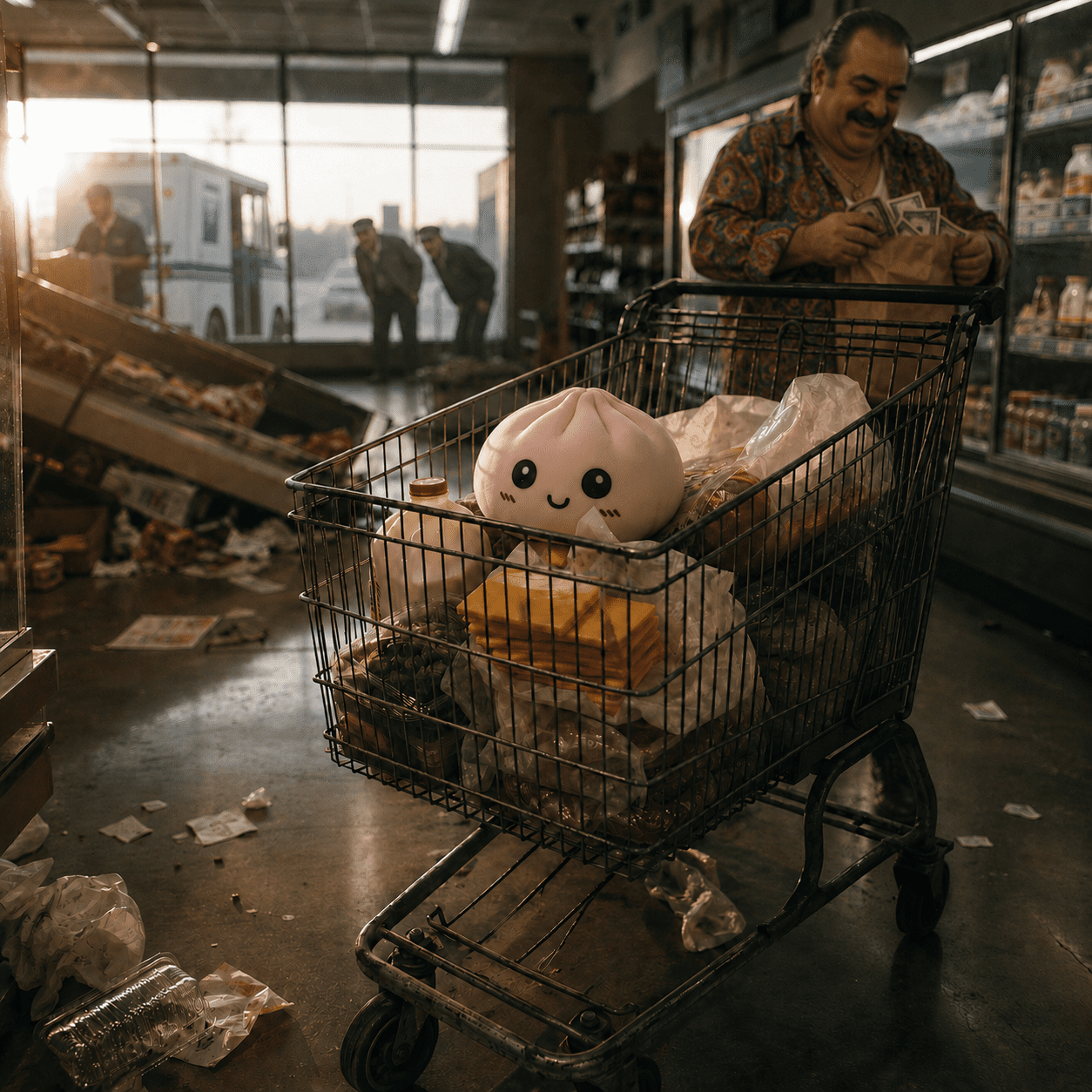
I am not bringing this up because I think suffering builds character, though it apparently does build a fairly high tolerance for nonsense. I am bringing it up because I posted a story yesterday about the unhinged obsession with dumpling toys and the full-contact emotional collapse happening in store aisles across America.
Parents are getting into altercations over ugly stuffed toys.
Adults are lining up outside Five Below at 5 a.m. for a ticket to buy a stuffed dumpling. Read that again and tell me we’re doing fine as a society.
And then there was the Darien Jewel deli counter incident.
Darien, once a respectable place where Italian grandpas could terrorize bank tellers and mailmen in peace, has apparently entered its gladiator era. Somewhere near the deli counter, where civilization is supposed to gather peacefully around potato salad, sliced ham, and the sacred question of “how thin do you want it,” a situation unfolded over cheese.
Thick-sliced cheese.
Not a parking spot. Not a stolen wallet. Not someone insulting a mother’s Sunday sauce.
Cheese.
The kind of cheese that should be going on a sandwich, not serving as the opening act for a suburban MMA match. From what I understand, things escalated, words were exchanged, tempers flared, and the fight spilled out into the parking lot like someone had rung the bell at WrestleMania: Deli Edition.
And all I could think was: What happened to us?
When did people stop being mildly irritated in public and start treating every inconvenience like the fall of Rome?
Because I grew up surrounded by old Italian men who could annoy the wallpaper off a wall, and still, somehow, nobody got body-slammed over provolone.
My dad had a group of friends who were delightful old Italian men, and by delightful, I mean they were professional ball busters with pension plans. In college, I worked at West Suburban Bank in Darien, and two of my dad’s friends had accounts there. Once they found out I worked at one of the branches, I became the most requested teller.
This was not a compliment.
This was a sentence.
These men made Miranda Priestly look like Keanu Reeves.
My father’s friend Lorenzo was the president of a men’s social club. They met every Friday, which meant that every Saturday morning, the dues were ready for deposit. Lorenzo would stroll into the bank at our busiest time with a paper sack full of bills that looked like they had been used as Kleenex, napkins, and possibly evidence.
They were damp.
They were crumpled.
They were shoved into a bag two sizes too small.
And because we were a small branch with only three tellers working the lobby and two working the drive-up lanes, we had coffee and cookies for customers, which was less hospitality and more a public apology for the long lines.
Lorenzo would walk into the lobby as if he had just finished paying off the mortgage on the building. It did not matter how many people were in my line. It did not matter what I was doing. He would stroll straight up to my window, plop that overfilled, oil-stained paper lunch sack on my counter, and then help himself to coffee and cookies.
Then he would return to my window and ask if I was done with his deposit.
As if he were the only customer in the bank.
And people moved. They actually relocated to another line, even if it meant waiting an extra forty-five minutes, because Lorenzo had the presence of a man who did not ask permission from time, space, or FDIC regulations.
He would stand there drinking coffee while I uncrumpled every bill and stacked them neatly so I could feed them into the counting machine.
I do not know what these men did at their club meetings because that sack was always full of singles and five-dollar bills. I shudder to picture any of them pursuing a career in professional pole dancing with their hairy Santa Claus bellies and bald heads.
The deposit was always close to a thousand dollars.
In singles and fives.
Do you know how long that takes to uncrumple and count?
And Lorenzo never spoke. He just watched me.
Once, he asked if I wanted coffee. Then he fixed me a cup and drank it himself because he said I looked too busy to take a break.
No kidding, Lorenzo.
What gave it away? The oil-stained bag of strip-club-adjacent currency?
I could have had a nervous breakdown. I could have reached across the counter and choked him until his head popped off like a cork. But I did not.
I smiled.
I did my job.
When he left the building, the string of profanities and all the things I wanted to do to end his life lasted about ten minutes in the break room.
But Lorenzo never knew.
He came to my window every Saturday morning until my last day.
And when I got married, Lorenzo came to the wedding. Instead of an envelope, he brought our gift in a crumpled, oil-stained paper lunch bag.
Honestly, after the PTSD subsided, I chuckled.
But I loved Lorenzo. He was interesting and ridiculous. He took up my time during the busy Saturday morning rush. He challenged my patience, attention span, and will to live.
And still, I never rolled my eyes.
I never confronted him.
I did not call security because an old man stole my cup of coffee and drank it in front of me.
So again I ask: What happened, Darien?
How did we go from respecting the elders of society, even when they were holding up a bank line with crumpled cash and nonsense questions, to squaring up at the Jewel deli counter over thick-sliced cheese?
My dad and another friend once terrorized the mailman for a month over a delivery they were expecting from Nicaragua. It was a special-sized screw, apparently only made by one company, because God forbid anything in our family be simple, domestic, or available at Ace Hardware.
They stalked that poor mailman.
They waited for him at the end of the driveway. They followed him down the street, asking him to double-check the truck in case he missed the package. They somehow found out his route and waited at different houses like two middle-aged mobsters planning a very low-stakes ambush over a missing screw.
That mailman was a saint.
He never lost his cool.
He never punched either one of them in the nose.
And maybe that is the point.
People have always been annoying. Customers have always been demanding. Old men have always believed their errands were matters of national importance. Parents have always lost their minds over whatever toy the culture has declared essential that week.
Cabbage Patch Kids. Beanie Babies. Tickle Me, Elmo. Stanley cups. Dumpling toys.
Humanity keeps changing the object, but the madness stays the same.
The difference is that somewhere along the way, people stopped absorbing irritation like adults and started outsourcing every inconvenience to rage. The line is too long. The toy is sold out. The cheese is sliced too thick. The cashier is too slow. The deli worker is breathing with attitude. The world has failed to bend immediately and perfectly to one person’s ridiculous expectation.
And instead of taking a breath, everyone is ready to throw hands next to the Havarti.
Shopping does bring out the worst in people.
It always has.
But there used to be a strange little social contract. You could be annoyed. You could mutter under your breath. You could wait until you got home and unleash a ten-minute profanity sermon in the privacy of your kitchen. You could even spend years silently resenting a man named Lorenzo while smiling through his weekly paper sack of swamp money.
What you could not do was turn the deli counter into a crime scene because someone disagreed about cheese.
So maybe the problem is not dumpling toys.
Maybe the problem is not thick-sliced cheese.
Maybe the problem is that too many people have forgotten how to be aggravated in public without becoming a headline.
And that is a shame.
Because honestly, if anyone deserved to snap, it was a teenage girl taking a three-ticket poker order at 10 p.m. for minimum wage.
But I didn’t.
I took the order.
I made the jokes.
I survived the rush.
And unlike the adults fighting in store aisles over stuffed dumplings, I understood one very important rule of civilization:
No toy, no sandwich, no slice of cheese, and no oil-stained bag of singles is worth losing your mind in public.
Unless, of course, Lorenzo drinks your coffee.
Then all bets are off.
Leave a Reply