
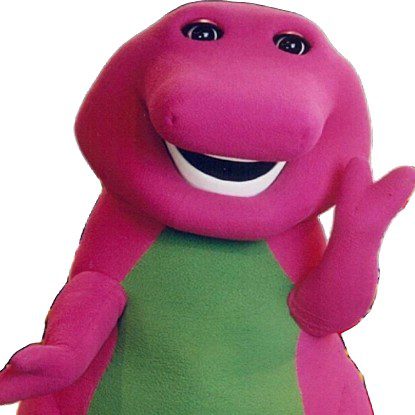
For anyone who grew up with “Barney & Friends,” Dean Wendt’s voice may live somewhere deep in the childhood memory vault, filed between snack time, VHS tapes, and that purple dinosaur who believed every problem could probably be solved with a song, a hug, and a little unconditional love.
Wendt, an Elgin native, has spent more than two decades as one of the voices behind Barney the Dinosaur, a role he first landed in 2002 and continued through the years on television episodes, videos, live appearances, and recordings. But before he became the voice of one of the most recognizable children’s characters in the world, he was just an Elgin kid obsessed with radio.
Long before anyone used the phrase “content creation,” Wendt was already doing it.
As a child, he built his own fake radio station, called it WFP, recorded shows, brought turntables to school dances, and treated them like live remote broadcasts. It was the kind of childhood obsession adults sometimes dismiss until, years later, it turns into a career.
For Wendt, it did.
His creative life started in Elgin, where radio, theater, and performance all began to take hold. He acted at Elgin High School, appearing in “A Midsummer Night’s Dream” and starring as the narrator in “Our Town.” In the summer of 1985, he attended Northwestern University’s Cherub program, a prestigious theater program for high school students.
“Elgin gave me the bug,” Wendt said. “Everything else just followed from that.”
That “everything else” would eventually include the University of Illinois Urbana-Champaign, where he hosted a morning radio show, and would be followed by moves to California and Texas. Today, Wendt lives in the Dallas/Fort Worth area, which he considers home. He also helped create Radio Disney, where he worked as a disc jockey from 1994 to 1999.
But the role that would define his career arrived in a way that was far less dramatic than one might imagine.

There was no sweeping Hollywood moment. No grand audition story with moody lighting and executives whispering behind glass. Wendt described the Barney audition as surprisingly informal. The callback was just as ordinary.
Then came the call.
The job that would shape the next chapter of his life had arrived quietly, almost casually.
Barney, however, was anything but small.
Wendt’s voice became part of a character watched by millions of children. Recording for the show was done live-to-tape, not dubbed afterward. The voice actor and the performer inside the Barney suit had to work together in real time, a process Wendt jokingly called “Dinosync.”
“We called it Dinosync,” he said. “The guy in the suit would follow what I had to say, and vice versa.”
That kind of coordination may sound simple until one remembers this was a large purple dinosaur trying to sing, dance, teach, comfort, and not fall apart in front of children who believed in him completely.
And Wendt understood the weight of that belief.
Over the years, Barney gave him stories that sound almost too odd and wonderful to be real. One of his favorites involves the song “I Love the Holidays.” It was the first song he ever recorded as Barney, during his first recording session, while preparing for the Macy’s Thanksgiving Day Parade. Decades later, it also became the last song he recorded for the show.
Same song. Different end of the journey.
Nobody planned it. That is probably what made it matter.
Then there was the time Barney did a Regis Philbin impression on “Live with Regis and Kelly.”
Wendt had been appearing on the show as Barney when the idea hit him mid-segment. Everyone did Regis impressions. Why not Barney?
So, without warning anyone, he asked Regis if he could do an impression of him.
Philbin agreed.
Wendt did Barney doing Regis.
The audience loved it. Apparently, the Barney office did not enjoy the surprise quite as much. Wendt reminded them that the show aired at 9 a.m., when most of the children were already in school.
That spontaneous impression led to an invitation to compete in the Relly Awards, a real contest for best Regis impression. Wendt found himself up against names like Jimmy Fallon and Neil Patrick Harris. He did not win, but he was invited back to emcee the event, as Barney.
Not bad for an Elgin kid who started with a fake radio station.
Another memory involves John Travolta, which feels like the kind of story a person should get to bring up at every dinner party for the rest of his life.
Wendt was waiting in the green room when Travolta walked by, recognized him, came in, and began talking about what Barney had meant to his family. Then, without warning, Travolta launched into “Hey Mr. Knickerbocker, boppity bop,” complete with the words and hand motions.
According to Wendt, Travolta knew it better than he did.
Then Travolta hugged him. For a long time.
Wendt later called his mother, a lifelong Travolta fan, to tell her what had happened.
Her first question was not about the hug. It was whether he got an autograph.
He told her he thought he got something better.
There is humor in Wendt’s stories, but the heart of his work came through most clearly in children’s hospitals. Those visits, he said, never became routine. Barney would walk into a room with a sick or frightened child, and something would shift. A child who had not smiled in days might smile.
That was the part that stayed with him.
“That’s what Barney really was to me,” Wendt said. “Not a job. A privilege.”
It would be easy to reduce Barney to nostalgia, a punchline, or one of those childhood things adults pretend they were too cool to watch. Barney has always had critics. A 2022 documentary, “I Love You, You Hate Me,” explored the strange backlash the character inspired among some adults.
Wendt does not seem interested in pretending that cynicism did not exist. He simply understands who Barney was for.
“Barney represents unconditional love and pure joy, and sometimes that makes people uncomfortable,” he said. “Cynicism is easy. Sincerity is harder. Barney is for the children. Not the adults.”
That may be the most honest explanation of the whole purple-dinosaur phenomenon. Barney was never trying to win over the adults in the room. He was speaking to the small people sitting cross-legged in front of the television, still young enough to believe that kindness was not embarrassing.
Wendt recently returned to Elgin as a surprise guest speaker for School District U-46’s Beacon Academy Awards at The Hemmens Cultural Center. The event may have brought him back, but the real story was the homecoming.
He had not been back to his hometown in more than 20 years.
“It’s a little surreal, honestly,” he said. “I haven’t been back in a long time, and this felt like the right reason to come home.”
For students listening to him speak, Wendt’s career offered a reminder that creative lives do not always arrive with a neat plan. Sometimes they begin with the thing a kid cannot stop doing. A fake radio station. A school play. A turntable at a dance. A voice. A curiosity. A habit that looks silly until it becomes the thing that opens every door.
Wendt’s story did not begin in a studio with Barney.
It began in Elgin, with a boy pretending to be on the air.
And in a way, he still is.
Source: Daily Herald reporting on Dean Wendt’s return to Elgin and appearance at School District U-46’s Beacon Academy Awards.

Leave a Reply