
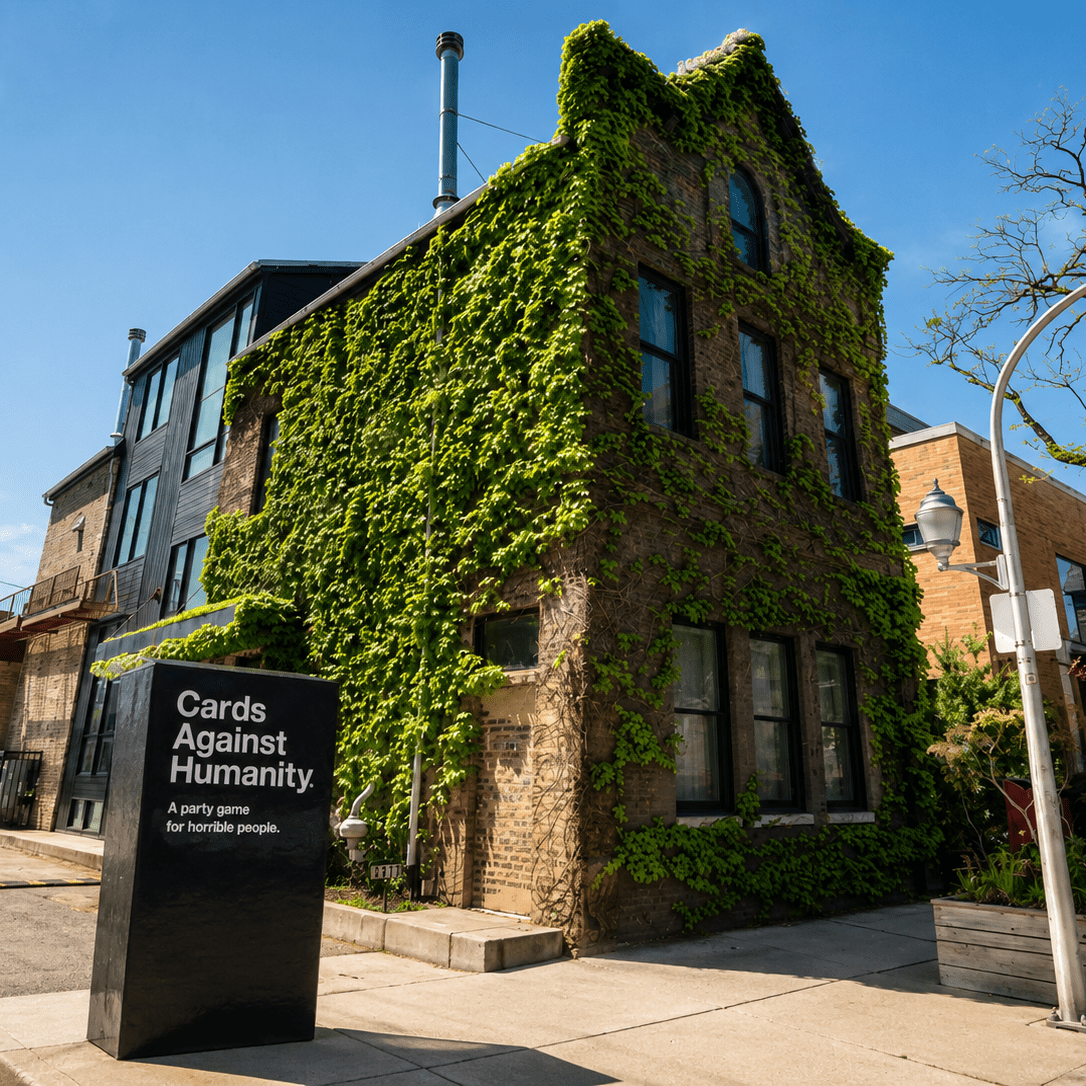
Some houses come with marble counters, custom millwork, and a garage-top terrace. Others come with a backstory.
The Bucktown home owned by Max Temkin, one of the co-founders of Cards Against Humanity, has hit the market for $2.45 million, according to the listing. The four-bedroom home on Wabansia Avenue is not just another polished Chicago rehab with exposed brick and expensive lighting. It is a late-19th-century brick building with a very modern Chicago twist: startup money, architectural reinvention, and the complicated legacy of a public figure whose career went from edgy game-night fame to workplace scandal.
Temkin bought the home in 2015 for $935,000, according to public property records. The house, built in 1891, has since been extensively renovated, turning an old Bucktown structure into the kind of residence that looks like it knows how to host a dinner party, a strategy meeting, and possibly a very uncomfortable deposition.
The property is represented by Kellie Kintigh of Compass. The listing describes the home as a “singular offering.” The house includes four bedrooms, three-and-a-half baths, two fireplaces, a two-car garage, multiple outdoor deck spaces, a Level 2 EV charger, and a renovation that addressed the roof, windows, and major systems. There is also a solarium, a garage-top terrace, and a primary suite with what the listing calls a “morning kitchen,” which is real estate language for “there is a refrigerator close enough to the bed that adulthood has officially reached its final form.”
Architecturally, the home leans into the kind of layered personality Bucktown does well. The neighborhood has never been interested in behaving like one thing. It is old workers’ cottages, rehabbed brick homes, designer kitchens, boutiques, restaurants, artists, tech money, and just enough grit left around the edges to remind everyone that Chicago did not come pre-staged by a luxury broker.
This house appears to follow that same logic. According to Crain’s, Von Weise Associates handled the rehab, creating “different vibes in different rooms.” The kitchen has a light industrial feel with scraped brick and wood beams. One bedroom features Japanese-inspired wood walls, a ceiling, and a platform bed. A historic fire escape remains attached to the exterior, giving the home one of those Chicago details that feels both practical and cinematic. It is the kind of feature that makes a building look as if it has survived the weather, arguments, bad decisions, and at least three eras of neighborhood reinvention.
But the name attached to the deed is what turns this from a luxury listing into a story.
Temkin was one of eight friends from Highland Park High School who created Cards Against Humanity, the wildly popular adult party game launched through Kickstarter in 2010. The game marketed itself as “a party game for horrible people,” and for years, that was the point. Its appeal rested on being offensive, politically incorrect, and willing to say the thing everyone else was supposedly too polite to say.
That brand of humor helped turn the company into a Chicago startup success story. By 2014, Cards Against Humanity had become a massive seller, reportedly topping Amazon’s game charts and moving hundreds of thousands of decks. It was crude, clever, profitable, and very aware of its own bad manners.
Then the joke started looking different.
In 2020, former employees accused Cards Against Humanity of fostering a racist and sexist workplace culture in its Chicago office. Many of the complaints centered on Temkin, who had led that office. Polygon published a detailed investigation based on interviews with 21 former employees, and the company later issued a public apology, saying employees had been “unheard or disrespected.” Cards Against Humanity said Temkin stepped down and no longer had an active role in the company.
The allegations were serious and damaging. Former employees described a toxic culture, and some specifically alleged that Black employees and women were mistreated. The company disputed certain claims, including an allegation that the N-word was used in the game, but acknowledged broader failures in its workplace culture. Temkin has also previously denied a sexual assault allegation from a former college classmate, which resurfaced during the public scrutiny around the company.
It was a hard fall for a founder who had once been one of the public faces of a game built on provocation. Cards Against Humanity had made millions by turning discomfort into entertainment. But inside the company, former employees said the discomfort was not always funny, voluntary, or equally distributed.
That is what makes the Bucktown listing feel like more than a real estate item. Houses are never just square footage. They hold the residue of ambition, success, image-making, reinvention, and sometimes retreat. This one sits in one of Chicago’s most desirable neighborhoods, dressed in beautiful materials and expensive upgrades, while carrying the backstory of a founder whose company helped define a certain era of ironic humor before being forced to answer for the culture behind it.
The Wabansia Avenue home may sell as a rare architectural residence in the heart of Bucktown. It has the bones, the renovation, the neighborhood, and the price tag. But it also arrives on the market with a reminder that every house has a history, and some histories are less about who built the walls than who lived behind them.

Leave a Reply