
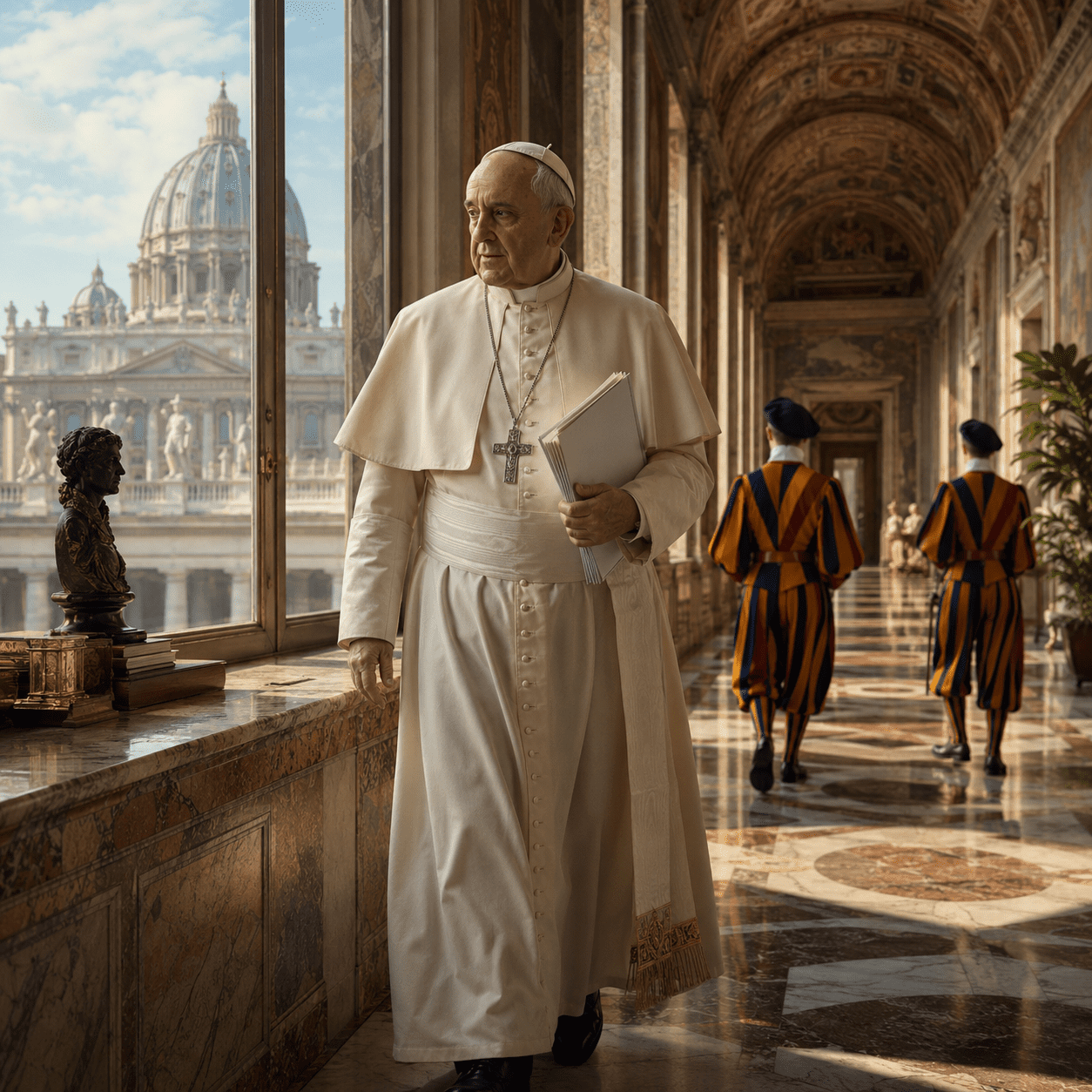
Most people see the pope in fragments.
A media blurb. A white cassock on a balcony. A hand raised over the crowd as if one flick of his fingers might send holy healing glitter raining down on the faithful gathered below. Or a careful smile from behind the glass of the Popemobile, which, depending on the angle, can feel oddly reminiscent of the Grumobile from Despicable Me.
He blesses thousands of pilgrims standing shoulder to shoulder in St. Peter’s Square while many hold their phones in the air, trying to capture holiness in portrait mode.
From the outside, the papacy can look almost suspended in time. Marble halls. Swiss Guards. Latin prayers. Gold-trimmed vestments. Incense curling through the air as if history itself has decided to make an appearance.
It is solemn. It is cinematic. It is one fedora away from an Indiana Jones scene.
But behind the ceremony lies a daily schedule that feels less like a quiet spiritual retreat and more like the impossible merger of a monastery, government office, global headquarters, diplomatic embassy, crisis center, and one very intense customer service desk.
The pope does not simply wake up, wave at pilgrims, say something holy, and disappear behind the ornately marbled walls of the Vatican. Despite the mystery surrounding his office, he is not a Marvel superhero in a bathrobe, summoned only for balcony appearances, dramatic blessings, and papal parades.
Far from it.
His day begins before most of Rome has had coffee.
It begins with prayer. With Mass. With Scripture, reflection, and the kind of silence most people imagine when they think of spiritual leadership. Before the cameras, the formal meetings, the public blessings, and the carefully arranged audiences, there is quiet meditation. It is the spiritual center of the job, the part that reminds everyone that the pope is not just the visible head of an ancient institution, but the spiritual leader of the Catholic Church.
That sounds peaceful. Almost serenely ethereal.
Then the calendar wakes up.
Once morning begins, the pope’s day becomes a long chain of appearances, conversations, decisions, and obligations. Private meetings unfold behind Vatican doors reserved for the privileged few, the kind of rooms where no one casually wanders in looking for the restroom. Reports arrive from distant corners of the world, carrying news of conflict, poverty, migration, disaster, Church matters, and human suffering. Decisions are made far from the cameras and prying eyes of the public, in rooms where even silence probably has a title.
Bishops come to Rome for audiences with the pope, bringing the needs and struggles of their dioceses with them. Each arrives during Vatican office hours carrying prayers, problems, and what is probably the holiest homework folder on earth.
Then come the documents, because even the Vatican has an inbox. Some need immediate attention. Some require revision and approval. Others are sent back with notes, because not even papal paperwork escapes a second draft. Speeches are prepared for upcoming audiences, ceremonies, trips, and feast days, each one carefully reviewed before it ever reaches the public.
Most of us jokingly pray for the strength to get through an endless list of tasks. The pope, presumably with better reception on the prayer line, is expected to remain prayerful, thoughtful, and diplomatic through all of it.
The Vatican may be small in size, but the responsibility attached to it is anything but. It is both the center of the Catholic Church and an independent city-state, which means the pope’s day is not limited to religious matters. He may move from Church governance to international diplomacy, from conversations with bishops to meetings with presidents, prime ministers, ambassadors, religious leaders, humanitarian groups, or people affected by war, poverty, migration, and disaster.
One meeting may involve global conflict. Another may involve a group of pilgrims who have traveled thousands of miles just to spend a few seconds in the same room as him.
No matter how much holy support the pope receives, he cannot do it alone. He is assisted by the Roman Curia, the administrative structure of the Holy See. Think of it as the Vatican’s central nervous system, a vast network of departments, offices, officials, advisors, and staff members handling everything from doctrine and diplomacy to communications, charity, education, liturgy, and the million tiny details required to keep a global Church moving.
But even with help, the final weight of the office still gathers around one man.
Then come the public moments.
On many Wednesdays, if the pope is in Rome, he appears for the General Audience. It is one of the more visible parts of papal life. Pilgrims gather, flags wave, choirs sing, and the pope offers teaching, greetings, and blessings. For many visitors, this is the moment they came for. They may never meet him personally, but they can say they saw him. They were there. They stood in the square, received his blessing, and heard his voice.
On Sundays, the pope traditionally leads the Angelus at noon from a window overlooking St. Peter’s Square. Compared with a major Mass or formal audience, it is brief, but deeply symbolic. The crowd gathers below, the pope appears above, and for a few minutes the ancient rhythm continues: prayer, reflection, blessing.
It can look effortless.
It is not.
Public appearances are only one part of the day. Behind them are private audiences that may sound small but can be some of the most important and emotionally demanding moments on the pope’s schedule. He meets Church leaders, visiting bishops, heads of state, ambassadors, representatives of religious communities, and individuals invited for reasons the public may never know. Some meetings are ceremonial. Some are strategic. Some are pastoral. Some probably leave a mark long after the door closes.
A pope hears joy, but he also hears grief.
He receives people celebrating milestones and people carrying unimaginable sorrow. He meets the powerful, but also the wounded. He blesses newlyweds, children, the sick, and the grieving. He carries the visible role of a leader, but also the hidden burden of someone expected to absorb the world’s pain with grace.
That may be the most overlooked part of the papal day. It is not only busy.
It is heavy.
The pope’s life is not his own in the ordinary sense. His schedule belongs to the Church. His image belongs to the world. His words are studied. His silences are studied. His gestures are studied. If he smiles, people notice. If he looks tired, people notice. If he changes a phrase, pauses too long, chooses one meeting over another, or skips an event for health reasons, people notice.
There are very few private corners in a public life.
Even meals are not exactly normal. A pope may eat simply, depending on his personality and preferences, but meals are often squeezed between duties or shared with guests. He may have time for rest in the afternoon, especially if age or health requires it, but the work does not disappear. The papers remain. The calls remain. The next ceremony waits. The next crisis arrives.
The world has a terrible habit of needing things during lunch.
By evening, the public-facing day may begin to quiet, but the work often continues. There may be reading, prayer, preparation for the next day, document review, or private reflection. Homilies need to be considered. Appointments need attention. Letters wait for answers. Decisions made inside Vatican walls may ripple far beyond them.
The pope is wrapped in symbols so ancient and powerful that the human being underneath can almost disappear. People see the office. They see the title. They see the white cassock, the ring, the balcony, the blessing.
But the day belongs to a person who wakes up tired, reads difficult news, carries impossible expectations, and still has to step into public view with calm on his face and purpose in his voice.
A day in the life of a pope is not a soft-focus religious postcard.
It is prayer interrupted by paperwork. Silence interrupted by ceremony. Faith interrupted by phone calls, security briefings, diplomatic meetings, and the endless machinery of a global Church.
It is holy, yes.
But it is also administrative. Political. Emotional. Exhausting. Repetitive. Public. Lonely. Human.
The pope begins his day as a man of prayer and ends it as a man who has spent the day being needed by nearly everyone.
And tomorrow, before Rome has had coffee, it begins again.

Leave a Reply